What Is a Conditional Use Permit and Does Your Project Need One?
A conditional use permit (CUP) allows property owners to use land in ways not automatically permitted by zoning, but that may be approved under specific conditions. Understanding when you need one, what the process looks like, and how to prepare your application can save you significant time and money on your next project.
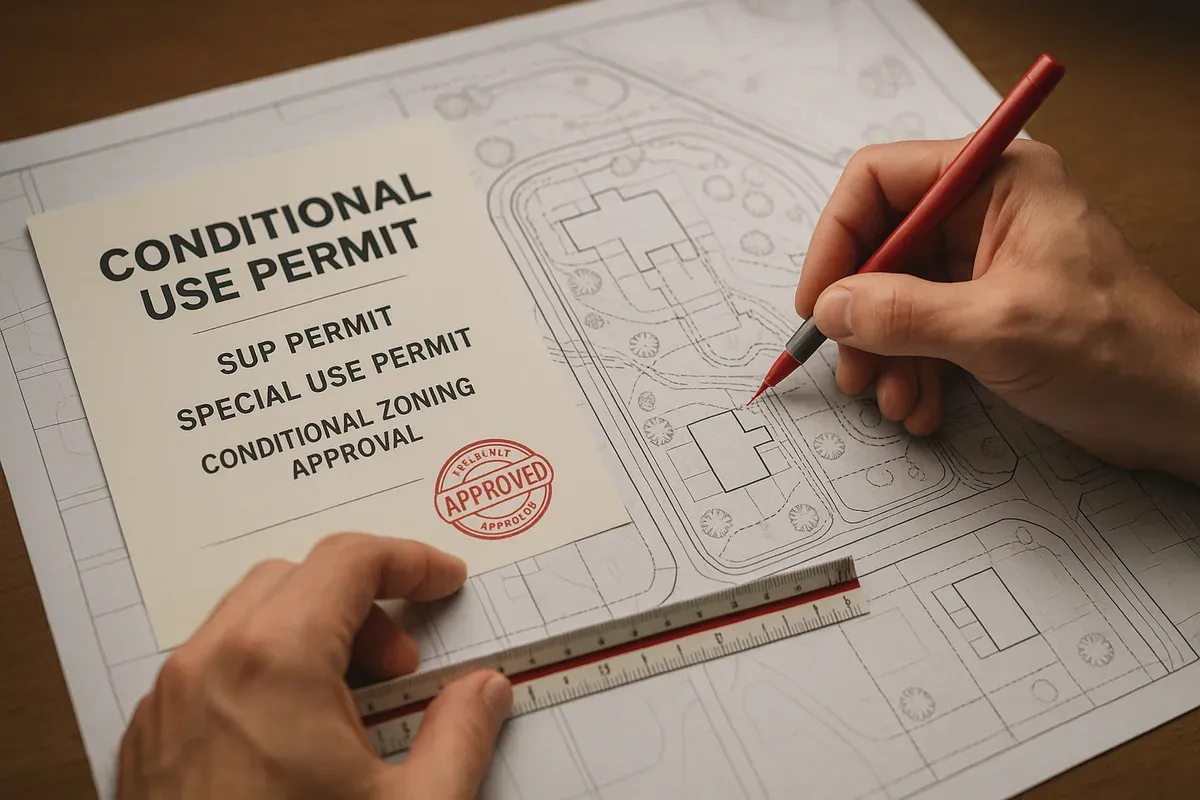
<h2>What Is a Conditional Use Permit and Does Your Project Need One?</h2>
<p>You've found the perfect property. You have a clear vision for what you want to build or operate there. Then someone mentions three words that stop you cold: conditional use permit. Suddenly, a project that seemed straightforward becomes wrapped in uncertainty, zoning codes, and public hearings.</p>
<p>Don't panic. A <strong>conditional use permit</strong> (CUP) is not a rejection. It's actually an invitation: your local government is saying that your proposed use of the land <em>might</em> be acceptable, provided you meet certain conditions and go through a review process. Millions of property owners, small business operators, and <a href="/homeowners">homeowners</a> navigate the CUP process every year and come out the other side with approved projects.</p>
<p>This guide will walk you through everything you need to know: what a conditional use permit actually is, how it differs from other zoning approvals, which projects typically require one, what the application process looks like, and how to prepare the documentation that gives your application the best chance of success.</p>
<hr>
<h2>The Basics: Understanding Conditional Use Permits</h2>
<h3>What Does "Conditional Use" Actually Mean?</h3>
<p>Zoning codes divide land into districts: residential, commercial, industrial, agricultural, and various subcategories. Within each district, some uses are permitted by right, meaning you can proceed without special approval. Other uses are prohibited outright. But there's a large middle category: uses that are neither automatically allowed nor flatly banned. These are <strong>conditional uses</strong>, sometimes called special uses or special exceptions.</p>
<p>A conditional use permit is the official approval that allows a property owner to proceed with one of these middle-ground uses, subject to conditions set by the local planning board or zoning authority. Those conditions might include restrictions on hours of operation, requirements for additional parking, landscaping buffers, traffic studies, or limits on the scale of the operation.</p>
<p>The underlying logic is straightforward. A daycare center in a residential neighborhood might be perfectly compatible with surrounding homes if it operates during daytime hours, has adequate drop-off space, and maintains appropriate fencing. But without those conditions in place, it could create noise, traffic, and safety concerns. The CUP process gives the community a structured way to evaluate and manage these situations case by case.</p>
<h3>CUP vs. Variance vs. Rezoning: What's the Difference?</h3>
<p>These three terms often get confused, and mixing them up can send your project in the wrong direction.</p>
<ul>
<li><strong>Conditional Use Permit (CUP):</strong> Allows a specific use that is already listed in the zoning code as conditionally permissible. The land stays in its current zone; you're just getting approval for a use that requires extra review.</li>
<li><strong>Variance:</strong> Grants relief from a specific dimensional or development standard, such as a setback requirement or maximum building height. A variance doesn't change what you can use the land for; it adjusts the physical rules for how you develop it.</li>
<li><strong>Rezoning:</strong> Changes the actual zoning classification of a parcel, which is a much larger undertaking involving legislative action by the local governing body.</li>
</ul>
<p>If your project involves a use that is conditionally permitted in your zone, you need a CUP. If your use is already permitted but your building can't meet <a href="/setback-guide">setback requirements</a>, you may need a variance. If your use isn't permitted in your zone at all, you'd need to pursue rezoning, which is a significantly longer and more complex process.</p>
<p>For a deeper look at how zoning classifications work across the country, the <a href="https://www.planning.org" rel="nofollow noopener" target="_blank">American Planning Association</a> maintains excellent resources on land use law and zoning practice.</p>
<hr>
<h2>Common Projects That Require a Conditional Use Permit</h2>
<h3>Residential Projects</h3>
<p>Many homeowners are surprised to learn that improvements or additions to their own property can trigger the CUP process. Common residential situations include:</p>
<ol>
<li><strong><a href="/adu-feasibility-software">Accessory Dwelling Units</a> (ADUs):</strong> Detached or attached secondary units, such as a backyard cottage or an in-law suite, frequently require a CUP in residential zones, particularly in jurisdictions that haven't yet streamlined ADU approval.</li>
<li><strong>Home-Based Businesses:</strong> Operating a business from your home that involves client visits, employees, or signage often falls under conditional use provisions.</li>
<li><strong>Bed and Breakfast Operations:</strong> Converting a home into a short-term lodging facility typically requires a CUP, even in residential zones.</li>
<li><strong>Group Homes and Care Facilities:</strong> Homes serving more than a certain number of residents with disabilities or special needs may require conditional approval.</li>
<li><strong>Religious Institutions in Residential Areas:</strong> Churches, temples, and mosques are frequently listed as conditional uses in residential zones.</li>
<li><strong>Private Schools or Daycares:</strong> Educational and childcare facilities in residential neighborhoods almost always require a CUP.</li>
</ol>
<h3>Commercial and Mixed-Use Projects</h3>
<p>On the commercial side, CUP requirements often apply to:</p>
<ol>
<li>Drive-through facilities attached to restaurants or banks</li>
<li>Automotive repair shops in general commercial zones</li>
<li>Bars and establishments serving alcohol beyond restaurant hours</li>
<li>Outdoor storage yards</li>
<li>Telecommunications towers and antenna installations</li>
<li>Funeral homes and mortuaries</li>
<li>Gas stations with convenience stores</li>
<li>Large-format retail (big box stores) in certain commercial zones</li>
</ol>
<h3>Agricultural and Rural Projects</h3>
<p>Rural property owners encounter CUP requirements for:</p>
<ol>
<li>Agritourism operations, including farm stays and u-pick facilities</li>
<li>Commercial cannabis cultivation (in states where permitted)</li>
<li>Concentrated animal feeding operations (CAFOs)</li>
<li>Wind turbines and utility-scale solar installations</li>
<li>Gravel pits and quarrying operations</li>
</ol>
<p>The specific list of conditional uses varies significantly by jurisdiction. Always consult your local zoning ordinance or planning department before assuming your project does or doesn't require a CUP.</p>
<hr>
<h2>How to Find Out If Your Project Needs a CUP</h2>
<h3>Step 1: Identify Your Zoning District</h3>
<p>Start by determining the current zoning classification of your property. Most counties and municipalities now provide online GIS mapping tools where you can look up your parcel by address. Your local assessor's office can also confirm your zoning designation.</p>
<h3>Step 2: Read the Permitted and Conditional Use Tables</h3>
<p>Once you know your zone, locate your jurisdiction's zoning ordinance. Most are available online through the municipal code website or planning department page. Look for the use table or use matrix for your zoning district. Uses are typically listed in three columns: permitted by right (P), conditional use (C or CU), and not permitted (blank or N).</p>
<p>If your proposed use appears in the conditional use column, you'll need a CUP before proceeding.</p>
<h3>Step 3: Talk to a Planner</h3>
<p>Zoning codes are written by lawyers and planners, and they can be genuinely difficult to interpret. Most planning departments offer pre-application meetings or counter appointments where a staff planner will give you an informal assessment of whether your project requires a CUP and what the process involves. These conversations are free, informal, and extremely valuable. Take advantage of them.</p>
<h3>Step 4: Check for Overlay Districts</h3>
<p>Even if the base zoning doesn't require a CUP, your property might fall within an overlay district, such as a historic preservation overlay, a flood hazard area, or an airport influence zone, that imposes additional review requirements. Always check for overlays in addition to base zoning.</p>
<hr>
<h2>The Conditional Use Permit Application Process</h2>
<h3>What to Expect</h3>
<p>The CUP process varies by jurisdiction, but most follow a similar sequence:</p>
<ol>
<li><strong>Pre-application meeting</strong> with planning staff</li>
<li><strong>Submission of application</strong> with required documents and fees</li>
<li><strong>Staff review and report</strong> preparation</li>
<li><strong>Public notice</strong> to neighboring property owners (typically mailed 10-15 days before the hearing)</li>
<li><strong>Public hearing</strong> before the planning commission or zoning board</li>
<li><strong>Decision</strong> (approval, approval with conditions, or denial)</li>
<li><strong>Appeal period</strong> (usually 10-30 days during which the decision can be appealed)</li>
</ol>
<p>Timelines vary widely. In smaller jurisdictions, the entire process might take 6-8 weeks. In larger cities with complex projects, it can take 6 months or more. Budget your project timeline accordingly.</p>
<h3>Application Requirements: What You'll Typically Need</h3>
<p>While every jurisdiction has its own checklist, most CUP applications require some combination of the following:</p>
<ul>
<li>Completed application form and filing fee</li>
<li><strong>Site plan</strong> showing property boundaries, existing structures, proposed improvements, parking, landscaping, and access points</li>
<li>Written project description or narrative explaining the proposed use and how it meets the criteria for approval</li>
<li>Floor plans or elevation drawings for any proposed buildings</li>
<li>Traffic study (for larger projects)</li>
<li>Environmental review documentation (varies by state)</li>
<li>Proof of property ownership or authorization from the owner</li>
<li>List of adjacent property owners (for public notice purposes)</li>
</ul>
<p>The site plan is almost always the centerpiece of the application. A clear, accurate, professionally presented site plan communicates your project's scope, demonstrates that you've thought through the impacts on neighboring properties, and signals to planning staff and commissioners that you're a serious applicant who respects the process.</p>
<hr>
<h2>What Criteria Do Planning Boards Use to Evaluate CUP Applications?</h2>
<p>Planning commissions don't make arbitrary decisions. They evaluate CUP applications against specific criteria written into the zoning ordinance. Common criteria include:</p>
<h3>Consistency with the General Plan or Comprehensive Plan</h3>
<p>Most jurisdictions have a long-range planning document (variously called the general plan, comprehensive plan, or master plan) that guides land use decisions. Your project should be consistent with the goals and policies in that document. If the plan calls for your area to develop as a quiet residential neighborhood, a proposed industrial use will have a hard time meeting this criterion.</p>
<h3>Compatibility with Surrounding Uses</h3>
<p>This is often the most scrutinized criterion. The planning commission will ask: will this use create noise, traffic, odors, visual impacts, or other conditions that are incompatible with what already exists in the neighborhood? Your application should proactively address these concerns with specific mitigation measures.</p>
<h3>Adequate Infrastructure</h3>
<p>Can the existing road network, water and sewer systems, and other infrastructure support the proposed use? If your project will significantly increase traffic or demand on utilities, you may need to demonstrate that those systems can handle the load or propose improvements.</p>
<h3>Public Health, Safety, and Welfare</h3>
<p>This broad criterion gives planning commissions flexibility to consider a wide range of impacts. Think about fire access, emergency response, pedestrian safety, and environmental hazards when preparing your application.</p>
<h3>Conditions That Can Make a Marginal Project Approvable</h3>
<p>One of the most powerful aspects of the CUP process is that planning commissions can approve projects with conditions. If your project raises concerns, you may be able to address them proactively by proposing conditions yourself:</p>
<ul>
<li>Limiting hours of operation</li>
<li>Adding landscaping buffers between your use and neighboring residential properties</li>
<li>Restricting the number of employees or customers on site at one time</li>
<li>Installing sound barriers or lighting shields</li>
<li>Agreeing to periodic review of the permit</li>
</ul>
<p>Applicants who come to hearings with thoughtful, pre-proposed conditions often fare much better than those who show up and wait to see what conditions the commission imposes.</p>
<hr>
<h2>The Role of the Site Plan in Your CUP Application</h2>
<p>If there's one document that can make or break a conditional use permit application, it's the site plan. Planning staff, commissioners, and the public all rely on the site plan to understand what you're proposing and how it will fit on the property.</p>
<h3>What a Good CUP Site Plan Shows</h3>
<p>A permit-ready site plan for a CUP application should include:</p>
<ul>
<li><strong>Property boundaries</strong> with accurate dimensions</li>
<li><strong>North arrow and scale</strong></li>
<li><strong>Existing structures</strong> with their footprints and dimensions</li>
<li><strong>Proposed new structures or additions</strong> clearly differentiated from existing</li>
<li><strong>Setbacks</strong> from all property lines (front, rear, and side)</li>
<li><strong><a href="/parking-layout-site-plans">Parking layout</a></strong> with stall counts and dimensions</li>
<li><strong>Driveways and access points</strong> showing connection to the public street</li>
<li><strong>Landscaping areas</strong> and any proposed screening or buffering</li>
<li><strong>Utilities</strong> including water, sewer, and drainage where relevant</li>
<li><strong>Adjacent land uses</strong> or at minimum adjacent parcel labels</li>
</ul>
<p>A hand-sketched drawing on notebook paper is unlikely to inspire confidence. Planning departments increasingly expect CAD-quality drawings that are to scale, clearly labeled, and professionally presented.</p>
<h3>Using <a href="/">Site Plan Creator</a> for Your CUP Application</h3>
<p>Site Plan Creator is designed specifically for property owners, small business operators, and <a href="/real-estate">real estate</a> professionals who need permit-quality site plans without the cost of hiring a surveyor or architect for every drawing. The browser-based platform lets you:</p>
<ul>
<li>Input your parcel dimensions and generate an accurate property boundary outline</li>
<li>Place building footprints, driveways, parking spaces, and landscaping elements with precision</li>
<li>Add setback lines to demonstrate code compliance</li>
<li>Export clean, scaled PDF drawings suitable for permit applications</li>
</ul>
<p>For a <strong>CUP home improvement</strong> project, such as adding a backyard ADU or converting a garage to a commercial space, Site Plan Creator can produce the kind of professional site plan that planning staff expect to see, often in a fraction of the time and cost of traditional methods.</p>
<hr>
<h2>Tips for a Successful CUP Application</h2>
<h3>Do Your Homework Before You Apply</h3>
<p>Read the approval criteria in your zoning ordinance. Review the staff reports and meeting minutes from similar CUP applications in your jurisdiction (most are public record). Understand what concerns have come up for similar projects and address them proactively in your application.</p>
<h3>Engage Your Neighbors Early</h3>
<p>Nothing derails a CUP application faster than a room full of angry neighbors at the public hearing. Before you submit your application, consider reaching out to adjacent property owners to explain your project, answer questions, and address concerns. Neighbors who feel heard and respected are far less likely to show up in opposition. Some applicants even gather letters of support from neighbors to include in the application packet.</p>
<h3>Be Specific in Your Project Narrative</h3>
<p>Vague descriptions create uncertainty, and uncertainty makes planning commissions nervous. Instead of writing "we plan to operate a small business from our home," write "we propose to operate a licensed landscape design consulting business from a dedicated home office. The business will employ one additional staff member who will work remotely. No clients will visit the property. Business vehicles will be stored in the existing garage. Business hours will be 8 a.m. to 5 p.m., Monday through Friday."</p>
<p>Specificity demonstrates that you've thought through the details and gives the commission clear, enforceable conditions to work with.</p>
<h3>Attend the Public Hearing Prepared</h3>
<p>Bring copies of your site plan and any supporting materials. Be ready to give a brief, clear presentation of your project. Anticipate questions about traffic, noise, hours of operation, and neighborhood impacts. Dress professionally. Be respectful of the process, even if you disagree with concerns raised.</p>
<h3>Consider Professional Help for Complex Projects</h3>
<p>For straightforward residential CUP applications, many property owners successfully navigate the process on their own. For larger, more complex, or more controversial projects, consider hiring a land use attorney or planning consultant. The cost is often well worth it in terms of time saved and likelihood of approval.</p>
<hr>
<h2>What Happens After Your CUP Is Approved?</h2>
<h3>Conditions Are Binding</h3>
<p>If your CUP is approved with conditions, those conditions are legally binding. Violating them can result in revocation of the permit. Keep a copy of your approval letter and all conditions somewhere accessible, and make sure anyone operating the use (employees, tenants, etc.) understands what the conditions require.</p>
<h3>CUPs Run with the Land</h3>
<p>In most jurisdictions, a conditional use permit runs with the land rather than with the owner. This means that if you sell the property, the new owner inherits both the benefit of the CUP and the obligation to comply with its conditions. This can be a selling point if the approved use is valuable.</p>
<h3>Periodic Review</h3>
<p>Some CUPs include a condition requiring periodic review, often one to three years after approval, to ensure that the use is operating as approved and that no unanticipated impacts have emerged. Take these reviews seriously and maintain good records of your compliance with all conditions.</p>
<h3>Modifications Require a New Process</h3>
<p>If you want to expand or significantly change the approved use, you'll generally need to go back to the planning commission for a modification or a new CUP. Minor changes may be approved administratively by planning staff; major changes require a new public hearing.</p>
<p>For guidance on how federal environmental review requirements may interact with your CUP process on larger projects, the <a href="https://www.epa.gov/nepa" rel="nofollow noopener" target="_blank">U.S. Environmental Protection Agency's NEPA resources</a> provide useful background. And for projects in flood-prone areas, always check <a href="https://msc.fema.gov" rel="nofollow noopener" target="_blank">FEMA's Flood Map Service Center</a> to understand whether your property is in a Special Flood Hazard Area, which can add another layer of review to your application.</p>
<hr>
<h2>Conclusion: Preparation Is Everything</h2>
<p>A conditional use permit is not a barrier to your project. It's a process, and like any process, it rewards preparation, attention to detail, and proactive communication. Property owners who understand what planning commissions are looking for, who engage their neighbors early, who submit complete and professional applications, and who come to hearings ready to have a genuine conversation consistently achieve better outcomes.</p>
<p>The site plan is your single most important application document. It's the first thing planning staff look at when they open your file, and it's what commissioners and neighbors see projected on the screen at the public hearing. A clear, accurate, to-scale site plan communicates professionalism and builds confidence in your project before you say a word.</p>
<p>Site Plan Creator makes it straightforward to produce that kind of professional, permit-ready site plan, whether you're proposing a backyard ADU, a home-based business, a small commercial operation, or any other use that requires <strong>conditional zoning approval</strong>. Start your site plan today at <a href="https://www.siteplancreator.com">siteplancreator.com</a> and give your CUP application the foundation it needs to succeed.</p>