Pool Setback Requirements: What Every State Gets Wrong
Swimming pool setback requirements are among the most misunderstood rules in residential permitting. From property line distances to easement conflicts, this guide breaks down what states consistently get wrong and how you can avoid costly mistakes before breaking ground.
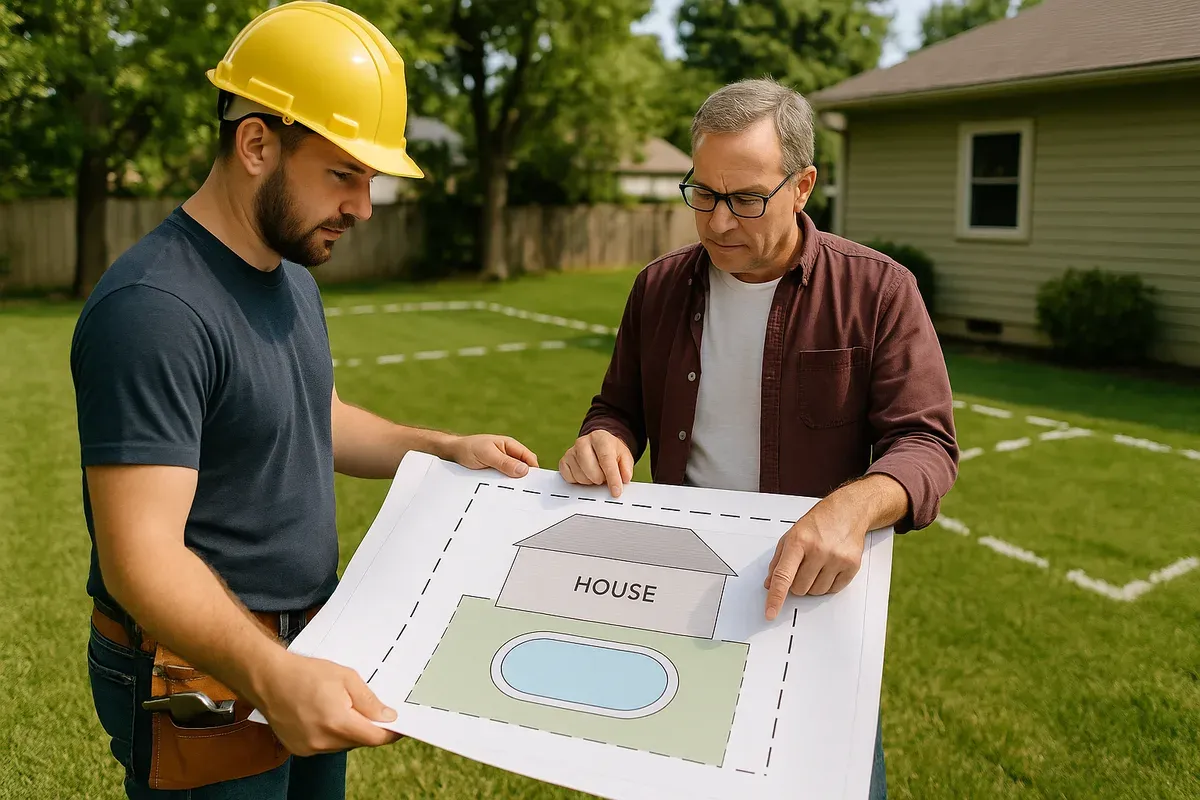
<h2>Why Pool Setback Requirements Trip Up Even Experienced Homeowners</h2>
<p>Every summer, thousands of <a href="/homeowners">homeowners</a> across the country plan their dream backyard pools. They research pool styles, compare <a href="/contractors">contractors</a>, and pick out patio furniture. What many skip entirely is the one step that can halt the entire project before a single shovel hits the ground: understanding pool <a href="/setback-guide">setback requirements</a>.</p>
<p>Setback requirements for swimming pools are not a single national standard. They are a patchwork of state codes, county ordinances, municipal zoning rules, and HOA restrictions that vary dramatically from one jurisdiction to the next. A pool that is perfectly legal in a Phoenix suburb might violate three separate rules in a New Jersey township two blocks from an identical property.</p>
<p>In 2026, permit rejections related to <a href="/pool-site-plans">swimming pool</a> zoning rules remain one of the top reasons residential construction projects stall. And the frustrating part is that most of these rejections are preventable. The errors are almost always the same, and they almost always come down to a misunderstanding of how setbacks work, what they measure, and which boundaries actually matter.</p>
<p>This article breaks down the most common mistakes states, municipalities, and homeowners make when it comes to pool setback compliance, and gives you a clear roadmap for getting your permit approved the first time.</p>
<hr>
<h2>What Pool Setbacks Actually Measure (And What Most People Think They Measure)</h2>
<p>Before diving into what goes wrong, it helps to understand what pool setback requirements are actually measuring.</p>
<p>A setback is the minimum required distance between a structure and a specific boundary or feature. For swimming pools, that boundary could be:</p>
<ul>
<li>The <strong>property line</strong> (the most common reference point)</li>
<li>The edge of a recorded easement</li>
<li>The foundation of the primary dwelling</li>
<li>A septic system or drain field</li>
<li>A well or water supply</li>
<li>A public sidewalk or right-of-way</li>
<li>A wetland, floodplain, or other environmental feature</li>
</ul>
<p>Here is where the first major mistake happens: most homeowners assume pool setbacks only refer to property lines. They measure from the fence or the edge of their yard, confirm there is enough space, and move on. In reality, many jurisdictions require separate setback distances from multiple features simultaneously, and all of them must be satisfied at the same time.</p>
<p>For example, a county might require:</p>
<ul>
<li>5 feet from the rear property line</li>
<li>5 feet from the side property line</li>
<li>10 feet from the primary structure</li>
<li>15 feet from a septic tank</li>
<li>50 feet from a well</li>
</ul>
<p>All five of those rules apply at once. Missing any one of them means the permit is denied.</p>
<hr>
<h2>The Most Common Pool Setback Mistakes by State and Region</h2>
<h3>Mistake 1: Treating State Code as the Final Word</h3>
<p>One of the most widespread misconceptions is that state building codes set the definitive pool setback rules. They do not. In most states, the building code establishes a minimum baseline, but local jurisdictions have the authority to adopt stricter standards.</p>
<p>The <a href="https://www.iccsafe.org/products-and-events/i-codes/international-swimming-pool-and-spa-code/" rel="nofollow noopener" target="_blank">International Swimming Pool and Spa Code (ISPSC)</a>, published by the International Code Council, is adopted in whole or in part by many states. But adoption is not uniform. Some states adopt it with amendments. Some adopt older versions. Some leave pool regulation almost entirely to municipalities.</p>
<p>In states like Texas and Florida, where pool construction is extremely common, this creates a situation where two neighboring counties can have dramatically different setback rules. A homeowner who moves from Harris County to Montgomery County in Texas might assume the same rules apply. They often do not.</p>
<p><strong>What to do:</strong> Always verify setback requirements at the local level, specifically with your city or county planning and zoning department. State code is the starting point, not the finish line.</p>
<h3>Mistake 2: Ignoring Easements Entirely</h3>
<p>Easements are legal rights that allow someone other than the property owner to use a portion of the land for a specific purpose. Common examples include utility easements, drainage easements, and access easements.</p>
<p>Here is the critical issue: easements are not the same as property lines. A utility easement that runs 10 feet inside your rear property line means you effectively cannot build within that 10-foot strip, even though you legally own the land. If your jurisdiction requires a 5-foot setback from the property line and you have a 10-foot utility easement, the easement is the controlling factor.</p>
<p>This mistake is especially common in newer subdivisions in the Southeast and Southwest, where drainage easements are frequently recorded along rear lot lines. Homeowners see a large backyard, measure from the fence, and plan accordingly. Then the permit reviewer pulls the recorded plat and finds the pool encroaches into a drainage easement. The project stops.</p>
<p>Easements are recorded on your property's title documents and on the official plat map. Before planning any pool placement, pull the recorded plat from your county assessor or recorder's office and identify every easement on the property.</p>
<h3>Mistake 3: Measuring from the Wrong Point on the Pool</h3>
<p>Another common error involves what part of the pool the setback is measured from. Most jurisdictions measure from the water's edge, which is the interior wall of the pool shell. But some measure from the coping (the finished edge surrounding the pool), and others measure from the outermost edge of any associated decking.</p>
<p>This distinction can easily account for 3 to 6 feet of difference, which is enough to push a pool out of compliance on a tight lot.</p>
<p>Always confirm with your local permit office whether setbacks are measured from the water's edge, the pool wall, the coping, or the deck perimeter. Get the answer in writing if possible.</p>
<h3>Mistake 4: Overlooking the Fence Setback Interaction</h3>
<p>Almost every jurisdiction in the United States requires a barrier fence around residential swimming pools. This is not just a local rule; it reflects decades of child drowning prevention policy. But the fence itself has its own setback requirements that interact with the pool setbacks in ways that catch homeowners off guard.</p>
<p>For example, a jurisdiction might require:</p>
<ul>
<li>Pool to be 5 feet from the property line</li>
<li>Pool fence to be at least 3 feet from the pool water's edge</li>
<li>Pool fence to be no closer than 2 feet from the property line</li>
</ul>
<p>On a lot where the homeowner has planned the pool exactly 5 feet from the rear property line, there may not be enough room to install a compliant fence between the pool and the property line. The pool placement needs to shift forward to accommodate the fence geometry.</p>
<p>This is a three-dimensional planning problem that requires mapping all the required distances on an accurate site plan before any design decisions are finalized.</p>
<h3>Mistake 5: Not Accounting for Accessory Structures</h3>
<p>Pools rarely come alone. Most installations include a pump house, an equipment pad, a cabana, a pergola, or at minimum a concrete or paver deck. Each of these elements may be classified as an accessory structure under local zoning codes, and each may have its own setback requirements that differ from the pool itself.</p>
<p>In many jurisdictions, pool equipment pads are treated as mechanical equipment and must maintain a minimum distance from property lines and from the dwelling. Pump noise ordinances sometimes add an additional layer of complexity, requiring equipment to be placed away from shared property lines.</p>
<p>If you are planning any structure in connection with your pool, confirm the setback rules for each element separately.</p>
<hr>
<h2>Regional Patterns: Where the Rules Get Most Complicated</h2>
<h3>The Southeast: Flood Zones and Drainage Easements</h3>
<p>States like Florida, Georgia, South Carolina, and Louisiana present a unique set of challenges because of their geography. Many residential lots in these states sit near or within FEMA-designated flood zones. Pool construction in a Special Flood Hazard Area (SFHA) triggers additional requirements under the National Flood Insurance Program (NFIP), and some municipalities impose additional setbacks from flood zone boundaries.</p>
<p>You can check your property's flood zone status using the <a href="https://msc.fema.gov/portal/home" rel="nofollow noopener" target="_blank">FEMA Flood Map Service Center</a>. If your property falls in a Zone A, AE, or VE designation, expect additional review requirements beyond standard pool setback compliance.</p>
<p>Drainage easements are also extremely common in this region due to the flat terrain and heavy rainfall. As discussed earlier, these easements can effectively reduce your buildable area significantly.</p>
<h3>The Northeast: Small Lots and Strict Municipalities</h3>
<p>In densely populated states like New Jersey, Connecticut, Massachusetts, and New York, lot sizes tend to be smaller and municipal zoning codes tend to be more restrictive. Pool setback requirements in some Northeast municipalities exceed 15 feet from property lines on all sides, which on a 60-foot-wide lot can make pool installation geometrically impossible without a variance.</p>
<p>Variances are available in most jurisdictions, but they require a formal application, often a public hearing, and are not guaranteed. The process can add months and hundreds or thousands of dollars to a project.</p>
<p>In the Northeast, the due diligence phase before purchasing a pool or signing a contract with an installer is especially important. Many homeowners in this region discover that their lot simply cannot accommodate a pool without a variance after they have already committed financially.</p>
<h3>The Southwest: Well and Septic Setbacks</h3>
<p>In Arizona, New Mexico, Nevada, and rural areas of California, many properties rely on private wells and septic systems rather than municipal water and sewer. This introduces a whole additional layer of pool setback requirements that urban homeowners rarely encounter.</p>
<p>Arizona, for example, requires pools to be set back a minimum of 50 feet from a private well and 5 feet from a septic tank, with additional distances required from septic leach fields. These rules exist to protect groundwater quality and to prevent pool water from interfering with septic system function.</p>
<p>If your property has a well or septic system, locate those features precisely on your property before planning pool placement. Your county health department typically has records of septic system installations, and well locations should be documented in your property records.</p>
<h3>The Midwest: Variance Processes That Vary Wildly</h3>
<p>Midwestern states like Ohio, Michigan, Illinois, and Minnesota have relatively consistent state-level frameworks, but local variance processes vary enormously. In some municipalities, a minor variance for a pool that is 1 foot short of the required setback is a routine administrative approval. In others, it requires a full board of zoning appeals hearing with neighborhood notification.</p>
<p>Homeowners in the Midwest often underestimate how much local political context shapes permit outcomes. A variance that is routinely approved in one township might face significant opposition in a neighboring township with a more active neighborhood association.</p>
<hr>
<h2>How to Research Pool Setback Requirements in Your Jurisdiction</h2>
<p>Given the complexity described above, here is a practical step-by-step approach to researching your local pool setback requirements before committing to a design.</p>
<h3>Step 1: Obtain Your Property's Official Plat</h3>
<p>Your county recorder, assessor, or register of deeds office maintains recorded plat maps for all properties. This document shows your exact property boundaries, lot dimensions, and all recorded easements. This is your baseline document for all setback measurements.</p>
<h3>Step 2: Contact Your Local Zoning Department</h3>
<p>Call or visit your city or county planning and zoning department. Ask specifically about:</p>
<ul>
<li>Minimum pool setbacks from all property lines (front, rear, side)</li>
<li>Required setbacks from the primary structure</li>
<li>Any easement restrictions</li>
<li>Fence requirements and their setbacks</li>
<li>Accessory structure rules for equipment and decking</li>
<li>Any overlay districts (flood zones, historic districts, etc.) that apply</li>
</ul>
<p>Many jurisdictions now publish zoning codes online through platforms like <a href="https://library.municode.com/" rel="nofollow noopener" target="_blank">Municode</a>, which can give you a head start before making calls.</p>
<h3>Step 3: Check for HOA Restrictions</h3>
<p>If your property is in a homeowners association, the HOA's CC&Rs (Covenants, Conditions, and Restrictions) may impose setback requirements that are stricter than local zoning. HOA approval is typically required in addition to, not instead of, municipal permits.</p>
<h3>Step 4: Identify Environmental Constraints</h3>
<p>Check FEMA flood maps, state wetland maps, and any local environmental overlay districts. These can impose additional setback requirements that are entirely separate from zoning rules.</p>
<h3>Step 5: Create an Accurate Site Plan</h3>
<p>Once you have gathered all the applicable rules, you need to map them onto an accurate representation of your property. This is where a proper site plan becomes essential.</p>
<hr>
<h2>Why an Accurate Site Plan Is Non-Negotiable for Pool Permits</h2>
<p>Most jurisdictions require a site plan as part of a pool permit application. The site plan must show:</p>
<ul>
<li>The property boundaries with dimensions</li>
<li>The location and footprint of all existing structures</li>
<li>The proposed pool location, shape, and dimensions</li>
<li>All required setback distances, labeled and measured</li>
<li>The proposed fence location</li>
<li>Any easements</li>
<li>Utility locations (in many jurisdictions)</li>
</ul>
<p>A hand-drawn sketch on graph paper is technically acceptable in some jurisdictions, but it is rarely sufficient for a smooth permit review. Reviewers need to verify measurements, and an inaccurate or unclear site plan is one of the most common reasons permit applications are sent back for revision.</p>
<p>A professionally prepared site plan drawn to scale, with all required dimensions clearly labeled, signals to the permit reviewer that the applicant understands the rules and has done the work. It reduces back-and-forth, speeds up review, and dramatically improves the likelihood of first-submission approval.</p>
<p>This is exactly the problem that <a href="/">Site Plan Creator</a> was built to solve. The platform allows homeowners, contractors, and designers to create accurate, permit-ready site plans in a browser-based CAD-style environment without requiring professional surveyor software or expensive drafting services. You can place your pool, mark your setbacks, show your fence line, and produce a clean, scaled drawing that meets permit office standards.</p>
<hr>
<h2>Common Misconceptions About Pool Setback Variances</h2>
<p>When a proposed pool cannot meet setback requirements, a variance is the formal mechanism for requesting an exception. But variances are widely misunderstood.</p>
<h3>Misconception 1: Variances Are Automatic if You Ask Nicely</h3>
<p>Variances require demonstrating a genuine hardship, typically a physical characteristic of the property (not the owner's preference) that makes strict compliance impractical. "I want a bigger pool" is not a hardship. "My lot is irregularly shaped and no compliant placement is feasible" might be.</p>
<h3>Misconception 2: A Variance from One Jurisdiction Transfers</h3>
<p>Variances are property-specific and jurisdiction-specific. If you sell the property, the variance typically transfers with it, but if you are buying a property and assuming a previous variance, verify that it was properly recorded and that it covers your intended use.</p>
<h3>Misconception 3: Variances Are Quick</h3>
<p>In many jurisdictions, a variance application takes 4 to 12 weeks to process, requires a public hearing, and may require notification of adjacent property owners. Build this timeline into your project schedule if you anticipate needing one.</p>
<hr>
<h2>What States Should Do Differently</h2>
<p>From a policy perspective, the fragmentation of pool setback requirements across thousands of local jurisdictions creates real costs for homeowners and the construction industry. Here is what better policy could look like:</p>
<ol>
<li><strong>Clearer state-level minimums</strong> that local jurisdictions can exceed but not undercut without documented justification.</li>
<li><strong>Standardized measurement definitions</strong> so that "setback from pool" means the same thing in every jurisdiction within a state.</li>
<li><strong>Online zoning portals</strong> that allow homeowners to enter an address and receive a clear summary of applicable setback rules, rather than requiring phone calls and in-person visits.</li>
<li><strong>Streamlined variance processes</strong> for minor deviations (less than 20% of required setback) that do not require full board hearings.</li>
<li><strong>Integrated permit checklists</strong> that list every required setback distance, measurement reference point, and associated document so applicants know exactly what they need before submitting.</li>
</ol>
<p>Some states are moving in this direction. California's push toward digital permitting and Florida's streamlined residential permit processes are positive examples. But the gap between best-practice jurisdictions and the rest remains wide.</p>
<hr>
<h2>Before You Sign a Pool Contract: A Compliance Checklist</h2>
<p>Before you commit to a pool design or sign a contract with an installer, work through this checklist:</p>
<ul>
<li><input disabled="" type="checkbox"> Obtain your recorded property plat and identify all easements</li>
<li><input disabled="" type="checkbox"> Contact your local zoning department and document all applicable setback rules</li>
<li><input disabled="" type="checkbox"> Check FEMA flood map status for your property</li>
<li><input disabled="" type="checkbox"> Identify any well or septic system locations and their required setbacks</li>
<li><input disabled="" type="checkbox"> Review HOA CC&Rs for additional restrictions</li>
<li><input disabled="" type="checkbox"> Confirm what part of the pool the setbacks are measured from (water edge, coping, deck)</li>
<li><input disabled="" type="checkbox"> Confirm fence setback requirements and how they interact with pool setbacks</li>
<li><input disabled="" type="checkbox"> Identify setback rules for all accessory structures (equipment pad, cabana, etc.)</li>
<li><input disabled="" type="checkbox"> Create a scaled site plan showing all setbacks and proposed pool placement</li>
<li><input disabled="" type="checkbox"> Submit your site plan to the permit office for pre-application review if available</li>
</ul>
<p>This checklist takes time upfront, but it is far less costly than discovering a compliance problem after a contractor has already begun excavation.</p>
<hr>
<h2>Conclusion: Get the Setbacks Right Before You Break Ground</h2>
<p>Swimming pool setback requirements are genuinely complex, and the complexity is not going away. The patchwork of state codes, local ordinances, easements, environmental overlays, and HOA rules means that every pool project needs to be researched from scratch, for that specific property, in that specific jurisdiction.</p>
<p>The good news is that the information is available. It requires effort to gather, but none of it is hidden. The homeowners and contractors who succeed at getting pool permits approved quickly are the ones who do the research first, document it clearly, and present it in a professional site plan that makes the permit reviewer's job easy.</p>
<p>If you are planning a pool project in 2026, start with an accurate site plan. Site Plan Creator gives you the tools to build a permit-ready drawing that shows your property boundaries, proposed pool placement, setback distances, fence lines, and all the details your local permit office needs to approve your application. It is browser-based, no software installation required, and designed specifically for residential permit applications.</p>
<p>Do the setback research. Build the site plan. Get the permit right the first time.</p>