Las Vegas Fence Permit Guide: Clark County Requirements 2026
Getting a fence permit in Las Vegas is more involved than most homeowners expect. This guide breaks down Clark County's 2026 fence regulations, height limits, setback rules, and exactly what your permit application needs to include, including a compliant site plan.
<h2>What You Need to Know Before Building a Fence in Las Vegas</h2>
<p>You've decided to put up a fence. Maybe you want privacy from neighbors, a safe yard for your kids, or a clean boundary around your property. Whatever the reason, if you live in the Las Vegas metro area, you're about to discover that fencing is one of the most regulated home improvement projects in Clark County. Get it wrong and you could face fines, forced removal, or a failed home sale inspection.</p>
<p>The good news is that Clark County's <a href="/fence-deck-site-plans">fence permit</a> process is navigable once you understand the rules. This guide walks you through everything you need to know in 2026: when a permit is required, what height limits apply in your zone, how setbacks work, what documents you need to submit, and how to prepare a site plan that will actually get approved.</p>
<p>Let's start at the beginning.</p>
<hr>
<h2>Do You Need a Fence Permit in Las Vegas?</h2>
<p>The short answer is: probably yes, depending on the height and location of your fence.</p>
<p>Clark County Building Department requires a permit for most fence installations. However, the rules differ slightly depending on whether your property falls under unincorporated Clark County jurisdiction or within the city limits of Las Vegas, Henderson, North Las Vegas, or another incorporated municipality. Many residents are surprised to learn that their address may fall under county jurisdiction even if they consider themselves Las Vegas residents.</p>
<h3>Unincorporated Clark County vs. City of Las Vegas</h3>
<p>Before you apply anywhere, confirm which jurisdiction governs your property. You can do this through the <a href="https://www.clarkcountynv.gov/assessor" rel="nofollow noopener" target="_blank">Clark County Assessor's parcel search tool</a> by entering your address and reviewing the jurisdiction listed on your parcel record.</p>
<ul>
<li><strong>Unincorporated Clark County:</strong> Governed by the Clark County Building Department and Clark County Development Code</li>
<li><strong>City of Las Vegas:</strong> Governed by the City of Las Vegas Department of Planning and Development Services</li>
<li><strong>Henderson:</strong> Has its own Building and Safety Division with separate code requirements</li>
<li><strong>North Las Vegas:</strong> Governed by the North Las Vegas Development Services Department</li>
</ul>
<p>This article focuses primarily on unincorporated Clark County and the City of Las Vegas, which together cover the majority of properties in the metro area. Always verify with your specific jurisdiction before submitting any application.</p>
<h3>When a Permit Is Required</h3>
<p>In Clark County, a <a href="/construction-permit-site-plans">building permit</a> is generally required for any fence that:</p>
<ol>
<li>Exceeds 3 feet in height in a front yard</li>
<li>Exceeds 6 feet in height in a side or rear yard</li>
<li>Is constructed of masonry, concrete block, or similar rigid materials regardless of height in some zones</li>
<li>Is installed around a <a href="/pool-site-plans">swimming pool</a> (pool barrier requirements apply separately under Nevada law)</li>
<li>Is located within a flood zone or special hazard area as defined by FEMA</li>
</ol>
<p>Low fences under 3 feet used for decorative purposes or garden edging may be exempt in some zones, but this is not universal. When in doubt, call your local building department before you dig a single post hole.</p>
<hr>
<h2>Clark County Fence Height Rules in 2026</h2>
<p>Height limits are the most commonly misunderstood aspect of fence regulations. In Clark County, the allowed height depends on your zoning designation and where on your lot the fence is located.</p>
<h3>Front Yard Height Limits</h3>
<p>For most residential zones in Clark County, including R-1, R-2, and R-3 designations, the maximum fence height in the front yard is <strong>3 feet</strong>. This applies to the area between the front property line and the front building setback line.</p>
<p>There are some important nuances:</p>
<ul>
<li>Corner lots have two front yards in many interpretations of the code, meaning the 3-foot limit may apply to both street-facing sides</li>
<li>Wrought iron and open-style fencing may have slightly different treatment in some zones</li>
<li>Fences with more than 50% open area (like split rail or picket) may be treated differently than solid privacy fencing</li>
</ul>
<h3>Side and Rear Yard Height Limits</h3>
<p>For side and rear yards, the standard maximum height in residential zones is <strong>6 feet</strong>. This is the limit most <a href="/homeowners">homeowners</a> are working within when they want a standard privacy fence.</p>
<p>Exceptions include:</p>
<ul>
<li>Properties adjacent to arterial roads or commercial zones, where up to 8 feet may be permitted with additional review</li>
<li>Agricultural zones, where height limits are generally more permissive</li>
<li>Noise attenuation walls approved through a separate process, which can exceed standard limits</li>
</ul>
<h3>Commercial and Industrial Zones</h3>
<p>Fence height rules in commercial (C-1, C-2) and industrial (M-1, M-2) zones are different and generally more permissive, particularly for security fencing. Chain-link fencing with barbed wire toppers may be permitted in industrial zones where it would never be allowed in a residential area. If your property has a commercial designation, review the Clark County Development Code chapter specific to your zone or consult directly with the Planning Department.</p>
<hr>
<h2>Setback Requirements for Fences in Clark County</h2>
<p>Setbacks define how far a structure must be from a property line, easement, or right-of-way. For fences, setback rules determine where your fence can legally begin.</p>
<h3>Property Line Setbacks</h3>
<p>In most residential zones, fences in side and rear yards can be built directly on the property line. However, there are critical exceptions:</p>
<ul>
<li><strong>Utility easements:</strong> If your property has a utility easement running along the rear or side, you may not be able to place a fence within that easement corridor. Common easement widths are 5 to 10 feet.</li>
<li><strong>Drainage easements:</strong> Similar to utility easements, drainage easements must remain accessible and unobstructed.</li>
<li><strong>HOA restrictions:</strong> Many Las Vegas-area subdivisions have Homeowners Association rules that are more restrictive than county code. Your HOA may require fences to be set back from the property line or require specific materials and colors.</li>
</ul>
<h3>Front Yard Setbacks</h3>
<p>In the front yard, fences are typically required to be placed behind the property line by a distance that varies by zone. In some cases, the fence must be set back from the edge of the public right-of-way rather than the legal property line, which can be a few feet further back than you might expect.</p>
<p>Always request a plot plan or survey before installing a front yard fence. Placing a fence even slightly into the public right-of-way is a code violation that will require correction at your expense.</p>
<h3>Corner Lot Considerations</h3>
<p>Corner lots face additional scrutiny because of sight distance triangles. Clark County requires a clear line of sight at intersections to maintain traffic safety. This means that even if a 6-foot fence is technically permitted, it cannot be placed within the sight distance triangle at a corner, which typically extends 25 to 35 feet from the intersection along each street frontage.</p>
<hr>
<h2>Materials and Design Standards</h2>
<p>Clark County and the City of Las Vegas have standards not just for fence height and location, but also for materials and construction quality.</p>
<h3>Approved Materials</h3>
<p>Common approved fencing materials in residential zones include:</p>
<ul>
<li>Concrete block (CMU), which is extremely common in Las Vegas due to the desert climate</li>
<li>Wood (though it weathers quickly in Nevada heat and is less common)</li>
<li>Wrought iron and tubular steel</li>
<li>Vinyl/PVC fencing</li>
<li>Aluminum fencing</li>
<li>Chain-link (with restrictions on height and location)</li>
</ul>
<h3>Materials That May Require Special Approval</h3>
<ul>
<li>Barbed wire: Generally prohibited in residential zones</li>
<li>Electric fencing: Prohibited in most residential applications</li>
<li>Corrugated metal or salvaged materials: May require additional review</li>
<li>Living fences (hedgerows): Not subject to fence permit requirements but may be subject to landscaping and height rules</li>
</ul>
<h3>Construction Standards</h3>
<p>For masonry walls, Clark County typically requires engineered drawings for walls exceeding a certain height (often 6 feet or when footings are required). Your permit application may need to include structural calculations or a letter from a licensed engineer.</p>
<p>For wood and metal fences, post depth and spacing requirements apply. In Clark County's high-wind environment (Las Vegas can see sustained winds exceeding 50 mph during storms), post embedment depth is taken seriously by inspectors.</p>
<hr>
<h2>How to Apply for a Fence Permit in Clark County</h2>
<p>The Clark County Building Department accepts applications online through its permitting portal, as well as in person at the permit counter. For most residential fence permits, the process follows these steps:</p>
<h3>Step 1: Gather Your Documents</h3>
<p>You will typically need:</p>
<ol>
<li>A completed permit application form</li>
<li>A site plan showing your property, existing structures, and the proposed fence location</li>
<li>Construction details (post spacing, footing depth, materials)</li>
<li>Proof of property ownership or authorization from the owner</li>
<li>HOA approval letter (if applicable)</li>
<li>For masonry walls over 6 feet: engineered drawings</li>
</ol>
<h3>Step 2: Prepare a Compliant Site Plan</h3>
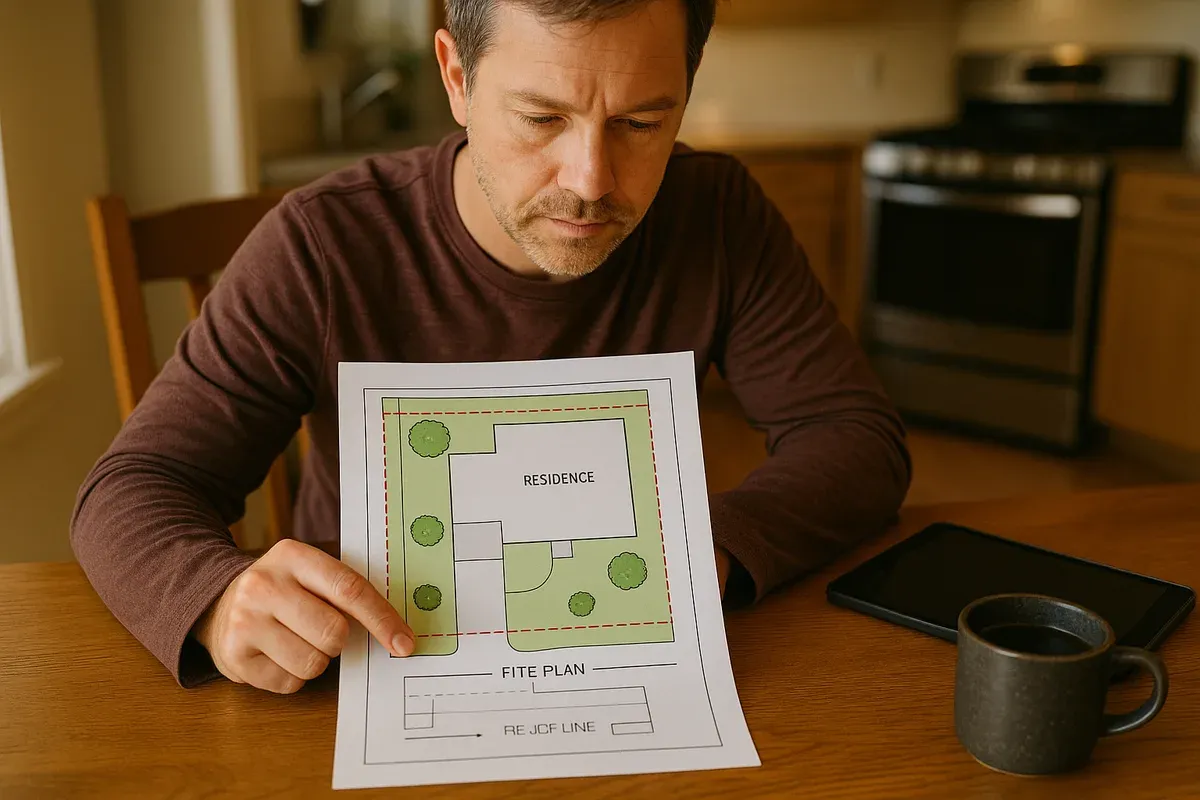
<p>This is where many homeowners run into trouble. The site plan is one of the most important documents in your application, and a poorly prepared one is the most common reason for permit delays or rejections.</p>
<p>A compliant fence permit site plan for Clark County must include:</p>
<ul>
<li>A north arrow and scale bar</li>
<li>Property boundaries with dimensions</li>
<li>Existing structures (house, garage, sheds, pool) shown with accurate footprints</li>
<li>Proposed fence location shown as a distinct line with dimensions from property lines</li>
<li>Setback dimensions clearly labeled</li>
<li>Easements, if any, shown on the plan</li>
<li>Street names and neighboring property references</li>
<li>Your parcel number (APN)</li>
</ul>
<p>This is exactly the type of document that <a href="https://www.siteplancreator.com">Site Plan Creator</a> is built to produce. Rather than hiring a drafter or struggling with complex CAD software, you can build a permit-ready site plan directly in your browser, plot your property boundaries, place your existing structures, draw the proposed fence line, and add all required annotations and dimensions. The result is a professional, to-scale site plan that meets Clark County's submission standards.</p>
<h3>Step 3: Submit and Pay Fees</h3>
<p>Fence permit fees in Clark County are relatively modest compared to other permit types. As of 2026, residential fence permits are typically calculated based on the valuation of the work. Expect fees in the range of $75 to $250 for a standard residential fence, though this can vary. The Clark County Building Department fee schedule is published on the <a href="https://www.clarkcountynv.gov/building" rel="nofollow noopener" target="_blank">Clark County website</a> and is updated periodically.</p>
<h3>Step 4: Wait for Review and Approval</h3>
<p>Simple residential fence permits in Clark County can often be approved over the counter or within a few business days when submitted with complete documentation. More complex applications involving masonry walls, engineered drawings, or variances will take longer.</p>
<p>If your application is returned with corrections, address every comment before resubmitting. Partial corrections are one of the most common causes of extended permit timelines.</p>
<h3>Step 5: Schedule Inspections</h3>
<p>Once your permit is approved, you can begin construction. Clark County typically requires at least one inspection for fence projects:</p>
<ul>
<li><strong>Footing inspection:</strong> Before concrete is poured for posts or wall footings</li>
<li><strong>Final inspection:</strong> Once the fence is complete</li>
</ul>
<p>For masonry walls, additional framing or reinforcement inspections may be required. Check your permit card for the specific inspections required for your project.</p>
<hr>
<h2>Pool Fencing: A Special Category</h2>
<p>If your fence project involves enclosing a swimming pool, the requirements are significantly more stringent. Nevada state law, aligned with the <a href="https://www.iccsafe.org" rel="nofollow noopener" target="_blank">International Building Code pool barrier provisions</a>, requires pool barriers to meet specific standards regardless of any other fence regulations.</p>
<p>Key Nevada pool barrier requirements include:</p>
<ul>
<li>Minimum height of 60 inches (5 feet) for pool enclosure fencing</li>
<li>Maximum vertical clearance of 2 inches at the bottom of the fence</li>
<li>No gaps or openings that would allow a 4-inch sphere to pass through</li>
<li>Self-closing, self-latching gates that open away from the pool</li>
<li>Latches located at least 54 inches from the ground or on the pool side of the gate</li>
</ul>
<p>Pool barrier permits are reviewed separately from standard fence permits in Clark County. If you are adding a fence that doubles as a pool barrier, make sure your site plan clearly shows the pool, the fence line, gate locations, and all relevant dimensions.</p>
<hr>
<h2>Common Mistakes That Delay or Derail Fence Permits</h2>
<p>After reviewing what the process requires, here are the pitfalls that most often cause problems for Las Vegas homeowners:</p>
<ol>
<li><p><strong>Assuming you don't need a permit.</strong> Many homeowners believe that a simple 6-foot wood fence doesn't require a permit. In Clark County, it almost certainly does.</p>
</li>
<li><p><strong>Not checking easements first.</strong> Building over a utility or drainage easement will result in a stop-work order and potential forced removal of the fence.</p>
</li>
<li><p><strong>Submitting a hand-drawn site plan.</strong> Clark County reviewers need to verify dimensions, setbacks, and relationships between structures. A rough sketch will not meet their standards.</p>
</li>
<li><p><strong>Ignoring HOA requirements.</strong> Your HOA may have rules that are more restrictive than county code. Getting county approval doesn't protect you from HOA enforcement.</p>
</li>
<li><p><strong>Starting construction before permit issuance.</strong> Building without a permit is a code violation. In Clark County, after-the-fact permits (retroactive permits) are possible but come with additional fees and inspections, and there is no guarantee of approval.</p>
</li>
<li><p><strong>Not accounting for corner lot sight triangles.</strong> A fence that impairs intersection sight lines will not pass inspection and will need to be relocated.</p>
</li>
<li><p><strong>Forgetting to call 811.</strong> Before any digging, Nevada law requires you to call 811 (the national call-before-you-dig line) to have underground utilities marked. This is both a legal requirement and a safety necessity.</p>
</li>
</ol>
<hr>
<h2>Tips for a Smooth Fence Permit Experience in 2026</h2>
<p>Here are practical steps that will make your permit application go as smoothly as possible:</p>
<ul>
<li><strong>Call the building department before you apply.</strong> A five-minute conversation with a permit technician can clarify zone-specific rules and save you hours of rework.</li>
<li><strong>Use your county assessor parcel map.</strong> The Clark County Assessor's online map shows parcel boundaries, easements, and APN information that you'll need for your site plan.</li>
<li><strong>Measure your property carefully.</strong> If you don't have a recent survey, use your recorded deed, title report, or a professional survey to establish accurate property dimensions before drawing your site plan.</li>
<li><strong>Choose materials appropriate for Las Vegas climate.</strong> Concrete block and steel hold up far better than wood in the desert heat. Choosing the right material upfront avoids costly replacements.</li>
<li><strong>Document everything.</strong> Keep copies of your permit application, approved plans, inspection records, and final sign-off. These documents will be valuable when you sell your home.</li>
<li><strong>Build your site plan digitally.</strong> A browser-based tool like <a href="/">Site Plan Creator</a> lets you produce a clean, dimensioned, to-scale site plan without any CAD training. You can export it as a PDF ready for submission.</li>
</ul>
<hr>
<h2>What Happens If You Build Without a Permit?</h2>
<p>Building a fence without a required permit in Clark County is a code violation. If a neighbor complains, a county inspector drives by, or the violation is discovered during a <a href="/real-estate">real estate</a> transaction, you could face:</p>
<ul>
<li>A stop-work order if construction is in progress</li>
<li>A notice of violation requiring you to obtain a retroactive permit or remove the fence</li>
<li>Fines that accumulate daily until the violation is corrected</li>
<li>Difficulty selling your home (unpermitted work must be disclosed and can kill a sale)</li>
<li>Potential liability if the unpermitted fence causes injury or property damage</li>
</ul>
<p>Retroactive permits are possible in Clark County, but the process is more expensive and more difficult than getting the permit upfront. You may be required to expose footings for inspection, which means partially dismantling the fence. Save yourself the headache and do it right from the start.</p>
<hr>
<h2>Conclusion: Get Your Fence Permit Right the First Time</h2>
<p>Building a fence in Las Vegas is a perfectly manageable project when you understand what Clark County requires. Know your zone, respect the height limits, verify easements, prepare a proper site plan, and submit a complete application. That's the formula for a fast, smooth permit approval in 2026.</p>
<p>The biggest single thing you can do to speed up your approval is to submit a high-quality, accurate site plan. That's where Site Plan Creator comes in. Our browser-based tool is designed specifically for homeowners and <a href="/contractors">contractors</a> who need permit-ready property drawings without the complexity of professional CAD software. You can draw your property boundaries, place your existing structures, map out your proposed fence line with accurate dimensions, and export a clean PDF that meets Clark County's submission standards.</p>
<p>Visit <a href="https://www.siteplancreator.com">siteplancreator.com</a> to start your site plan today. Most users complete a basic residential site plan in under an hour, and you can get your permit application out the door by tomorrow.</p>