Site Plan Requirements in Grand Rapids, MI (Permit Guide)
Grand Rapids, Michigan homeowners need a site plan for most residential building permits, from decks and additions to ADUs and pools. This guide covers local permit triggers, zoning setbacks, plan review timelines, and how Site Plan Creator can help you prepare a compliant drawing fast.
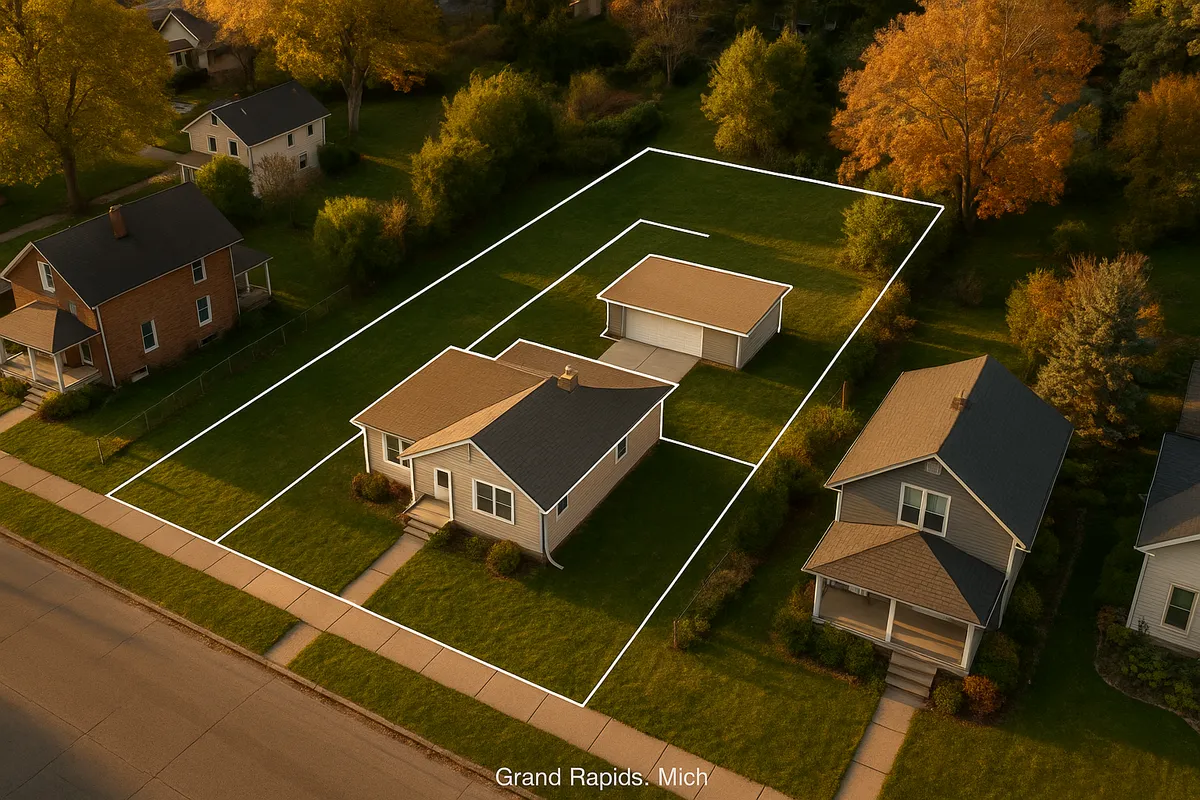
Residential Site Plans and Permits in Grand Rapids, MI
Grand Rapids is Michigan's second-largest city and one of the fastest-growing metros in the Midwest. With a booming housing market, a rich mix of historic neighborhoods like Heritage Hill and East Hills, and an active infill-development scene, the City's Building Safety Services department processes thousands of residential permit applications every year. Whether you are adding a backyard deck in Eastown, converting a garage into an ADU near Wealthy Street, or putting up a privacy fence in Creston, you will almost certainly need a permit -- and that permit will require a site plan that shows exactly where your project sits on the property.
What Is a Residential Site Plan and Why Does Grand Rapids Require One?
A residential site plan is a scaled, bird's-eye drawing of your lot that shows the property boundaries, existing structures, proposed construction, setbacks from property lines, driveways, utilities, and any relevant natural features such as floodplain areas or trees. Grand Rapids requires site plans as part of most building permit applications so that plan reviewers can verify your project complies with the Michigan Building Code and the City's local zoning ordinance before construction begins.
Without an accurate site plan, your application will be returned or placed on hold, adding weeks to your project timeline. Getting the drawing right the first time is the single most effective way to keep your permit moving.
Permit Triggers: When Grand Rapids Requires a Building Permit
The City of Grand Rapids requires a building permit for virtually any structural improvement to residential property. Common triggers include:
- Decks and porches: Any deck attached to the house or elevated more than 30 inches above grade requires a permit. A site plan showing the deck footprint, distance to property lines, and ledger attachment point is required.
- Detached sheds and accessory structures: Sheds larger than 200 square feet require a permit. Even smaller sheds may need zoning approval to confirm setback compliance.
- Swimming pools: Both in-ground and above-ground pools deeper than 24 inches require a permit and a site plan showing the pool location, required barrier/fencing, and setbacks.
- Fences: Fences over six feet in height require a permit. Fences in front yards have additional height restrictions (typically four feet maximum) and must comply with corner-lot sight-triangle rules.
- Additions and room expansions: Any addition to the building footprint requires full permit review, structural drawings, and a site plan.
- Accessory Dwelling Units (ADUs): Grand Rapids has actively worked to expand ADU allowances as part of its housing affordability strategy. Both attached and detached ADUs require permits, and the site plan must show the ADU footprint, parking, and setbacks from all property lines.
- Driveways and impervious surfaces: New driveways or significant expansions of existing paved surfaces may require a stormwater review, particularly in areas near the Grand River or in low-lying neighborhoods subject to drainage concerns.
- HVAC, electrical, and plumbing: Separate trade permits are required for mechanical work; these often accompany a larger building permit application.
Grand Rapids Zoning: Key Local Considerations
Grand Rapids uses a form-based and use-based hybrid zoning code administered through the City's Planning Department. A few local quirks are worth knowing before you start your project:
Historic Districts
Grand Rapids has several locally designated historic districts, including Heritage Hill, one of the largest historic districts in the United States. If your property is within a historic district, you will need a Certificate of Appropriateness from the Historic Preservation Commission before the Building Safety Services office will issue a permit. This adds a review layer that can take four to six weeks.
Floodplain Areas
Portions of Grand Rapids near the Grand River and its tributaries fall within FEMA-designated Special Flood Hazard Areas (SFHAs). Projects in these zones must comply with floodplain management regulations and may require an Elevation Certificate. You can check your property's flood zone status on the FEMA Flood Map Service Center.
Impervious Surface and Stormwater
Grand Rapids has adopted stormwater management standards that limit how much impervious surface (roofs, driveways, patios) can cover a residential lot. If your project pushes total impervious coverage past the threshold for your zoning district, you may need to incorporate a rain garden, permeable pavers, or other best-management practices.
ADU-Friendly Zoning Updates
As of 2026, Grand Rapids has continued to refine its ADU ordinance to make it easier to add accessory units in residential zones. Detached ADUs are allowed in most single-family (RS) and two-family (RT) districts, subject to lot coverage limits and the setback requirements below.
Typical Setback Requirements in Grand Rapids
Setbacks vary by zoning district, but the following ranges are typical for standard single-family residential (RS) zones in Grand Rapids:
- Front yard setback: 20 to 30 feet from the front property line (or matching the average setback of adjacent homes on the block)
- Side yard setback: 5 to 10 feet per side (interior lots); corner lots have a larger street-side setback, often 15 to 20 feet
- Rear yard setback: 25 to 30 feet for principal structures; detached garages and sheds often have a reduced rear setback of 3 to 5 feet
- Accessory structures: Smaller accessory structures may be permitted closer to the rear and side lot lines, sometimes as close as 3 feet, depending on the zoning district
Always verify the exact setbacks for your specific parcel and zoning district through the City's online zoning map or by contacting the Planning Department directly, as infill lots and planned unit developments can have non-standard requirements.
How to Submit a Permit Application in Grand Rapids
Grand Rapids processes residential building permits through its Building Safety Services division. Here is the general process:
- Determine your zoning district and applicable setbacks using the City's online GIS mapping tools or by calling the Planning Department.
- Prepare your site plan and construction documents. Your site plan must be drawn to scale, show property dimensions, all existing and proposed structures, setbacks, easements, utilities, and north arrow.
- Submit your application online through the City of Grand Rapids permitting portal at grandrapidsmi.gov. Online submission is the preferred and fastest method as of 2026.
- Pay the permit fee. Fees are based on the valuation of the project. Residential additions and new construction fees typically start around $100 to $200 for small projects and scale up with project value.
- Await plan review. Simple residential projects (sheds, decks, fences) are often reviewed within 5 to 10 business days. More complex projects such as additions or ADUs can take 3 to 6 weeks, especially if they require historic preservation or floodplain review.
- Receive your permit and schedule inspections. Once approved, post the permit on site and schedule required inspections at each phase of work (footings, framing, final).
Common Reasons Grand Rapids Permit Applications Are Rejected
Plan reviewers in Grand Rapids most frequently kick back applications for the following reasons:
- Missing or inaccurate dimensions: The site plan does not show measured distances from the proposed structure to all property lines.
- No scale or north arrow: The drawing is not drawn to a recognized scale or lacks orientation.
- Setback violations: The proposed structure is shown too close to a property line for the zoning district.
- Incomplete construction details: Structural drawings lack footing sizes, lumber species, or connection hardware specs required by the Michigan Building Code.
- Historic district oversight: The applicant did not obtain a Certificate of Appropriateness before submitting to Building Safety Services.
- Floodplain issues: The site plan does not address FEMA flood zone requirements for properties in or near the Grand River floodplain.
- Lot coverage exceedance: The project pushes total lot coverage past the maximum allowed in the zoning district.
Get Your Grand Rapids Site Plan Ready Fast
Preparing a code-compliant site plan does not have to be complicated or expensive. Site Plan Creator is an online tool built specifically for homeowners and contractors who need professional-quality residential site plans without hiring a surveyor or drafting firm for every small project. You answer a few questions about your lot and project, and Site Plan Creator generates a scaled, permit-ready drawing you can download and submit to Grand Rapids Building Safety Services right away.
For additional guidance on Michigan statewide building codes, visit the Michigan Bureau of Construction Codes. Whether you are tackling a simple deck or a full ADU build, having an accurate site plan from the start is the best way to avoid delays and get your Grand Rapids project approved on the first submission.
Frequently Asked Questions
- Do I need a permit to build a deck in Grand Rapids, MI?
- Yes. Grand Rapids requires a building permit for any deck that is attached to the house or elevated more than 30 inches above grade. Your permit application must include a site plan drawn to scale that shows the deck's footprint, its distance from all property lines, and how it connects to the house. You will also need basic structural drawings showing footing sizes, beam spans, and joist spacing that comply with the Michigan Residential Code. Simple deck permits are typically reviewed within 5 to 10 business days when submitted online through the City's Building Safety Services portal. Skipping the permit can result in fines and a requirement to remove or bring the deck into compliance before you can sell your home.
- How much does a building permit cost in Grand Rapids?
- Grand Rapids permit fees are based on the estimated construction value of your project. For small residential projects such as a shed or a simple deck, fees often start in the range of $100 to $200. Larger projects like room additions, ADUs, or new construction carry higher fees that scale with project valuation and can run several hundred to a few thousand dollars. There may also be separate plan review fees and trade permit fees for electrical, plumbing, or mechanical work. For the most current fee schedule, contact the City of Grand Rapids Building Safety Services department directly or check the fee schedule posted on the City's website, as fees are subject to annual adjustment.
- How long does it take to get a building permit approved in Grand Rapids?
- Plan review timelines in Grand Rapids depend on the complexity of your project. Simple residential permits such as fences, sheds, and straightforward decks are often reviewed within 5 to 10 business days after a complete application is submitted online. More complex projects including room additions, ADUs, and projects in historic districts or FEMA floodplain areas can take 3 to 6 weeks or longer. Applications that are missing information, lack a proper site plan, or require Historic Preservation Commission review will experience additional delays. Submitting a complete, accurate application with a properly drawn site plan is the most effective way to avoid back-and-forth with plan reviewers and keep your project on schedule.
- What does Grand Rapids require on a residential site plan?
- A residential site plan submitted to Grand Rapids Building Safety Services must include: the property boundaries with dimensions, the location and footprint of all existing structures on the lot, the location and footprint of the proposed new structure or addition, measured setback distances from the proposed work to all property lines, the location of driveways and utility easements, a north arrow, and a recognized drawing scale (such as 1 inch equals 20 feet). For projects near the Grand River or in FEMA flood zones, the site plan must also address floodplain considerations. Historic district properties may need additional documentation showing how the project relates to adjacent structures. All dimensions must be accurate and legible.
- Can I draw my own site plan in Grand Rapids, or do I need a licensed surveyor?
- For most standard residential projects in Grand Rapids, such as decks, sheds, fences, and pools, you are not required to hire a licensed surveyor or engineer to prepare the site plan. You can draw your own site plan as long as it is accurate, drawn to scale, and contains all the information required by Building Safety Services. A licensed survey is helpful for establishing exact property line locations if you are unsure of your boundaries, particularly on older lots or properties without clear corner markers. For larger projects such as new construction, ADUs, or significant additions, the City may require stamped engineering or architectural drawings in addition to the site plan. Online tools like Site Plan Creator can help you produce a professional-quality site plan without specialized drafting skills.
- What are the setback requirements for residential properties in Grand Rapids?
- Setbacks in Grand Rapids vary by zoning district. In typical single-family residential (RS) zones, front yard setbacks are generally 20 to 30 feet from the front property line, often matched to the average setback of neighboring homes on the block. Interior side yard setbacks are typically 5 to 10 feet per side, while corner lots face a larger street-side setback of 15 to 20 feet. Rear yard setbacks for principal structures are usually 25 to 30 feet. Detached garages, sheds, and other accessory structures often have reduced rear and side setbacks, sometimes as close as 3 feet. Because Grand Rapids has a variety of zoning districts and many non-standard infill lots, always confirm the exact setbacks for your specific parcel through the City's GIS map or by calling the Planning Department.
- Where do I submit a site plan and permit application in Grand Rapids?
- As of 2026, the City of Grand Rapids strongly encourages online permit submission through its Building Safety Services portal at grandrapidsmi.gov. Online submission is the fastest method and allows applicants to upload site plans, construction documents, and pay fees electronically. In-person submissions are accepted at the Building Safety Services office located at 1120 Monroe Ave NW, Grand Rapids, MI 49503. For questions before submitting, you can call the department at (616) 456-3000. Planning-related questions about zoning and setbacks are handled by the City's Planning Department, which can be reached through the same general city contact channels. Having your site plan fully prepared before you begin the online application will speed up the process considerably.
- What happens if I build without a permit in Grand Rapids, MI?
- Building without a required permit in Grand Rapids is a violation of the Michigan Building Code and the City's local ordinances. If the City discovers unpermitted work, you can expect a stop-work order requiring all construction to halt immediately. You will then be required to obtain a retroactive permit, which often involves additional fees and may require opening up finished work so inspectors can verify code compliance. In some cases, structures that cannot be brought into compliance must be demolished. Unpermitted work also creates serious problems when you try to sell your home, as title companies and buyers' lenders typically require permits and final inspections to be on record. Fines for unpermitted work can be substantial, and repeat violations may result in additional legal action by the City.
- Can I build an ADU on my property in Grand Rapids?
- Yes. Grand Rapids has made significant efforts to expand ADU (accessory dwelling unit) allowances as part of its housing affordability strategy, and as of 2026, detached and attached ADUs are permitted in most single-family (RS) and two-family (RT) zoning districts. ADUs are subject to lot coverage limits, maximum square footage restrictions, and the standard setback requirements for the zoning district. Both attached ADUs (such as a basement apartment) and detached ADUs (such as a backyard cottage or garage conversion) require a full building permit, a site plan, and in most cases structural drawings. Parking requirements for ADUs have been relaxed in many districts. Contact the Grand Rapids Planning Department to confirm ADU eligibility for your specific parcel before beginning design work.
- Does my Grand Rapids property fall in a FEMA flood zone, and how does that affect my permit?
- Some properties in Grand Rapids, particularly those near the Grand River, Plaster Creek, and other tributaries, fall within FEMA-designated Special Flood Hazard Areas (SFHAs). If your property is in a flood zone, any new construction, addition, or substantial improvement must comply with the City's floodplain management regulations, which are tied to FEMA requirements. This typically means your finished floor elevation must be at or above the Base Flood Elevation (BFE), and you may need an Elevation Certificate prepared by a licensed surveyor. Your site plan will need to address flood zone considerations. You can look up your property's flood zone designation for free on the FEMA Flood Map Service Center at msc.fema.gov. Grand Rapids's floodplain administrator can provide guidance on specific requirements for your project.
How to Create a Site Plan in Grand Rapids
- Check Your Zoning and Setbacks: Before drawing anything, look up your parcel on the City of Grand Rapids GIS map to confirm your zoning district and the applicable setback requirements for your project type. Note whether your property is in a historic district, a FEMA flood zone, or subject to any special overlay regulations. This information will determine exactly where on your lot your project can legally be placed and what additional reviews may be required.
- Prepare Your Site Plan: Create a scaled site plan that shows your property boundaries with dimensions, all existing structures, the proposed new structure or addition, and the measured distances from the proposed work to every property line. Include a north arrow, a drawing scale, driveways, utility easements, and any floodplain or historic district notes that apply. Tools like Site Plan Creator can generate a professional, permit-ready drawing quickly without requiring surveying or drafting expertise.
- Gather Supporting Documents: In addition to the site plan, most Grand Rapids building permit applications require construction drawings showing structural details such as footing dimensions, framing members, and connection hardware. For historic district properties, you will also need a Certificate of Appropriateness from the Historic Preservation Commission before Building Safety Services will accept your application. Gather your property survey, any HOA approval letters, and completed permit application forms before you submit.
- Submit Online and Pay Fees: Log in to the City of Grand Rapids Building Safety Services online portal at grandrapidsmi.gov and upload your completed site plan, construction documents, and permit application. Pay the required permit fee, which is calculated based on your project's estimated construction value. Online submission is the fastest method and allows you to track your application status. Keep copies of all uploaded documents for your records.
- Respond to Plan Review Comments: After submission, a City plan reviewer will examine your application for code compliance. If corrections are needed, you will receive a comment letter listing deficiencies. Address each comment by revising your site plan or construction documents and resubmitting promptly. Common correction requests involve missing dimensions, setback clarifications, or additional structural details. Responding quickly and completely to each comment is the best way to avoid multiple review cycles.
- Post Permit and Schedule Inspections: Once your permit is approved, print and post it visibly on the job site before any work begins. Schedule required inspections through the City's inspection scheduling system at each phase of construction, typically including footing, framing, and final inspections. Do not cover or conceal work before the relevant inspection is completed and approved. A final inspection sign-off closes out your permit and creates the official record that the work was done to code.