Site Plan Requirements in Grand Prairie, TX (Permit Guide)
Grand Prairie, Texas homeowners need a site plan for most residential construction projects, from backyard decks and pools to accessory dwelling units and room additions. This guide covers Grand Prairie's permit triggers, setback rules, submission process, and how Site Plan Creator can help you get approved faster.
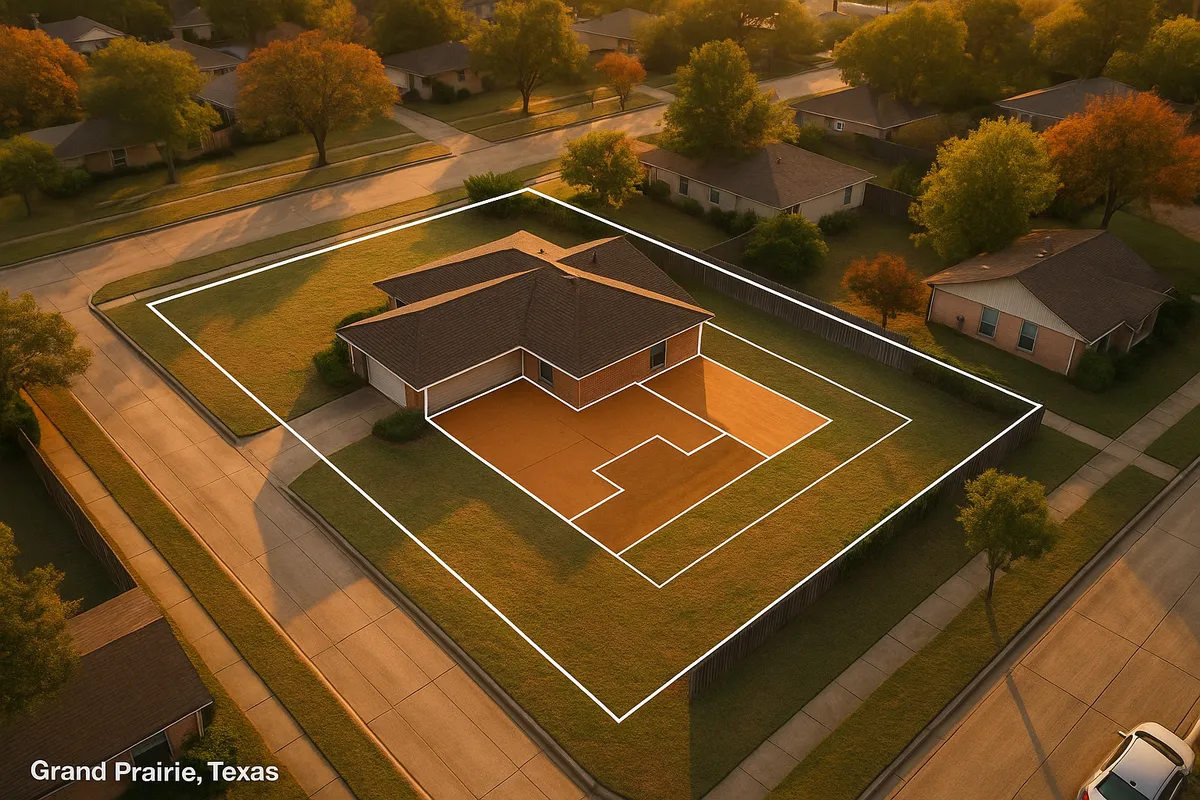
Residential Site Plans in Grand Prairie, TX: What Every Homeowner Needs to Know
Grand Prairie sits at the crossroads of Dallas and Tarrant counties, making it one of the Dallas-Fort Worth Metroplex's most uniquely positioned cities. With a population approaching 200,000 and rapid residential growth along corridors like SH-161 and I-20, the city's Development Services department stays busy reviewing permit applications year-round. Whether you are planning a new backyard deck, installing an in-ground pool, or converting your garage into a living space, Grand Prairie requires a properly drawn site plan as part of nearly every residential building permit application. Getting that site plan right the first time saves you weeks of back-and-forth with city reviewers.
What Is a Residential Site Plan and Why Does Grand Prairie Require One?
A residential site plan is a scaled, bird's-eye drawing of your property that shows the lot boundaries, existing structures, proposed construction, setbacks from property lines, driveways, easements, and any other features relevant to your project. Grand Prairie's Development Services department uses your site plan to confirm that what you are building complies with the city's Unified Development Code (UDC), zoning district requirements, and adopted building codes. Without an accurate site plan, reviewers cannot verify setbacks, lot coverage, or impervious surface limits, and your application will be returned incomplete.
Texas does not have a statewide residential building code mandate in the same way some states do, but Grand Prairie has adopted the International Building Code (IBC) and International Residential Code (IRC) through local ordinance, along with the National Electrical Code (NEC) and other model codes. You can review the International Code Council's model codes for technical reference.
Residential Permit Triggers in Grand Prairie
Most structural improvements to a home or lot in Grand Prairie require a building permit, and almost every permit requires a site plan. Common residential permit triggers include:
- Decks and patios: Any deck attached to the house or elevated more than 30 inches above grade requires a permit. Even ground-level detached patios over a certain square footage may trigger review.
- Accessory structures and sheds: Sheds and detached garages over 200 square feet generally require a permit. Smaller structures may still need to meet setback requirements.
- Swimming pools and spas: In-ground and above-ground pools over 24 inches deep require a permit and site plan showing required barrier/fence compliance.
- Fences: Fences over 6 feet in height require a permit. Front-yard fences and fences in corner-lot sight triangles have additional restrictions.
- Room additions: Any addition to the home's footprint requires a full permit package including a site plan, floor plan, and structural details.
- Accessory Dwelling Units (ADUs): Grand Prairie allows ADUs on qualifying single-family lots, but they must meet specific size limits, setbacks, and utility connection requirements.
- Driveways and impervious surfaces: New driveways or significant expansions require a permit, especially where they connect to a public street or affect drainage.
- Carport conversions and garage enclosures: Enclosing an existing carport or garage to create living space requires a permit and updated site plan.
Zoning Quirks and Notable Local Considerations
Grand Prairie's geography creates some unique planning considerations that homeowners should be aware of before submitting:
Dual-county jurisdiction: Grand Prairie straddles Dallas and Tarrant counties. While the city itself handles building permits, your county of record can matter for property records, deed restrictions, and floodplain administration.
FEMA floodplain zones: Portions of Grand Prairie, particularly areas near Joe Pool Lake, Mountain Creek Lake, and tributaries of the Trinity River system, lie within FEMA-designated Special Flood Hazard Areas (SFHAs). If your property is in a flood zone, your site plan must show finished floor elevations, and you may need an Elevation Certificate before a permit is issued. Check your flood zone status through the FEMA Flood Map Service Center.
HOA restrictions: Many Grand Prairie neighborhoods, especially newer master-planned communities, have HOA covenants that are stricter than city zoning. Always check with your HOA before submitting a city permit application. HOA approval does not replace city permits, and city permits do not override HOA rules.
Tree preservation: Grand Prairie has tree preservation provisions in its UDC. Significant trees on your lot may require protection during construction or mitigation if removal is necessary.
Impervious surface limits: Depending on your zoning district, there may be maximum lot coverage or impervious surface percentages. Adding a large patio, pool deck, or driveway extension can push you over these limits, so your site plan needs to calculate existing and proposed impervious coverage.
Typical Setback Requirements in Grand Prairie
Setbacks vary by zoning district, but the following ranges are typical for standard single-family residential (SF) districts in Grand Prairie:
- Front yard setback: 20 to 25 feet from the front property line (may be greater in larger-lot districts)
- Side yard setback: 5 to 7.5 feet for interior lots; corner lots typically require 15 feet on the street side
- Rear yard setback: 20 to 25 feet for the primary structure; accessory structures may be allowed closer, sometimes as little as 5 feet from the rear property line
- Accessory structure setbacks: Detached garages, sheds, and ADUs often have reduced setbacks compared to the main house, but must still clear utility easements
Always verify your specific district's setbacks in the Grand Prairie Unified Development Code before finalizing your site plan, as planned developments (PDs) and overlay districts can have different requirements.
The Grand Prairie Permit Submission Process
Grand Prairie's Development Services department handles residential building permit applications. As of 2026, the city offers both in-person and online permit submission options:
- Determine your project scope and zoning: Confirm your zoning district and any applicable overlay zones before drawing your site plan.
- Prepare your permit package: This typically includes a completed permit application, a to-scale site plan (usually 1 inch = 20 feet or similar), floor plans, construction details, and any required engineering or energy calculations.
- Submit online or in person: Grand Prairie uses an online permitting portal for many permit types. In-person submissions are accepted at the Development Services office at 300 W. Main Street, Grand Prairie, TX 75050.
- Plan review: Residential plan review in Grand Prairie typically takes 5 to 15 business days for straightforward projects. Complex projects, or those requiring floodplain review, can take longer. Expedited review may be available for an additional fee.
- Respond to comments: If reviewers identify deficiencies, you will receive a correction list. Address all comments and resubmit promptly to avoid further delays.
- Permit issuance and inspections: Once approved, your permit is issued and you can begin construction. Schedule required inspections (foundation, framing, final, etc.) through the city's inspection request system.
For the most current fee schedule and portal access, visit the Grand Prairie Development Services page.
Common Reasons Site Plan Applications Get Rejected
Based on common residential plan review patterns across DFW cities, Grand Prairie reviewers frequently return applications for these reasons:
- Missing or incorrect dimensions: Setback distances are not labeled, or the drawing is not to scale.
- No north arrow or scale bar: Reviewers need to orient the drawing and verify distances.
- Easements not shown: Utility, drainage, and access easements must appear on the site plan. These are shown on your property's recorded plat.
- Lot coverage not calculated: The site plan does not include a summary of existing and proposed impervious surface or lot coverage percentages.
- Structures placed in easements: Proposed sheds, pools, or additions are drawn inside utility easements where construction is not permitted.
- Incomplete project description: The application does not clearly describe the scope of work, making it impossible for reviewers to know what codes apply.
- Floodplain information missing: Properties in or near flood zones require additional elevation and floodplain data that is often omitted.
Get Your Grand Prairie Site Plan Right the First Time
Preparing an accurate, code-compliant site plan does not have to be complicated. Site Plan Creator is designed specifically for homeowners and small contractors who need a professional-quality site plan without hiring a surveyor or architect for a straightforward residential project. Our tool walks you through every required element, from lot boundaries and setbacks to easements and impervious surface calculations, so you can submit with confidence and avoid costly resubmittals. Start your Grand Prairie site plan today at siteplancreator.com and move your project forward.
Frequently Asked Questions
- Do I need a permit to build a deck in Grand Prairie, TX?
- Yes, most decks in Grand Prairie require a building permit. If the deck is attached to your home, or if it is detached but elevated more than 30 inches above grade, a permit is required under the International Residential Code as adopted by the city. Your permit application must include a site plan showing the deck's location, dimensions, and distance from all property lines. Ground-level patios made of pavers or concrete may also require a permit if they significantly increase your lot's impervious surface coverage. Contact Grand Prairie Development Services at (972) 237-8255 to confirm requirements for your specific project before starting any work.
- How long does it take to get a building permit approved in Grand Prairie?
- For standard residential projects in Grand Prairie, plan review typically takes 5 to 15 business days after a complete application is submitted. Straightforward permits like sheds or simple decks may be reviewed more quickly, while projects involving floodplain review, structural engineering, or complex zoning issues can take several weeks. If your application has deficiencies, the clock essentially resets when you resubmit corrected documents. Submitting a complete, accurate permit package, including a properly drawn site plan, is the single best way to avoid delays. Grand Prairie may also offer expedited review for an additional fee; check with Development Services for current availability.
- What does Grand Prairie require on a residential site plan?
- Grand Prairie's Development Services department expects a residential site plan to include the property's legal description and address, lot dimensions and total lot area, the location and dimensions of all existing structures, the location and dimensions of the proposed construction, setback distances from all property lines, any utility or drainage easements shown on the recorded plat, a north arrow, a graphic scale bar, and a lot coverage or impervious surface summary. For projects near floodplains, an Elevation Certificate or FEMA flood zone notation may also be required. The drawing should be legible and to scale, typically 1 inch equals 20 feet for most residential lots.
- Can I draw my own site plan in Grand Prairie, or do I need a licensed surveyor?
- For most standard residential projects in Grand Prairie, such as decks, sheds, pools, and fences, you are not required to hire a licensed surveyor or engineer to prepare your site plan. Homeowners and contractors can draw their own site plans as long as the drawing is accurate, to scale, and includes all required information. However, if your project involves structural engineering, is located in a FEMA floodplain, or requires a new survey because your property boundaries are unclear, a licensed professional may be necessary. Tools like Site Plan Creator can help you produce a professional-quality site plan from your property's plat without needing to hire a surveyor for routine projects.
- What are the setback requirements for a residential property in Grand Prairie?
- Setbacks in Grand Prairie vary by zoning district, but typical single-family residential lots require a front yard setback of 20 to 25 feet, interior side yard setbacks of 5 to 7.5 feet, a street side setback of 15 feet on corner lots, and a rear yard setback of 20 to 25 feet for the primary structure. Accessory structures like sheds and detached garages may be allowed closer to the rear and side property lines, sometimes as close as 5 feet, but they must not be placed within recorded utility easements. Always verify setbacks for your specific zoning district in Grand Prairie's Unified Development Code before finalizing your site plan.
- Do I need a permit to install a fence in Grand Prairie, TX?
- In Grand Prairie, fences over 6 feet in height require a building permit. Fences in the front yard and on corner lots near street intersections are subject to additional height and sight-triangle restrictions regardless of permit requirements. Even if your fence does not technically require a permit, it must still comply with the city's Unified Development Code and any applicable HOA rules. If you live in a neighborhood with a homeowners association, get HOA approval before installing any fence, since HOA covenants are often stricter than city regulations. A site plan showing the fence location relative to property lines is typically required with the permit application.
- What happens if I build without a permit in Grand Prairie?
- Building without a required permit in Grand Prairie can result in a stop-work order, fines, and a requirement to obtain an after-the-fact permit, which typically costs more and involves additional inspections. In some cases, unpermitted work that cannot be brought into compliance may need to be demolished at the owner's expense. Unpermitted structures can also create problems when you sell your home, as they may appear in title searches or fail to match your property's official records. Texas law and Grand Prairie's ordinances give the city authority to enforce these requirements, so it is always better to pull the permit before breaking ground.
- Does Grand Prairie allow accessory dwelling units (ADUs), and what are the rules?
- Grand Prairie does allow accessory dwelling units on qualifying single-family residential lots, but they are subject to specific regulations under the city's Unified Development Code. ADUs must generally be smaller than the primary residence, meet minimum lot size requirements, and comply with setback rules for the applicable zoning district. Utility connections, parking, and owner-occupancy requirements may also apply. A site plan showing the ADU's location, dimensions, and relationship to the primary structure and property lines is required with the permit application. Because ADU rules can vary significantly by zoning district, it is important to confirm your property's eligibility with Grand Prairie Development Services before investing in design or construction.
- Is my Grand Prairie property in a FEMA floodplain, and how does that affect my permit?
- Parts of Grand Prairie, especially areas near Joe Pool Lake, Mountain Creek Lake, and Trinity River tributaries, are located within FEMA-designated Special Flood Hazard Areas. If your property is in a flood zone, your building permit application will require additional information, including a site plan that shows finished floor elevations and may require an Elevation Certificate prepared by a licensed surveyor. Construction in a floodplain must comply with both Grand Prairie's floodplain management ordinance and FEMA requirements. You can check your property's flood zone status using the FEMA Flood Map Service Center at msc.fema.gov. Grand Prairie's Development Services department can also help you determine whether a floodplain development permit is required.
- How much does a residential building permit cost in Grand Prairie, TX?
- Permit fees in Grand Prairie are generally based on the valuation of the proposed construction or the type and size of the project. For small accessory structures and simple improvements, fees may range from around $50 to a few hundred dollars. Larger projects like room additions, pools, or ADUs will have higher fees calculated on construction valuation. Plan review fees are often included in the permit fee or charged separately. Fee schedules can change, so it is best to contact Grand Prairie Development Services directly or check the city's website for the current residential fee schedule before budgeting your project. Expedited review, if available, carries an additional surcharge.
How to Create a Site Plan in Grand Prairie
- Confirm Your Zoning and Flood Zone: Before drawing anything, look up your property's zoning district using Grand Prairie's online GIS mapping tools or by contacting Development Services. Identify your zoning district's setbacks, lot coverage limits, and any overlay zones. Also check the FEMA Flood Map Service Center to determine if your property is in a Special Flood Hazard Area, since floodplain properties require additional documentation and may face stricter construction standards.
- Gather Your Property Plat and Measurements: Obtain a copy of your property's recorded plat from the Dallas County or Tarrant County deed records office, or from your title company. The plat shows your lot dimensions, easements, and legal description, all of which must appear on your site plan. If you do not have a current survey, measure your lot and existing structures carefully, or hire a licensed surveyor to confirm boundaries before you draw your site plan.
- Draw Your Site Plan to Scale: Create a to-scale drawing of your property showing lot lines, all existing structures, the proposed project, setback distances from every property line, utility and drainage easements, driveways, and a north arrow with a scale bar. Include a lot coverage summary calculating existing and proposed impervious surfaces. Site Plan Creator makes this step straightforward by guiding you through each required element with built-in templates suited to Texas residential projects.
- Assemble Your Complete Permit Package: In addition to your site plan, Grand Prairie typically requires a completed permit application form, a project description, floor plans or construction drawings for the proposed work, and any required engineering calculations or energy compliance forms. For pools, you will need barrier and fencing details. For ADUs, additional documentation on utilities and parking may be required. Confirm the full checklist with Development Services before submitting to avoid an incomplete application rejection.
- Submit and Respond to Review Comments: Submit your permit package online through Grand Prairie's permitting portal or in person at the Development Services office at 300 W. Main Street. After submission, plan review typically takes 5 to 15 business days. If reviewers issue a correction list, respond to every comment thoroughly and resubmit promptly. Once approved, pay your permit fees, receive your permit, post it on-site, and schedule required inspections through the city's inspection request system as your project progresses.