Site Plan Requirements in Glendale, AZ (Permit Guide)
Glendale, Arizona homeowners need a site plan for most residential construction permits, from backyard pools to ADUs and room additions. This guide covers Glendale's permit triggers, setback rules, zoning quirks, and how to submit your application to the city's Building Safety division. Site Plan Creator makes it easy to produce a code-compliant site plan fast.
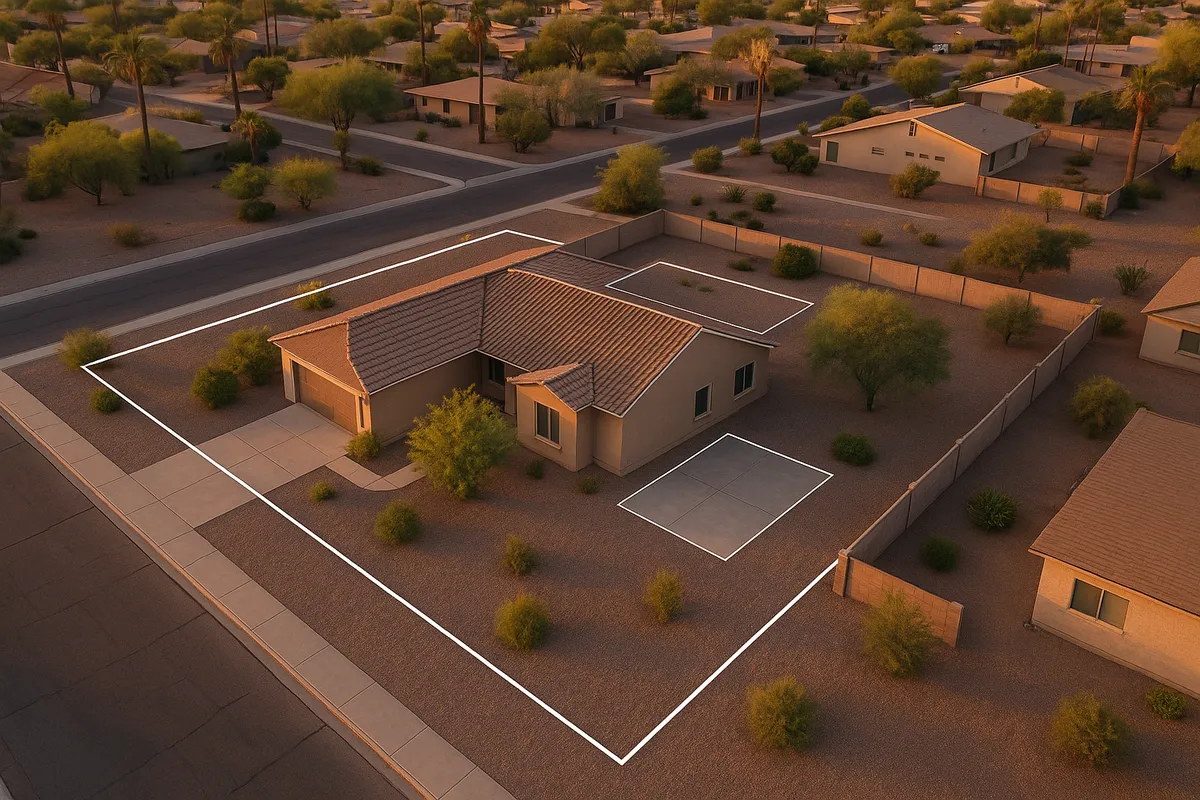
Residential Site Plans and Permits in Glendale, AZ
Glendale, Arizona is one of the fastest-growing cities in the West Valley of Maricopa County, and with that growth comes a steady stream of residential construction projects. Whether you are adding a covered patio to beat the summer heat, converting your garage into an accessory dwelling unit, or installing a swimming pool, the City of Glendale requires a building permit and, in nearly every case, a professionally prepared site plan. Understanding the local rules before you break ground can save you significant time, money, and frustration.
Glendale sits in a region with intense summer temperatures, frequent monsoon storms, and FEMA-mapped floodplain areas along the New River and Agua Fria River corridors. These environmental realities shape how the city reviews construction plans and why accurate, to-scale site plans matter so much here.
What Is a Residential Site Plan and Why Does Glendale Require One?
A residential site plan is a scaled, bird's-eye drawing of your property showing the lot boundaries, existing structures, proposed construction, setback distances, easements, utility locations, and drainage patterns. Glendale's Building Safety Division uses site plans to verify that your proposed project complies with the city's zoning code, the adopted 2018 International Building Code (IBC), and the 2018 International Residential Code (IRC) as amended by the State of Arizona.
Without an accurate site plan, plan reviewers cannot confirm setback compliance, lot coverage limits, or floodplain impacts. Submitting an incomplete or inaccurate site plan is one of the most common reasons permit applications are delayed or rejected in Glendale.
Residential Projects That Require a Permit in Glendale
Glendale's building code triggers a permit requirement for a wide range of common residential improvements. Below are the most frequent project types:
- Decks and Patios: Any attached or detached deck, covered patio, or ramada over 200 square feet requires a permit. Uncovered concrete slabs may also require a grading or drainage review.
- Storage Sheds: Detached accessory structures larger than 200 square feet require a permit. Smaller sheds may still need to meet setback requirements even without a full permit.
- Swimming Pools and Spas: All in-ground and above-ground pools deeper than 18 inches require a permit, a site plan, barrier/fencing plans, and electrical review. Arizona law mandates specific pool barrier requirements statewide.
- Fences and Block Walls: Fences over six feet in height, or any masonry block wall regardless of height, typically require a permit in Glendale.
- Room Additions: Any addition to a home's conditioned living space requires a full building permit, structural plans, and a site plan showing setbacks and lot coverage.
- Accessory Dwelling Units (ADUs): Glendale has adopted ADU-friendly regulations in response to Arizona state law (ARS Title 9). Detached and attached ADUs are permitted in single-family zones with specific size and setback requirements.
- Driveways and Curb Cuts: New driveways or modifications to existing driveways that involve a curb cut or significant impervious surface addition require a permit and often a drainage review.
- Solar Panels: Rooftop photovoltaic systems require an electrical and structural permit, though a simplified site plan showing panel placement on the roof is typically sufficient.
Glendale Zoning Quirks and Local Considerations
Glendale has several zoning and environmental factors that make local permit review distinct from other Valley cities:
Floodplain Overlay Zones
Portions of Glendale near the New River, Agua Fria River, and various retention basins fall within FEMA Special Flood Hazard Areas (SFHAs). If your property is in or near a floodplain, your site plan must include base flood elevation data, and construction may require elevation certificates. You can check your flood zone status using FEMA's Flood Map Service Center.
HOA Restrictions
Glendale has numerous master-planned communities and HOA-governed neighborhoods, particularly in the Arrowhead Ranch, Westgate, and Camelback Ranch areas. Your HOA may have architectural review requirements that are separate from and in addition to city permit requirements. Always check with your HOA before submitting to the city.
Historic Preservation
Glendale's historic downtown district and the Catlin Court neighborhood have additional design review requirements. Projects in these areas must be reviewed for compatibility with the historic character of the neighborhood before a building permit is issued.
Impervious Surface and Drainage
Maricopa County and the City of Glendale have adopted strict stormwater management rules. Adding large amounts of impervious surface (concrete, pavers, roofing) can trigger a drainage study requirement. Your site plan should clearly show how stormwater will be managed on your lot.
Typical Setback Requirements in Glendale
Setbacks in Glendale vary by zoning district, but the following ranges are typical for standard single-family residential (R1-6 and R1-8) zones:
- Front yard setback: 20 to 25 feet from the front property line
- Side yard setback: 5 to 10 feet (corner lots may have a 15-foot street-side setback)
- Rear yard setback: 15 to 25 feet
- Accessory structures (sheds, detached garages): Typically 5 feet from side and rear property lines
- Swimming pools: Generally 5 feet from any property line, measured to the water's edge
Always verify setbacks for your specific parcel and zoning classification with the Glendale Planning Division, as planned unit developments (PUDs) and older subdivisions may have custom setback requirements recorded with the plat.
How to Submit a Permit Application in Glendale
Glendale has invested in online permitting infrastructure, making it possible to submit many residential permit applications digitally. Here is how the process typically works:
- Determine your project type and required documents. Visit the Glendale Building Safety Division website to download the applicable checklist for your project.
- Prepare your site plan. Your site plan must be drawn to scale, show all property lines with dimensions, locate all existing and proposed structures, and clearly label setback distances. Tools like Site Plan Creator allow homeowners and contractors to produce compliant, to-scale site plans quickly without hiring a surveyor.
- Submit online or in person. Glendale accepts electronic plan submittals through its online permitting portal for most residential projects. In-person submittals are accepted at the Glendale Municipal Building at 5850 W. Glendale Ave.
- Pay permit fees. Fees are based on the valuation of the project. Residential permit fees in Glendale typically range from a few hundred dollars for simple projects to several thousand for large additions or new construction.
- Await plan review. Simple over-the-counter permits may be approved same-day. More complex projects, such as room additions and ADUs, typically take 10 to 20 business days for initial review.
- Schedule inspections. Once your permit is issued, you must schedule required inspections at key construction milestones (footing, framing, electrical rough-in, final).
Common Reasons Permit Applications Are Rejected in Glendale
Glendale plan reviewers flag incomplete or non-compliant applications regularly. The most common rejection reasons include:
- Site plan not drawn to scale or missing a north arrow and scale bar
- Missing or incorrect setback dimensions from proposed structures to property lines
- Lot coverage calculation not included or exceeding the maximum allowed (typically 40-50% in residential zones)
- No drainage or grading information shown on the site plan
- Pool barrier or fence details missing from pool permit applications
- ADU applications that do not address owner-occupancy declarations (where required)
- Structures shown in easements or utility corridors
Get Started with Site Plan Creator
Preparing a code-compliant site plan for a Glendale permit application does not have to be complicated or expensive. Site Plan Creator is an intuitive online tool designed specifically for homeowners, contractors, and small builders who need professional-quality, to-scale site plans without the cost of hiring a draftsperson. You can import your parcel data, add structures, label setbacks, and export a print-ready PDF in a fraction of the time it would take using traditional methods. Start your Glendale site plan today and move your project forward with confidence.
For official code references, the International Code Council (ICC) publishes the model codes adopted by Arizona and amended locally by Glendale.
Frequently Asked Questions
- Do I need a permit to build a shed in Glendale, AZ?
- In Glendale, Arizona, detached accessory structures such as storage sheds that exceed 200 square feet in floor area require a building permit and a site plan. Sheds under 200 square feet are generally exempt from a full permit, but they must still comply with zoning setback requirements, meaning they cannot be placed too close to your property lines. In most single-family residential zones in Glendale, accessory structures must be set back at least 5 feet from side and rear property lines. If your shed will have electrical wiring, a separate electrical permit is also required regardless of the shed's size. Contact the Glendale Building Safety Division to confirm requirements for your specific zoning district before you start construction.
- How long does it take to get a building permit approved in Glendale, AZ?
- Permit approval timelines in Glendale vary depending on the complexity of your project. Simple residential permits, such as a water heater replacement or a small patio cover, may be approved over the counter on the same day you apply. More involved projects, including room additions, swimming pools, and accessory dwelling units, typically go through a full plan review process that takes 10 to 20 business days for the initial review cycle. If the plan reviewer sends back correction comments, you will need to revise and resubmit, which adds additional time. Submitting a complete and accurate site plan from the start is the single most effective way to avoid delays in Glendale's permit review process.
- What are the setback requirements for residential properties in Glendale, AZ?
- Setback requirements in Glendale depend on your property's zoning classification, but for standard single-family zones such as R1-6 and R1-8, typical setbacks are: 20 to 25 feet for the front yard, 5 to 10 feet for interior side yards, 15 feet for the street-side yard on corner lots, and 15 to 25 feet for the rear yard. Swimming pools are generally required to be at least 5 feet from any property line, measured to the water's edge. Accessory structures like sheds and detached garages typically require a 5-foot setback from side and rear lines. Because planned unit developments and older subdivisions sometimes have custom setbacks recorded on the plat, always verify your specific parcel's requirements with the Glendale Planning Division before finalizing your site plan.
- Can I draw my own site plan for a Glendale permit, or do I need a licensed surveyor?
- For most standard residential permits in Glendale, Arizona, you are not required to hire a licensed land surveyor or architect to prepare your site plan. Homeowners and contractors can draw their own site plans as long as the plan is drawn to a recognized scale, includes all required elements (property lines with dimensions, north arrow, scale bar, existing and proposed structures, setback dimensions, and lot coverage calculation), and is legible. However, for complex projects such as new home construction, large additions, or projects in floodplain areas, a licensed engineer or architect may be required to stamp structural or drainage plans. Tools like Site Plan Creator make it straightforward to produce a professional, code-compliant site plan without specialized drafting software.
- How much does a building permit cost in Glendale, AZ?
- Building permit fees in Glendale are calculated based on the estimated construction valuation of your project, using a fee schedule adopted by the city. As a general guide, a simple project like a patio cover valued at around $5,000 might carry a permit fee in the range of $150 to $300. A swimming pool permit can run $400 to $800 or more. A room addition valued at $50,000 or higher could see permit fees of $1,000 to $2,500 including plan review charges. Additional fees may apply for electrical, plumbing, or mechanical permits tied to the same project. The Glendale Building Safety Division can provide an estimated fee based on your project's valuation before you formally submit your application.
- Do I need a permit to install a swimming pool in Glendale, AZ?
- Yes, a building permit is required for any swimming pool or spa in Glendale, Arizona, whether it is in-ground or above-ground and deeper than 18 inches. Your permit application must include a site plan showing the pool's location relative to all property lines and existing structures, pool barrier and fencing plans that comply with Arizona's statewide pool safety law (ARS Section 36-1681), electrical plans for the pump and lighting, and structural details for the pool shell. Arizona law requires a compliant barrier around all residential pools, and Glendale inspectors will verify barrier compliance before issuing a final inspection approval. Failing to obtain a pool permit can result in fines and a requirement to demolish the pool.
- What happens if I build without a permit in Glendale, AZ?
- Building without a required permit in Glendale is a serious code violation that can have lasting consequences. If the city discovers unpermitted work, a stop-work order can be issued immediately, halting all construction. You may be required to obtain a retroactive permit, which often involves opening walls or exposing work for inspection at your expense. Glendale can also assess civil penalties and fines for each day the violation continues. Unpermitted structures can complicate or prevent the sale of your home, since title companies and lenders typically flag unpermitted work during escrow. Homeowner's insurance may also deny claims related to damage caused by unpermitted construction. It is always less costly to get the permit before you build.
- What are the ADU rules in Glendale, AZ?
- Glendale, Arizona allows accessory dwelling units (ADUs) in single-family residential zones in alignment with Arizona state law under ARS Title 9, which limits the ability of cities to prohibit ADUs outright. In Glendale, both attached and detached ADUs are permitted subject to setback requirements, maximum size limits (typically capped at a percentage of the primary home's floor area or an absolute maximum square footage), and design standards intended to maintain neighborhood character. ADUs must have their own entrance and meet building code requirements for habitable space, including minimum ceiling heights, ventilation, and egress. Parking requirements may apply. Glendale does not currently require owner-occupancy for ADUs as of 2026, but regulations can change, so confirm current rules with the Glendale Planning Division.
- Where do I submit a site plan or permit application in Glendale, AZ?
- Glendale accepts residential permit applications both online and in person. Online submittals are processed through the city's electronic permitting portal, which allows you to upload your site plan, supporting documents, and pay fees digitally. This is the fastest option for most homeowners. In-person submittals are accepted at the Glendale Municipal Building located at 5850 W. Glendale Ave., Glendale, AZ 85301, during regular business hours. The Building Safety Division counter staff can answer basic questions about submittal requirements. For complex projects, it is advisable to schedule a pre-application meeting with a plan reviewer before formally submitting to identify any potential issues early in the process.
- Does my property in Glendale need a floodplain review before I can get a permit?
- Some properties in Glendale, Arizona are located within FEMA-designated Special Flood Hazard Areas (SFHAs), particularly near the New River, Agua Fria River, and various drainage channels and retention basins. If your parcel falls within or adjacent to a mapped floodplain, your building permit application will require a floodplain review. This may involve providing base flood elevation data, completing a floodplain development permit, and potentially obtaining an elevation certificate prepared by a licensed surveyor. Construction in a floodplain may also require the finished floor of any structure to be elevated above the base flood elevation. You can check your property's flood zone status using FEMA's Flood Map Service Center at msc.fema.gov before you apply.
How to Create a Site Plan in Glendale
- Confirm Your Permit Requirements: Visit the City of Glendale Building Safety Division website or call (623) 930-2800 to confirm whether your specific project requires a building permit and what documents are needed. Download the applicable submittal checklist for your project type. Knowing exactly what is required before you start preparing documents saves time and prevents incomplete submissions that trigger correction cycles.
- Prepare Your Site Plan: Create a to-scale site plan that shows your lot boundaries with dimensions, the location of all existing structures, the proposed new construction, setback distances from all property lines, easements, utility locations, and drainage flow direction. Use Site Plan Creator at siteplancreator.com to produce a professional, print-ready site plan quickly. Make sure to include a north arrow, scale bar, and lot coverage calculation, as these are commonly flagged as missing by Glendale plan reviewers.
- Gather Supporting Documents: Depending on your project, you may need additional documents beyond the site plan. These can include floor plans and elevations for additions or ADUs, pool barrier and fencing details for pool permits, electrical or mechanical plans, a drainage or grading plan if you are adding significant impervious surface, and proof of HOA approval if your neighborhood has an architectural review committee. Assemble all documents before submitting to avoid piecemeal corrections.
- Submit Your Application and Pay Fees: Submit your complete permit application through Glendale's online permitting portal or in person at 5850 W. Glendale Ave. Pay the applicable permit and plan review fees at the time of submission. Fees are based on the estimated construction valuation of your project. Keep your permit application number handy, as you will use it to track review status and schedule inspections.
- Respond to Plan Review Comments: Glendale plan reviewers will either approve your permit or issue a correction letter identifying deficiencies. If corrections are required, revise your site plan and supporting documents to address each comment specifically and resubmit promptly. Clear, detailed correction responses speed up the second review cycle. Most residential projects in Glendale are approved within one or two review cycles when the initial submittal is thorough.
- Schedule Required Inspections: Once your permit is issued, post it on site and begin construction. Schedule required inspections through the Glendale Building Safety Division at key milestones such as footing, framing, rough electrical and plumbing, and final inspection. Do not cover or conceal work before it has been inspected and approved. A final inspection approval and certificate of occupancy (where required) officially closes out your permit and confirms your project is code-compliant.