Site Plan Requirements in Garland, TX (Permit Guide)
Garland, Texas homeowners need a site plan for most residential construction projects, from backyard decks to accessory dwelling units. This guide covers Garland's permit triggers, setback rules, submission process, and how Site Plan Creator can help you get started fast.
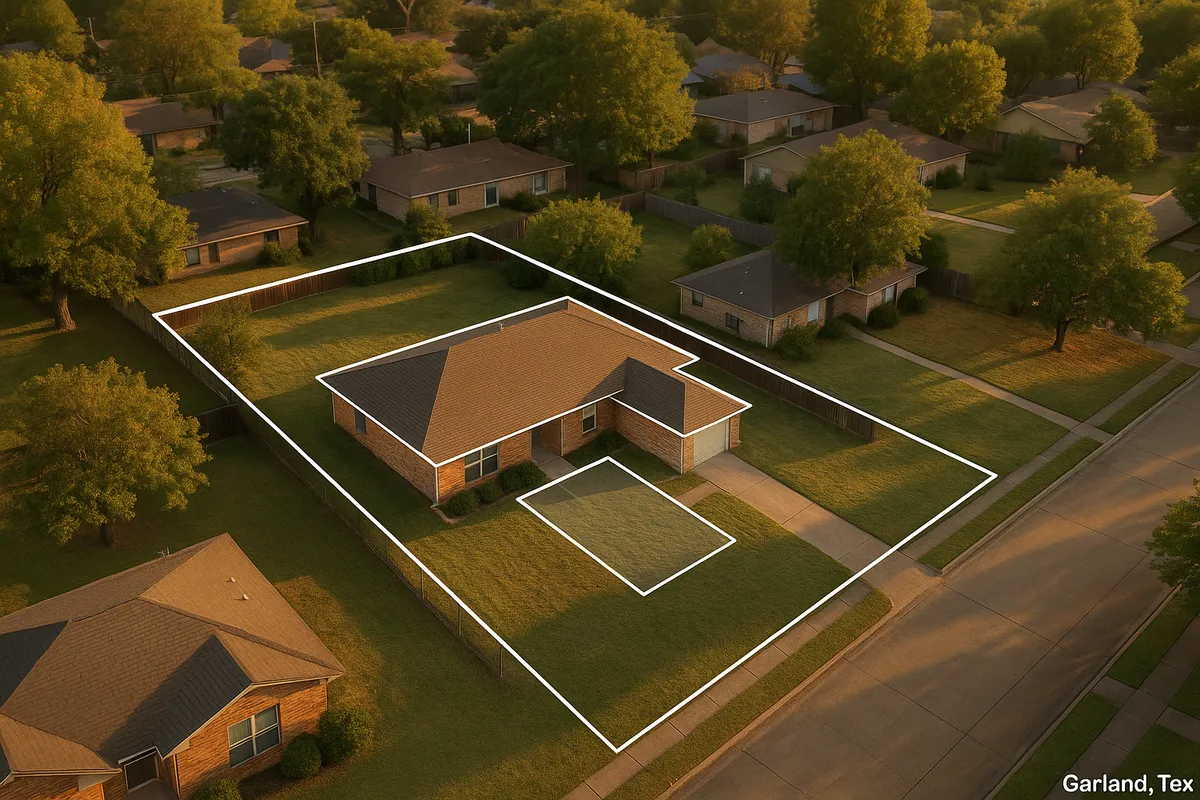
Residential Site Plans and Permits in Garland, TX
Garland, Texas is one of the Dallas-Fort Worth Metroplex's largest cities, home to more than 240,000 residents spread across a mix of established neighborhoods, newer subdivisions, and commercial corridors. As the city continues to grow and homeowners invest in backyard improvements, room additions, and accessory structures, understanding the local permitting process becomes essential. Whether you are planning a swimming pool in a Firewheel-area home or converting a garage into living space near downtown Garland, the City requires a compliant site plan before any building permit can be issued. Getting that document right the first time saves you weeks of back-and-forth with the Building Inspection Division.
What Is a Residential Site Plan and Why Does Garland Require One?
A residential site plan is a scaled, bird's-eye drawing of your property that shows the lot boundaries, existing structures, proposed construction, setback distances, utility easements, and other site features. Garland's Building Inspection Division uses your site plan to confirm that a proposed project meets the Garland Development Code before a permit is issued. The plan gives reviewers a clear picture of where a new structure sits in relation to property lines, neighboring homes, drainage patterns, and public rights-of-way. Without an accurate site plan, the City cannot verify zoning compliance, and your application will be returned.
Which Residential Projects Require a Permit in Garland?
Garland follows the 2021 International Building Code (IBC) and 2021 International Residential Code (IRC) as adopted by Texas, with local amendments. Most structural and many non-structural projects trigger a permit requirement. Common residential permit triggers include:
- Decks and patios: Any attached or detached deck more than 30 inches above grade requires a permit and a site plan showing location and setbacks.
- Sheds and accessory structures: Detached structures larger than 200 square feet generally require a permit. Smaller sheds may be exempt but must still comply with setback rules.
- Swimming pools and spas: All in-ground and above-ground pools deeper than 24 inches require a permit, a site plan, and barrier/fence documentation.
- Fences: Fences over six feet in height require a permit. Fences within certain setback areas or near corner lots have additional restrictions.
- Room additions: Any addition to the home's conditioned footprint requires a full permit package including a site plan, floor plan, and energy compliance documentation.
- Accessory Dwelling Units (ADUs): Garland allows ADUs in most single-family zones, but they require a permit, a site plan, and must meet specific size and setback standards.
- Driveways and impervious cover: New driveways or significant expansions may require a permit and must not push total impervious cover beyond allowable limits for the zoning district.
- Carports and garage conversions: Attached carports and garage-to-living-space conversions both require permits and updated site plans.
Garland Zoning Quirks and Local Considerations
Garland's zoning map includes a variety of single-family residential districts (SF-7, SF-10, and others), each with its own minimum lot size, setback, and coverage standards. A few local considerations are worth noting:
- Floodplain awareness: Portions of Garland lie within FEMA-designated Special Flood Hazard Areas, particularly near Rowlett Creek, Duck Creek, and Spring Creek. Projects in or near these areas may require a Floodplain Development Permit in addition to a standard building permit. Always check the FEMA Flood Map Service Center before finalizing your site plan.
- HOA overlay: Many Garland subdivisions, especially those built after 1990, have active homeowners associations with their own design standards. HOA approval is separate from city permitting but is often required before construction begins.
- Tree preservation: Garland has a tree preservation ordinance that protects certain heritage and significant trees. Removal of protected trees requires a separate review, and your site plan may need to document existing tree locations and canopy drip lines.
- Impervious cover limits: Adding hardscape, driveways, or structures can push a lot over its allowable impervious cover percentage. Reviewers will check your site plan math carefully.
- Corner lot setbacks: Homes on corner lots face street-side setbacks on two sides, which can significantly limit where accessory structures may be placed.
Typical Setback Requirements in Garland
Setbacks in Garland vary by zoning district and structure type, but the following ranges are typical for standard single-family residential zones:
- Front yard setback: 20 to 25 feet from the front property line (varies by district and subdivision plat)
- Rear yard setback: 5 to 20 feet depending on zoning district and structure type
- Interior side yard setback: 5 to 7.5 feet for principal structures; accessory structures may have reduced side setbacks of 3 to 5 feet if they meet height limits
- Street-side setback (corner lots): 15 to 20 feet from the side street right-of-way
- Accessory structures: Must generally be located in the rear yard and maintain a minimum 3-foot setback from side and rear property lines, though some districts require more
Always verify current setback requirements with the Garland Development Services Department, as individual plats and overlay districts can modify base zoning standards.
How to Submit a Permit Application in Garland
Garland has modernized its permitting process and accepts applications through its online portal as well as in person at the Development Services counter. Here is the general workflow:
- Determine your project scope and identify the correct permit type on the City's permit fee schedule.
- Prepare your site plan showing lot dimensions, existing structures, proposed work, setback distances, easements, and north arrow to scale.
- Gather supporting documents such as floor plans, elevation drawings, energy compliance forms, and contractor license information.
- Submit online or in person through the City of Garland Development Services portal or at 800 Main Street, Garland, TX 75040.
- Pay the plan review fee at submission. Fees are based on project valuation and permit type.
- Await plan review: Simple residential projects typically take 5 to 10 business days for initial review. More complex projects, or those requiring floodplain or zoning board review, can take 3 to 6 weeks.
- Respond to correction comments promptly if the reviewer requests changes to your site plan or supporting documents. Each resubmittal cycle adds additional review time.
- Schedule inspections at each required phase once your permit is issued.
Common Reasons Garland Permit Applications Get Rejected
Plan reviewers in Garland flag applications for a consistent set of issues. Avoid these common mistakes:
- Site plan is not drawn to scale or lacks a scale bar and north arrow
- Setback dimensions are missing or measured from the wrong reference point
- Proposed structure encroaches into a utility or drainage easement
- Impervious cover calculations are absent or exceed the district maximum
- Lot dimensions do not match the recorded plat
- Contractor information or state license numbers are missing from the application
- Floodplain designation is not addressed when the lot is in or near a FEMA flood zone
- Supporting drawings (floor plans, elevations) are inconsistent with the site plan
Get Started with Site Plan Creator
Preparing an accurate, to-scale residential site plan does not have to be complicated or expensive. Site Plan Creator gives Garland homeowners and contractors an easy-to-use online tool to draw professional site plans that meet local review standards. You can input your lot dimensions, place structures, annotate setbacks, and export a clean PDF ready for submission to the Garland Building Inspection Division. Whether you are tackling a backyard deck, a new pool, or an ADU project in 2026, Site Plan Creator helps you get your application right the first time and avoid costly resubmittal delays.
Frequently Asked Questions
- Do I need a permit to build a deck in Garland, TX?
- Yes, in most cases you need a building permit to construct a deck in Garland, Texas. The City of Garland requires a permit for any deck that is attached to the home or that stands more than 30 inches above finished grade. Your permit application must include a site plan showing the deck's location, dimensions, distance from all property lines, and distance from other structures on the lot. The site plan must be drawn to scale and include a north arrow. Decks that are low to the ground and detached from the house may sometimes be exempt, but you should confirm with the Garland Building Inspection Division before starting work, because setback rules still apply even to unpermitted structures.
- How much does a building permit cost in Garland, TX?
- Permit fees in Garland are based on the estimated valuation of the project. For most residential projects, you can expect a base plan review fee plus a permit issuance fee calculated as a percentage of construction value. As a rough benchmark, a deck or shed permit might run from $75 to $200, while a room addition or pool permit could range from $300 to $700 or more depending on project value. There may also be additional fees for floodplain review, zoning variances, or re-inspections. The City of Garland publishes a current fee schedule through its Development Services Department, and you can request a fee estimate before submitting your application.
- How long does it take to get a building permit approved in Garland?
- For straightforward residential projects like sheds, fences, and simple decks, Garland's Building Inspection Division typically completes an initial plan review within 5 to 10 business days of a complete application submission. More complex projects, such as room additions, swimming pools, or accessory dwelling units, can take 3 to 6 weeks, especially if the project requires floodplain review or a Board of Adjustment hearing. If the reviewer issues correction comments, each resubmittal cycle adds additional review time, usually 5 to 7 business days per round. Submitting a complete, accurate site plan with all required documents the first time is the single best way to minimize your approval timeline.
- What does Garland require on a residential site plan?
- A residential site plan submitted to Garland's Building Inspection Division should include: the lot boundaries with dimensions matching the recorded plat; the location and footprint of all existing structures on the property; the location and dimensions of the proposed project; setback distances measured from the proposed structure to all property lines; the location of utility and drainage easements; a north arrow; a graphic scale or stated scale; and the property address. For projects near floodplains, the site plan should also note the Base Flood Elevation and any FEMA flood zone designation. Pools require additional notation of barrier and fence locations. Missing any of these elements is one of the most common reasons applications are returned for correction.
- Can I draw my own site plan in Garland, or do I need a licensed surveyor?
- For most standard residential permits in Garland, Texas, you are not required to hire a licensed surveyor or engineer to prepare your site plan. Homeowners and contractors can draw their own site plans as long as the document is accurate, drawn to scale, and contains all required information. However, if your project is in a FEMA Special Flood Hazard Area, involves significant grading, or requires an elevation certificate, a licensed surveyor or engineer may be necessary for those specific components. Using an online tool like Site Plan Creator can help you produce a professional-quality, to-scale site plan without specialized drafting software, making the process much easier for homeowners handling their own permits.
- What are the typical setback requirements for residential properties in Garland, TX?
- Setbacks in Garland vary by zoning district, but typical single-family residential zones require a front yard setback of 20 to 25 feet from the front property line, rear yard setbacks of 5 to 20 feet, and interior side yard setbacks of 5 to 7.5 feet for the main structure. Accessory structures like sheds and detached garages are often allowed closer to rear and side property lines, sometimes as little as 3 feet, provided they meet height limits and are located in the rear yard. Corner lots face an additional street-side setback of 15 to 20 feet. Individual subdivision plats and overlay districts can modify these base standards, so always verify with the Garland Development Services Department before finalizing your plans.
- Where do I submit a permit application in Garland, TX: online or in person?
- Garland accepts building permit applications both online and in person. The City's online permitting portal allows homeowners and contractors to upload site plans, supporting documents, and pay fees without visiting City Hall, which is the fastest and most convenient option for most projects. In-person submissions are accepted at the Development Services counter located at 800 Main Street, Garland, TX 75040. The Building Inspection Division can be reached at (972) 205-2300 for questions about which submission method is best for your specific project type. Online submission is generally recommended because it creates a digital record of all correspondence and correction comments, making it easier to track your application's progress.
- What happens if I build without a permit in Garland, TX?
- Building without a required permit in Garland can lead to serious consequences. The City's Building Inspection Division has the authority to issue a stop-work order, which halts all construction immediately. You may be required to obtain a retroactive permit, which often involves paying double the standard permit fee plus additional investigation fees. In some cases, unpermitted work must be partially demolished so inspectors can verify code compliance with structural, electrical, or plumbing elements that are now hidden inside walls or underground. Unpermitted structures can also complicate home sales, since title companies and buyers' inspectors routinely check permit records. Additionally, your homeowner's insurance may deny claims related to damage caused by unpermitted construction.
- Does Garland, TX allow accessory dwelling units (ADUs) on residential lots?
- Yes, Garland allows accessory dwelling units in most single-family residential zoning districts, consistent with Texas state law that broadly permits ADUs statewide. An ADU in Garland must comply with the applicable zoning district's setback requirements, maximum lot coverage limits, and height restrictions. The ADU cannot exceed a certain percentage of the primary dwelling's square footage, and it must have its own utility connections or share them with the primary home in a code-compliant way. A building permit is required, and your application must include a site plan showing both the existing home and the proposed ADU, along with floor plans and elevation drawings. Contact the Garland Development Services Department to confirm current ADU size limits and any recent code amendments before designing your unit.
- Does Garland have floodplain rules that affect where I can build on my property?
- Yes, floodplain regulations are an important consideration for many Garland homeowners. Portions of the city lie within FEMA-designated Special Flood Hazard Areas (SFHAs), particularly near Rowlett Creek, Duck Creek, and Spring Creek. If your property is in or adjacent to a FEMA flood zone, you may need a Floodplain Development Permit in addition to a standard building permit. Structures in the floodplain must be elevated to or above the Base Flood Elevation, and certain types of development may be prohibited entirely within the floodway. You can check your property's flood zone status using the FEMA Flood Map Service Center at msc.fema.gov. The Garland Development Services Department also has floodplain staff who can answer questions specific to your parcel.
How to Create a Site Plan in Garland
- Confirm Your Permit Requirements: Before drawing anything, contact the City of Garland Building Inspection Division at (972) 205-2300 or visit the Development Services portal to confirm whether your specific project requires a permit and site plan. Identify your zoning district using the City's online zoning map so you know which setback standards, lot coverage limits, and height restrictions apply to your property. Also check whether your lot is in a FEMA flood zone, which adds an extra layer of review.
- Gather Your Property Documents: Collect your recorded plat or survey, which shows your lot's legal boundaries, dimensions, and any utility or drainage easements. You will also need the footprint dimensions of all existing structures on the property. If you do not have a recent survey, you can often obtain a copy of the recorded plat from the Dallas County Clerk's office or through the City of Garland's records. Accurate lot dimensions are essential because reviewers will compare your site plan against the official plat.
- Draw Your Site Plan to Scale: Using Site Plan Creator or other drafting software, draw your lot to scale and place all existing and proposed structures on the plan. Label all setback distances from the proposed project to each property line. Include a north arrow, a graphic or stated scale, the property address, and the locations of easements. For pools, add fence and barrier locations. For ADUs, show both the primary dwelling and the new unit. Export a clean PDF at a standard sheet size such as 24x36 or 11x17.
- Assemble Your Full Permit Package: In addition to the site plan, most Garland residential permits require supporting documents such as floor plans, framing or structural drawings, elevation drawings, energy compliance forms (Manual J or REScheck for conditioned space), and contractor license information. Pools require barrier documentation. Verify the complete checklist for your permit type on the Garland Development Services website so you do not submit an incomplete package, which will delay your review.
- Submit and Pay Fees: Submit your complete permit package through Garland's online permitting portal or in person at 800 Main Street, Garland, TX 75040. Pay the required plan review and permit fees at the time of submission. Keep a copy of your submission confirmation and fee receipt. If you submit online, you will receive email notifications when your application status changes, including when correction comments are posted or when your permit is ready for issuance.
- Respond to Comments and Schedule Inspections: If the plan reviewer issues correction comments, address each item carefully and resubmit your revised documents promptly. Once your permit is approved and issued, post the permit card at the job site as required. Schedule each required inspection phase through the City's inspection scheduling system. Common inspection stages include footing, framing, rough mechanical or electrical, and final. Do not cover work before it has been inspected and approved, as this can result in mandatory destructive inspections.