Site Plan Requirements in Garden Grove, CA (Permit Guide)
Garden Grove homeowners need a properly prepared site plan for most residential building permits, from ADUs and room additions to pools and fences. This guide covers Garden Grove's permit triggers, setback rules, submission process, and how Site Plan Creator can help you get approved faster.
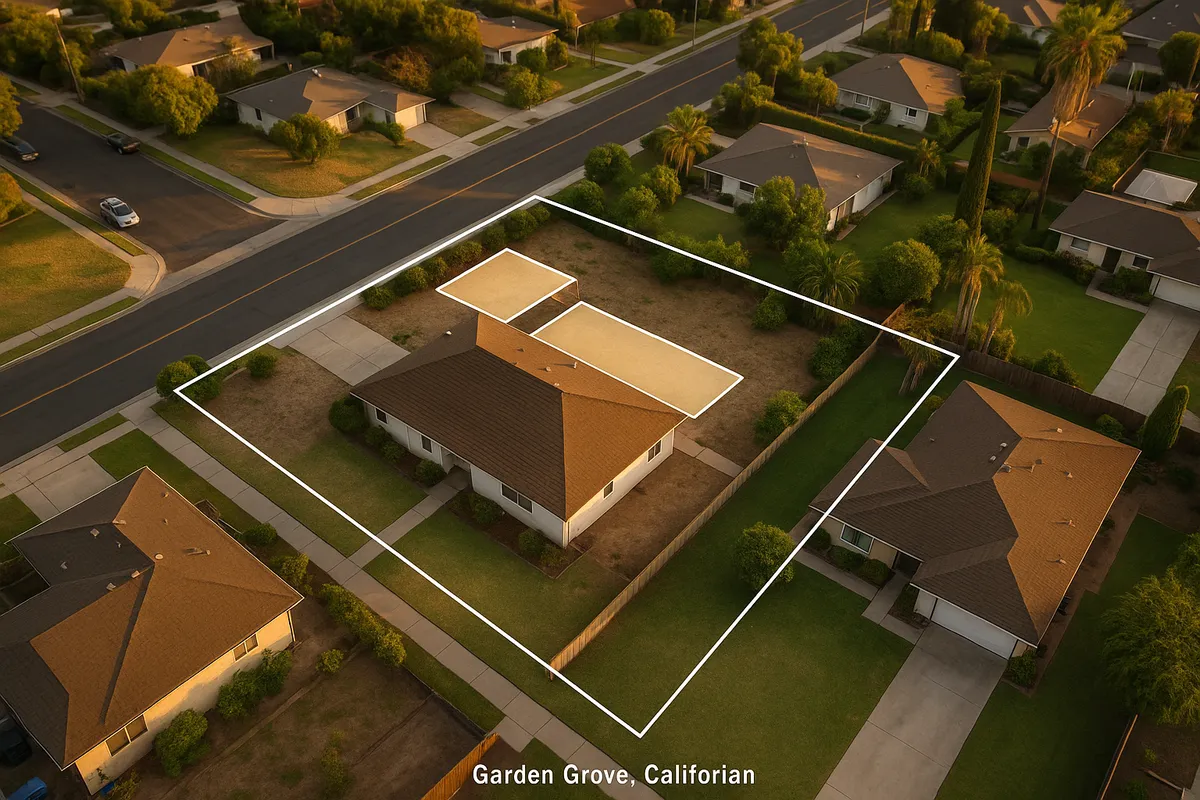
Residential Site Plans and Building Permits in Garden Grove, CA
Garden Grove is a densely developed city of roughly 170,000 residents in the heart of Orange County, and its neighborhoods reflect decades of residential growth that have left little room for error when it comes to property improvements. Whether you are converting a garage into a rental unit, adding a covered patio, or installing an in-ground pool, the city's Building and Safety Division requires a complete permit application that includes a residential site plan. Getting that document right the first time can be the difference between a smooth approval and weeks of back-and-forth with plan checkers.
What Is a Residential Site Plan and Why Does Garden Grove Require One?
A residential site plan is a scaled, bird's-eye drawing of your property showing the lot boundaries, existing structures, proposed improvements, driveways, easements, setbacks, and relevant dimensions. Garden Grove requires one because the city needs to verify that any new construction or modification complies with the California Building Code, local zoning ordinances, and Orange County flood-zone maps before a permit is issued.
Without a site plan, plan checkers cannot confirm that your proposed deck stays within the required setbacks, that your new ADU meets lot coverage limits, or that a pool does not encroach on a utility easement. A complete, accurate site plan protects you legally, speeds up review, and reduces the likelihood of costly corrections during construction.
Residential Permit Triggers in Garden Grove
Most property improvements in Garden Grove require a building permit and an accompanying site plan. Common residential permit triggers include:
- Room additions and second stories: Any addition of conditioned living space requires a full permit set, including a site plan showing existing and proposed footprints.
- Accessory Dwelling Units (ADUs) and Junior ADUs (JADUs): California state law has expanded ADU rights significantly, but Garden Grove still requires a site plan, floor plans, and elevations for every ADU application.
- Detached garages and accessory structures: Structures over 120 square feet generally require a permit. Even smaller sheds may require one depending on placement.
- Swimming pools and spas: In-ground pools always require a permit. Above-ground pools over a certain depth (typically 18 inches) may also trigger permit requirements.
- Patio covers, decks, and pergolas: Attached or detached patio covers and decks require permits when they exceed 200 square feet or are attached to the main dwelling.
- Fences and walls: Fences over 6 feet in height require a permit. Retaining walls over 4 feet (measured from the bottom of the footing) also require permits.
- Driveways and hardscape: New driveways or significant expansions of impervious surface may require a permit and must comply with the city's stormwater management requirements.
- Electrical, plumbing, and mechanical work: Any significant system upgrade or new installation requires its own permit, often paired with the site plan from the primary project.
Local Zoning Considerations for Garden Grove
Garden Grove's zoning code divides residential areas into several districts, most commonly R-1 (Single-Family Residential) and R-2/R-3 (multi-family zones). A few local quirks are worth knowing before you submit:
Lot coverage limits: Most R-1 lots in Garden Grove cap total lot coverage (all structures combined) at around 40 to 50 percent of the lot area. ADUs and accessory structures count toward this total, so it is critical to calculate coverage accurately on your site plan.
ADU-friendly rules: California's ADU statutes (Government Code Section 65852.2) have streamlined approvals considerably. Garden Grove must ministerially approve compliant ADUs, meaning discretionary review is largely off the table for standard ADU projects. However, your site plan still needs to show the ADU's relationship to the main dwelling, parking (if applicable), and utility connections.
Flood zones: Portions of Garden Grove fall within FEMA-designated Special Flood Hazard Areas, particularly near the Santa Ana River corridor. If your property is in a flood zone, you may need an Elevation Certificate and must meet base flood elevation requirements. Check the FEMA Flood Map Service Center to determine your property's flood zone designation.
HOA overlays: Many Garden Grove neighborhoods, particularly newer planned communities, have active Homeowners Associations with their own architectural review requirements. HOA approval does not replace city permits, but you may need both before breaking ground.
Historic resources: Garden Grove has a small historic district centered on its original downtown. Properties within or adjacent to designated historic resources may face additional review under the California Environmental Quality Act (CEQA).
Typical Setback Requirements in Garden Grove
Setbacks in Garden Grove vary by zoning district and lot configuration, but the following ranges are typical for standard R-1 single-family lots:
- Front yard setback: 20 to 25 feet from the front property line
- Interior side yard setback: 5 feet minimum (each side), with a combined total often required
- Street-side setback (corner lots): 10 feet from the side street property line
- Rear yard setback: 15 to 20 feet for main structures; accessory structures may be permitted closer to the rear property line (sometimes as close as 5 feet) under certain conditions
- ADU setbacks: State law allows ADUs to be placed as close as 4 feet from the side and rear property lines in most cases
Always verify the specific setbacks for your parcel through the Garden Grove Community and Economic Development Department, as corner lots, flag lots, and parcels with easements can have different requirements.
The Permit Submission Process in Garden Grove
Garden Grove's building permit applications are handled by the Community and Economic Development Department. As of 2026, the city accepts both in-person and electronic plan submittals for most residential projects.
Step-by-Step Overview
- Determine your project scope and confirm whether a permit is required by contacting the Building and Safety Division.
- Prepare your permit application package, including a completed application form, a scaled site plan, floor plans, elevations, and any required engineering or energy calculations (Title 24 compliance).
- Submit your application either in person at City Hall (11222 Acacia Parkway, Garden Grove, CA 92840) or through the city's online portal if available for your project type.
- Pay the plan check fee at the time of submission. Fees are based on the valuation of the project and the type of work.
- Wait for plan review. Standard residential plan check timelines in Garden Grove typically run 3 to 6 weeks for over-the-counter projects. Complex projects or those requiring corrections can take longer. ADU applications have a state-mandated 60-day review clock.
- Respond to correction notices promptly. If the plan checker identifies deficiencies, you will receive a correction list and must resubmit revised documents.
- Pick up your permit (or receive it electronically) and schedule inspections as work progresses.
Common Reasons Applications Get Rejected in Garden Grove
Understanding why applications fail can save you significant time. The most frequent issues include:
- Missing or inaccurate dimensions: Setbacks that are not clearly labeled or are measured from the wrong baseline are a leading cause of correction notices.
- Incorrect scale: Site plans that are not drawn to a recognized scale (1:20, 1:40, etc.) are routinely rejected.
- Failure to show all existing structures: Plan checkers need to see everything on the lot, not just the proposed improvement.
- Lot coverage not calculated: If your site plan does not include a lot coverage calculation, expect a correction.
- Missing easements: Utility, drainage, or access easements recorded on the title must appear on the site plan.
- Non-compliant ADU setbacks or height: ADU applications frequently fail because the design does not account for the 4-foot side/rear setback or the 16-foot height limit for detached ADUs.
- Incomplete Title 24 energy documentation: California's energy code requires compliance documentation for most permitted work involving the building envelope or mechanical systems.
Get Your Garden Grove Site Plan Right the First Time
Creating a code-compliant, accurately scaled site plan does not have to be a frustrating process. Site Plan Creator (siteplancreator.com) makes it straightforward for Garden Grove homeowners and contractors to produce professional-quality site plans that meet city requirements. Our intuitive tools let you draw your lot, place structures, label setbacks, and calculate lot coverage in a fraction of the time it would take with traditional CAD software. Start your Garden Grove site plan today and move your permit application forward with confidence.
Frequently Asked Questions
- Do I need a permit to build a deck or patio cover in Garden Grove?
- Yes. In Garden Grove, any attached patio cover or deck that exceeds 200 square feet, is attached to the main dwelling, or involves structural framing requires a building permit. Your application must include a site plan showing the deck's location on the lot, its dimensions, and its distance from all property lines. Even freestanding patio covers can require a permit depending on their size and proximity to the property line. The city's Building and Safety Division can confirm whether your specific project crosses the permit threshold. Submitting an accurate site plan at the start avoids the most common correction notices and helps you get your permit faster.
- How much does a building permit and site plan review cost in Garden Grove?
- Garden Grove calculates building permit fees based on the estimated valuation of the project. A plan check fee, typically 65 to 80 percent of the building permit fee, is collected at the time of application submittal. For a modest room addition valued around $50,000, total permit and plan check fees often fall in the $1,500 to $3,000 range. ADU projects may have additional fees for utility connections and school district impact fees. The site plan itself is not a city fee; it is a document you prepare and submit. Using a tool like Site Plan Creator can reduce the cost of producing that document significantly compared to hiring a drafter.
- How long does it take to get a building permit approved in Garden Grove?
- For straightforward residential projects, Garden Grove's Building and Safety Division typically completes an initial plan review in 3 to 6 weeks. ADU applications are subject to California's state-mandated 60-day review clock, meaning the city must act within 60 days of receiving a complete application. Projects that require corrections can add several additional weeks to the timeline, especially if the resubmittal is incomplete. Submitting a thorough, accurate application package including a properly scaled site plan is the single most effective way to shorten your approval timeline. Complex projects involving structural engineering or CEQA review may take considerably longer.
- What does Garden Grove require on a residential site plan?
- A Garden Grove residential site plan must be drawn to scale and include: the legal dimensions of the lot and all property lines; the location, footprint, and dimensions of all existing structures on the property; the proposed structure's footprint, dimensions, and distance from every property line; driveway and walkway locations; any recorded easements; north arrow and scale indicator; lot coverage calculation showing existing and proposed coverage as a percentage of total lot area; and the street name and address. For ADU projects, you must also show the relationship between the ADU and the primary dwelling, utility connection points, and any required parking. Missing any of these elements is a leading cause of plan check corrections.
- Can I draw my own site plan in Garden Grove, or do I need a licensed surveyor?
- For most standard residential permits in Garden Grove, including decks, patio covers, sheds, pools, and ADUs, you are not required to hire a licensed land surveyor or architect to prepare the site plan. You can draw it yourself or use an online tool like Site Plan Creator, provided the plan is accurate, drawn to a recognized scale, and includes all required elements. However, if your project involves structural work such as a room addition or second story, the city will also require plans stamped by a licensed California architect or structural engineer. For complex projects or properties with disputed boundaries, a licensed surveyor's boundary survey may be advisable.
- What are the setback requirements for a single-family home in Garden Grove?
- In Garden Grove's standard R-1 single-family residential zone, typical setbacks are 20 to 25 feet from the front property line, 5 feet from each interior side property line, 10 feet from a side street on corner lots, and 15 to 20 feet from the rear property line for the main dwelling. Detached accessory structures and ADUs may be permitted closer to the rear and side property lines. California state law allows detached ADUs to be placed as close as 4 feet from the rear and side property lines. Always confirm the specific setbacks for your parcel with Garden Grove's Community and Economic Development Department, since easements, lot shape, and overlay zones can affect the requirements.
- Where do I submit a site plan or permit application in Garden Grove?
- As of 2026, Garden Grove accepts residential permit applications both in person and, for eligible project types, through the city's online permitting portal. In-person submissions are made at the Building and Safety Division counter at Garden Grove City Hall, located at 11222 Acacia Parkway, Garden Grove, CA 92840. The division can be reached at (714) 741-5006. It is a good idea to call ahead or check the city's website to confirm current counter hours and whether your project type qualifies for electronic submittal. Bringing a complete package including your site plan, floor plans, energy calculations, and completed application form on your first visit will save significant time.
- What happens if I build without a permit in Garden Grove?
- Building without a required permit in Garden Grove can result in serious consequences. The city's code enforcement officers can issue a stop-work order, requiring all construction to halt immediately. You may be assessed double or triple the standard permit fee as a penalty for unpermitted work. Unpermitted structures can complicate or block the sale of your property, since buyers' lenders and title companies routinely flag unpermitted additions during escrow. In some cases, the city can require you to demolish unpermitted work entirely. Legalizing unpermitted construction after the fact often requires opening walls for inspection and is significantly more expensive and time-consuming than obtaining a permit upfront.
- What are the ADU rules in Garden Grove, and do I need a site plan?
- Garden Grove follows California state ADU law, which allows most single-family and multi-family properties to add at least one ADU and one Junior ADU. Detached ADUs can generally be up to 1,200 square feet, while JADUs are capped at 500 square feet and must be within the existing primary dwelling footprint. The city must ministerially approve compliant ADU applications within 60 days, without discretionary design review. Yes, a site plan is required for every ADU permit application. It must show the ADU's location on the lot, its setbacks from property lines (minimum 4 feet from side and rear), lot coverage, and utility connections. Site Plan Creator can help you prepare this document efficiently.
- Is my Garden Grove property in a FEMA flood zone, and does that affect my permit?
- Some parcels in Garden Grove, particularly those near the Santa Ana River and lower-lying areas, fall within FEMA-designated Special Flood Hazard Areas (SFHAs). If your property is in a flood zone, your building permit application will be subject to additional requirements, including compliance with base flood elevation standards and potentially an Elevation Certificate prepared by a licensed surveyor. Structures in SFHAs may need to be elevated or flood-proofed. You can check your property's flood zone status at the FEMA Flood Map Service Center at msc.fema.gov. Garden Grove's Building and Safety Division can also advise you on local floodplain management requirements before you submit your application.
How to Create a Site Plan in Garden Grove
- Confirm Your Permit Requirements: Contact Garden Grove's Building and Safety Division at (714) 741-5006 or visit the counter at City Hall to confirm whether your specific project requires a building permit and site plan. Describe the scope of work clearly, including the size, location, and type of structure. This step prevents wasted effort if your project falls below the permit threshold, and ensures you gather the correct application forms and submittal checklist before investing time in plan preparation.
- Prepare Your Scaled Site Plan: Using Site Plan Creator or comparable drafting software, draw your lot to scale showing all property lines with dimensions, existing structures, the proposed improvement, setback distances from every property line, easements, driveways, and a lot coverage calculation. Include a north arrow, scale bar, and your property address. Accuracy at this stage is critical: incorrect setback measurements or a missing easement are among the top reasons Garden Grove plan checkers issue correction notices.
- Assemble Your Full Application Package: In addition to the site plan, gather all required documents for your project type. Most Garden Grove residential permits require a completed permit application form, floor plans drawn to scale, exterior elevations, and California Title 24 energy compliance documentation. ADU applications also need to show utility connection points. Room additions and structural projects require plans stamped by a California-licensed architect or structural engineer. Having a complete package on your first submittal dramatically reduces review time.
- Submit and Pay Plan Check Fees: Submit your application package in person at the Garden Grove Building and Safety Division counter (11222 Acacia Parkway) or through the city's online portal if your project type qualifies. Pay the plan check fee at the time of submission. Fees are calculated based on the project's estimated valuation. Keep your receipt and application number, as you will need them to track the status of your review and respond to any correction notices.
- Respond to Plan Check Corrections: Garden Grove plan checkers typically complete an initial review in 3 to 6 weeks. If corrections are required, you will receive a written list of deficiencies. Address every item on the correction list before resubmitting. Common corrections involve setback labeling, missing lot coverage calculations, or incomplete energy documentation. Responding promptly and thoroughly to each correction shortens your overall approval timeline significantly.
- Obtain Your Permit and Schedule Inspections: Once your plans are approved, pick up your issued building permit or receive it electronically. Post the permit on site as required. Schedule required inspections through the Building and Safety Division at key milestones such as foundation, framing, rough electrical or plumbing, and final inspection. All required inspections must be completed and signed off before your project receives a final approval and Certificate of Occupancy if applicable.