Site Plan Requirements in Fullerton, CA (Permit Guide)
Fullerton, California homeowners need a properly prepared site plan for most residential building permits, from ADUs and room additions to pools and fences. This guide covers Fullerton's permit triggers, setback rules, submission process, and how Site Plan Creator can help you get your project approved faster.
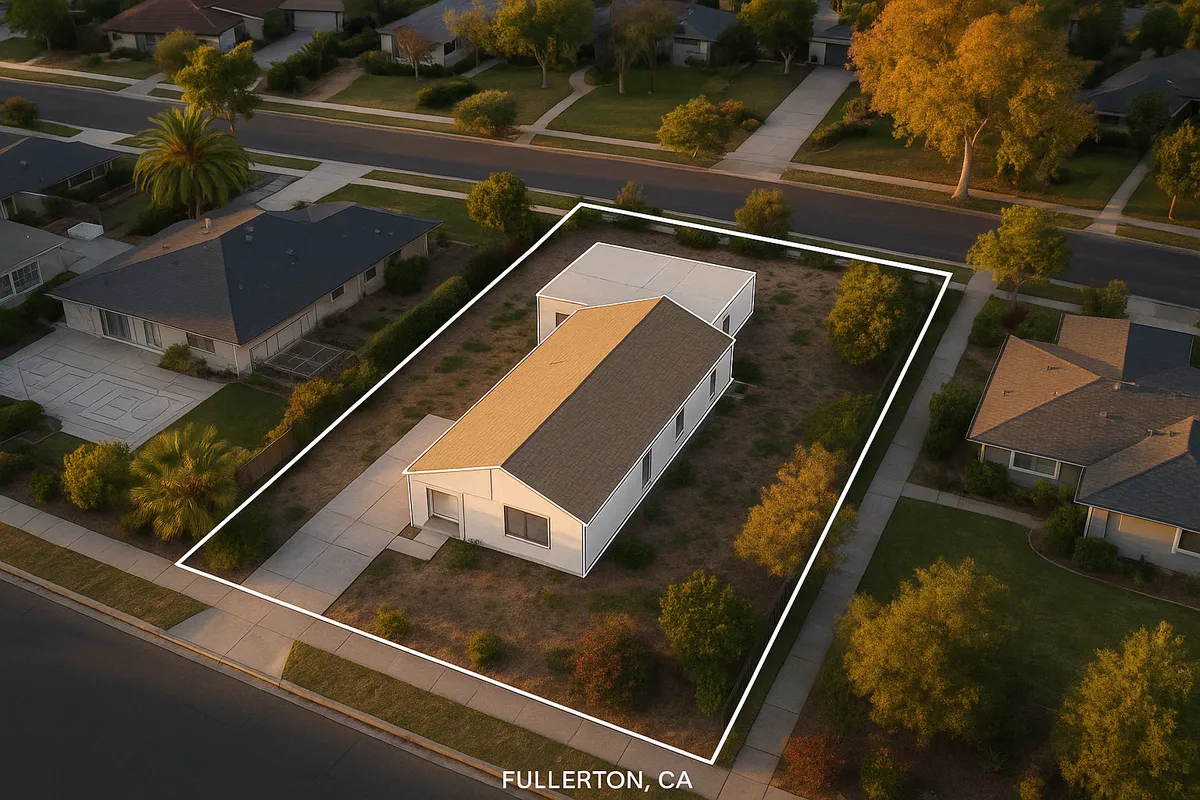
Residential Site Plans and Building Permits in Fullerton, CA
Fullerton is a vibrant city of roughly 140,000 residents in northern Orange County, known for its historic downtown, tree-lined neighborhoods, and a housing stock that ranges from Craftsman bungalows to mid-century ranch homes. Whether you are adding a detached garage, converting your basement into a living space, or installing a backyard pool, the City of Fullerton requires a building permit for most structural and site improvements. A key part of every permit application is a residential site plan: a scaled, bird's-eye drawing of your property that shows exactly where proposed and existing structures sit in relation to your lot lines, utilities, and neighboring properties. Without an accurate site plan, your permit application will be returned before it even reaches a plan checker.
What Is a Site Plan and Why Does Fullerton Require One?
A site plan (sometimes called a plot plan) is a scaled overhead drawing of your entire parcel. It documents the footprint of every structure on the lot, distances from structures to all property lines (setbacks), driveway and parking locations, easements, utility connections, and any grading or drainage features. Fullerton's Building Division requires a site plan because plan checkers must verify that your project complies with the City's Zoning Code, the California Building Code (CBC), and any applicable Orange County flood-zone or grading requirements before issuing a permit.
California adopted the 2022 California Building Code, which remains in effect in 2026, and Fullerton enforces it locally with amendments. You can review statewide building standards through the California Building Standards Commission.
Residential Permit Triggers in Fullerton
Not every home improvement requires a permit, but most structural or site-altering work does. Common residential permit triggers in Fullerton include:
- Room additions and second-story additions: Any addition that expands conditioned living space requires a full building permit and a detailed site plan showing the new footprint.
- Accessory Dwelling Units (ADUs) and Junior ADUs (JADUs): California's ADU laws (AB 68, SB 9, and subsequent legislation) have made ADUs a top permit category in Fullerton. A site plan must show the ADU footprint, setbacks, parking (if required), and utility connections.
- Detached garages, carports, and workshops: Structures over 120 square feet require a permit. Even smaller accessory structures may need one depending on zoning.
- Swimming pools and spas: In-ground pools always require a permit. Above-ground pools over a certain depth (typically 18 inches) also trigger permitting.
- Patio covers, pergolas, and decks: Attached patio covers and raised decks require permits. Freestanding structures over 200 square feet generally do as well.
- Fences and walls: Fences over 6 feet in height require a permit in most zones. Retaining walls over 4 feet (measured from the bottom of the footing) require both a building permit and structural calculations.
- Driveways and impervious surfaces: New or significantly expanded driveways may require a grading or encroachment permit, particularly where they connect to a public street.
- Solar panels and EV chargers: Roof-mounted solar and new electrical service upgrades require permits, though California's streamlined solar permitting process often simplifies the site plan requirements.
Zoning and Local Considerations in Fullerton
Fullerton's Zoning Code divides the city into several residential districts, including R-1 (single-family), R-2 (two-family), R-3 (medium-density multifamily), and R-4 (high-density multifamily). Each district carries its own setback, lot coverage, and height rules. A few local quirks are worth knowing:
- Historic districts: Fullerton has a designated historic downtown area and several historically significant residential neighborhoods. Properties within or adjacent to these areas may require review by the City's Planning Division before a building permit is issued, even for relatively minor exterior alterations.
- Hillside and slope considerations: Parts of Fullerton near the Puente Hills and the Coyote Hills area involve sloped terrain. Projects on lots with significant grade changes often require a soils report and grading plan in addition to a standard site plan.
- FEMA flood zones: Portions of Fullerton near the Santa Ana River and local flood-control channels fall within FEMA-designated Special Flood Hazard Areas. If your property is in one of these zones, your site plan must address finished floor elevations and may require a FEMA Elevation Certificate. You can look up your flood zone at the FEMA Flood Map Service Center.
- Lot coverage limits: In R-1 zones, total lot coverage (all structures combined) is typically capped at 40 percent of the lot area. Your site plan must calculate and display this coverage percentage.
- Tree preservation: Fullerton has a Heritage Tree Ordinance that protects certain large or historically significant trees. If your project involves removing or significantly trimming a heritage tree, you will need separate approval from the City's Public Works or Community Development Department.
Typical Setback Requirements in Fullerton
Setbacks in Fullerton vary by zoning district, but the following ranges are typical for standard R-1 single-family residential lots:
- Front yard setback: 20 feet (measured from the front property line to the nearest point of the structure)
- Side yard setbacks: 5 feet on each side for single-story structures; corner lots have a 10-foot street-side setback
- Rear yard setback: 20 feet for the primary dwelling; accessory structures may be permitted closer to the rear line (often 5 feet) depending on height and use
- ADU setbacks: Under current California law, ADUs that are converted from existing space may have no setback requirement; new detached ADUs must maintain at least 4 feet from side and rear property lines
Always confirm current setback requirements with the Fullerton Planning Division, as specific overlay zones, planned development agreements, or lot configuration can alter these standards.
How to Submit a Permit Application in Fullerton
The City of Fullerton processes residential building permits through its Community Development Department. Here is the general process:
- Determine your project type and requirements. Contact the Building Division or visit the City of Fullerton Community Development Department to confirm what documents are required for your specific project.
- Prepare your site plan and construction documents. Your site plan must be drawn to scale (typically 1 inch = 10 feet or 1 inch = 20 feet for residential lots), include a north arrow, show all existing and proposed structures, label dimensions and setbacks, and identify utilities and easements.
- Submit your application. Fullerton accepts permit applications online through its permit portal as well as in person at City Hall (303 W. Commonwealth Ave). Online submission has become the preferred method for straightforward residential projects.
- Pay plan check fees. Fees are calculated based on project valuation. Plan check fees are typically 65-80 percent of the building permit fee and are paid at the time of application.
- Await plan review. Standard residential plan review in Fullerton generally takes 2-4 weeks for over-the-counter projects and 4-8 weeks for more complex submittals. Incomplete applications or applications with errors are returned and restart the clock.
- Respond to correction comments. If the plan checker identifies deficiencies, you will receive a correction list. Revise your documents and resubmit promptly to avoid delays.
- Receive your permit and schedule inspections. Once approved, your permit is issued and you can begin work. Schedule required inspections through the City's inspection line at each milestone.
Common Reasons Applications Are Rejected in Fullerton
Plan checkers in Fullerton frequently return applications for the following reasons:
- Site plan is not drawn to scale or lacks a scale bar and north arrow
- Missing or incorrect setback dimensions from proposed structures to all four property lines
- Lot coverage calculation is absent or exceeds the zoning limit
- ADU application does not address owner-occupancy status or utility connections
- Grading or drainage plan is missing for sloped lots
- Structures are shown encroaching into easements or flood-zone setbacks
- Project description on the application does not match the scope shown on the drawings
Get Started with Site Plan Creator
Preparing an accurate, to-scale site plan does not have to be complicated or expensive. Site Plan Creator is an easy-to-use online tool designed specifically for homeowners and small contractors who need professional-quality residential site plans for permit applications. You can input your parcel dimensions, place structures, label setbacks, and generate a print-ready PDF that meets Fullerton's Building Division requirements. Skip the back-and-forth with plan checkers and get your Fullerton permit application right the first time.
Frequently Asked Questions
- Do I need a permit to build a deck or patio cover in Fullerton, CA?
- Yes, in most cases. Attached patio covers and raised decks in Fullerton require a building permit regardless of size because they are considered structural additions to the home. Freestanding patio covers or pergolas over 200 square feet also typically require a permit. Your permit application must include a site plan showing the structure's footprint, its distance from all property lines, and the overall lot coverage percentage. Unpermitted decks and patio covers can create problems when you sell your home, since a home inspection or title search may flag the unpermitted work, potentially requiring costly retroactive permitting or removal.
- What are the setback requirements for a single-family home in Fullerton?
- In Fullerton's standard R-1 single-family zone, the typical setbacks are 20 feet from the front property line, 5 feet from each interior side property line, and 20 feet from the rear property line for the primary dwelling. Corner lots must maintain a 10-foot setback from the street-side property line. Accessory structures like detached garages or sheds may be allowed closer to the rear and side lines, often as little as 5 feet, depending on their height and use. ADUs built under California state law must maintain at least 4 feet from side and rear lines. Always verify your specific parcel's setbacks with the Fullerton Planning Division, as overlay zones and planned development agreements can alter these standard figures.
- How long does it take to get a building permit approved in Fullerton?
- Plan review timelines in Fullerton vary by project complexity. Simple over-the-counter projects, such as small accessory structures or basic electrical work, can sometimes be approved the same day or within a few business days. Standard residential projects, including room additions, ADUs, and pools, typically take 2 to 4 weeks for an initial plan check. More complex submittals, such as new construction or projects requiring Planning Division review, can take 4 to 8 weeks or longer. If your application is returned with correction comments, the clock effectively resets on the resubmittal. Submitting a complete, accurate application with a properly prepared site plan is the single best way to avoid delays.
- How much does a site plan cost for a permit application in Fullerton?
- The cost of a site plan in Fullerton depends on how you obtain it. Hiring a licensed land surveyor to produce a boundary and topographic survey can cost anywhere from $800 to $2,500 or more, depending on lot size and complexity. A draftsperson or architect may charge $300 to $800 to draw a basic residential site plan from existing survey data. Online tools like Site Plan Creator offer a much more affordable option, often under $100, allowing homeowners to create a to-scale, permit-ready site plan themselves using their property's dimensions. In addition to the site plan itself, Fullerton charges plan check fees based on project valuation, typically 65 to 80 percent of the building permit fee, which is calculated separately.
- What needs to be on a residential site plan submitted to Fullerton?
- Fullerton's Building Division requires that a residential site plan include: a north arrow and graphic scale bar; the lot's legal dimensions and total square footage; the footprint and dimensions of all existing structures on the property; the footprint and dimensions of all proposed new structures; labeled setback distances from every structure to all four property lines; driveway location and dimensions; utility connections including water, sewer, and gas; any easements or rights-of-way on the parcel; and a lot coverage calculation showing the percentage of the lot covered by all structures combined. For projects in FEMA flood zones, finished floor elevations must also be noted. Plans should generally be drawn at a scale of 1 inch equals 10 or 20 feet.
- Can I draw my own site plan in Fullerton, or do I need a licensed surveyor?
- For most standard residential permit applications in Fullerton, you are not required to hire a licensed land surveyor or architect to prepare your site plan. Homeowners and contractors can prepare their own site plans as long as the drawing is accurate, to scale, and includes all required information. However, if your project involves significant grading, complex structural work, or is located in a FEMA Special Flood Hazard Area, a licensed civil engineer or surveyor may be required for specific portions of the submittal. Online tools like Site Plan Creator are designed for exactly this situation, allowing non-professionals to produce clean, accurate, permit-ready site plans without expensive professional fees.
- What are the ADU rules in Fullerton, CA, and what does my site plan need to show?
- Fullerton follows California state ADU law, which has significantly expanded homeowners' rights to build accessory dwelling units. In most R-1 and R-2 zones, you can build at least one ADU and one Junior ADU (JADU) on a single-family lot. New detached ADUs must maintain a minimum 4-foot setback from side and rear property lines. ADUs converted from existing permitted space, such as a garage conversion, may have no setback requirement at all. Your site plan must show the ADU's footprint, its setbacks, parking provisions (if applicable), utility connections, and its relationship to the primary dwelling. Height limits for detached ADUs are generally 16 feet, or up to 18 feet on lots near transit. The Fullerton Planning Division can confirm current ADU standards for your specific parcel.
- What happens if I build without a permit in Fullerton?
- Building without a required permit in Fullerton can result in significant consequences. The City's Code Enforcement Division has the authority to issue a stop-work order, requiring all construction to halt immediately. You may be required to obtain a retroactive permit, which typically costs more than a standard permit and requires exposing completed work for inspection. In some cases, unpermitted work that cannot be brought into compliance must be demolished at the owner's expense. Unpermitted improvements can also complicate or delay the sale of your home, since lenders and buyers often require that all work be properly permitted. California law also allows municipalities to assess fines for code violations, so the financial risk of skipping the permit process far outweighs the short-term convenience.
- Where do I submit a permit application in Fullerton - online or in person?
- Fullerton accepts residential building permit applications both online and in person. The City's online permit portal, accessible through the Community Development Department's website at cityoffullerton.com, is the preferred method for most straightforward residential projects and allows you to upload your site plan and supporting documents digitally. In-person submissions are accepted at the Building Division counter at City Hall, located at 303 W. Commonwealth Ave, Fullerton, CA 92832. For complex projects or if you have questions about submittal requirements, an in-person pre-application meeting with a plan checker can save time. The Building Division's general phone line is (714) 738-6547.
- Does Fullerton have any historic district rules that affect my building permit?
- Yes. Fullerton has a historic downtown area and several historically significant residential neighborhoods, and properties within or adjacent to these areas may be subject to additional review. If your home is a designated historic landmark or is located in a historic overlay zone, exterior alterations, additions, and even some interior changes may require review and approval from the City's Planning Division or a Historic Preservation Committee before a building permit can be issued. This review is separate from the standard building permit plan check process and can add several weeks to your project timeline. Homeowners should check with the Fullerton Planning Division early in their project planning to determine whether historic preservation rules apply to their property.
How to Create a Site Plan in Fullerton
- Confirm Your Permit Requirements: Before drawing anything, contact the City of Fullerton Building Division at (714) 738-6547 or visit the Community Development Department online to confirm exactly what permits and documents your specific project requires. Project type, zoning district, lot size, and proximity to flood zones or historic districts can all affect what you need to submit. Getting clarity upfront prevents wasted effort and costly resubmittals later.
- Gather Your Property Information: Collect your property's legal dimensions, existing survey data, and any recorded easements or rights-of-way. You can often find parcel information through the Orange County Assessor's website or your property's title documents. Accurate lot dimensions are the foundation of a correct site plan. If you do not have a recorded survey, you may need to pace off or measure your lot boundaries, or hire a surveyor for complex parcels.
- Create Your To-Scale Site Plan: Use Site Plan Creator or drafting software to draw your site plan to a standard scale (1 inch = 10 or 20 feet is typical for residential lots in Fullerton). Include all existing structures, the proposed new structure's footprint, setback dimensions to all four property lines, driveway location, utility connections, easements, a north arrow, a scale bar, and a lot coverage calculation. Make sure all labels are legible and dimensions are clearly marked.
- Assemble and Submit Your Application: Compile your completed site plan, construction drawings, project description, and any required supplemental documents (such as a soils report for sloped lots or a FEMA Elevation Certificate for flood-zone properties). Submit your application through Fullerton's online permit portal or in person at City Hall, 303 W. Commonwealth Ave. Pay the plan check fee at the time of submission. Keep copies of everything you submit.
- Respond to Plan Check Comments: Fullerton's plan checkers typically complete an initial review within 2 to 4 weeks for standard residential projects. If corrections are required, you will receive a written correction list. Address each comment carefully, revise your site plan and documents as needed, and resubmit promptly. Incomplete or slow responses to correction comments are the most common cause of extended permit timelines in Fullerton.
- Obtain Your Permit and Schedule Inspections: Once your application is approved, pay the remaining permit fee and receive your issued building permit. Post the permit card visibly at the job site as required. Schedule required inspections with the City's inspection line at each construction milestone, such as foundation, framing, and final inspection. Work must not be covered before the relevant inspection is passed. A final inspection and sign-off closes out your permit and confirms your project is code-compliant.