Site Plan Requirements in Fremont, CA (Permit Guide)
Fremont, CA homeowners need a compliant site plan for most residential building permits, from ADUs and room additions to decks and pools. This guide covers Fremont's permit triggers, setback rules, zoning quirks, and how to submit your application to the city's Building and Safety Division. Site Plan Creator makes it easy to generate a professional, permit-ready site plan in minutes.
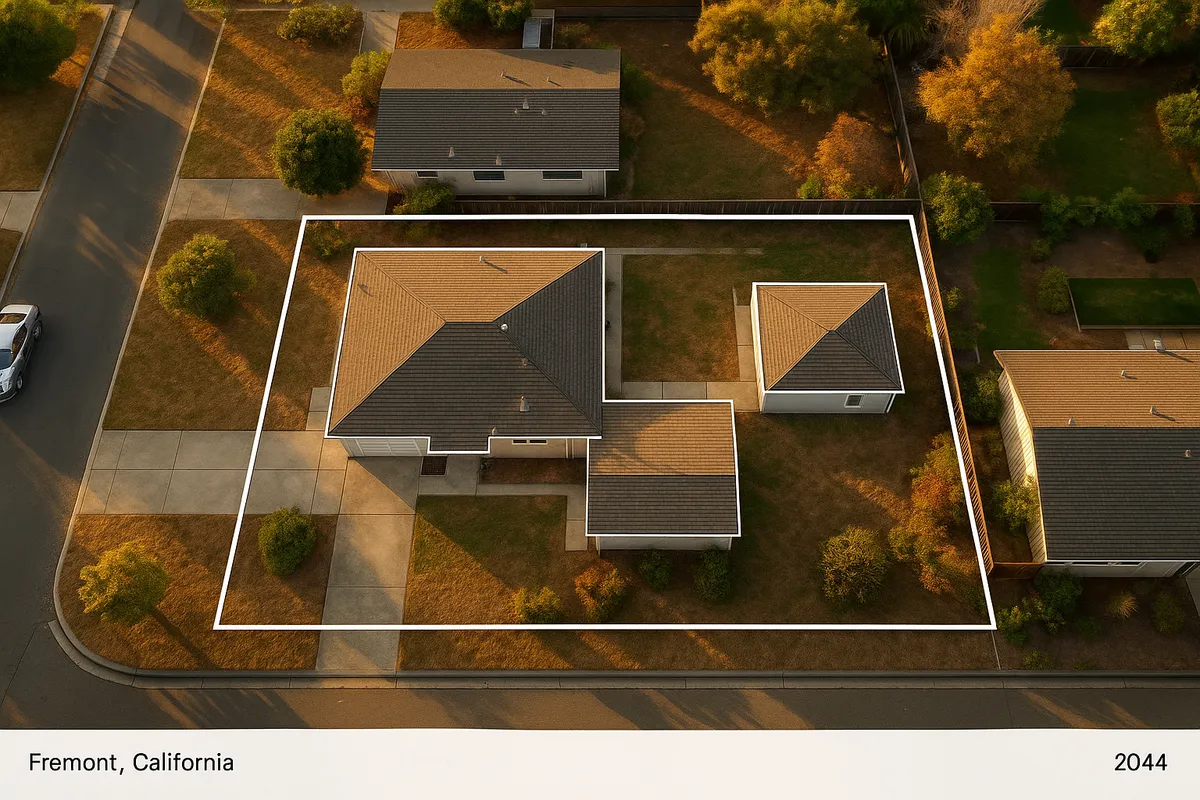
Residential Site Plans and Building Permits in Fremont, CA
Fremont is one of the Bay Area's largest cities, spanning nearly 90 square miles across Alameda County and encompassing diverse neighborhoods from the flat Irvington and Mission San Jose districts to the hillside communities near the Fremont Hills. With a booming housing market, a strong push for accessory dwelling units (ADUs), and strict California Building Code standards, getting your residential project permitted correctly in Fremont matters more than ever in 2026. Whether you are adding a backyard deck, converting your garage into a living space, or building a brand-new ADU, you will almost certainly need a site plan before the city will issue a building permit.
What Is a Residential Site Plan and Why Does Fremont Require One?
A residential site plan is a scaled, bird's-eye drawing of your property that shows the lot boundaries, existing structures, proposed construction, setbacks from property lines, driveways, utility easements, and other relevant site features. Fremont's Building and Safety Division requires a site plan as part of virtually every building permit application because it allows plan reviewers to verify that your project complies with the city's zoning ordinance, the California Building Code, and any applicable state or local regulations.
Without an accurate site plan, the city cannot confirm that your proposed structure respects required setbacks, does not encroach on easements, and meets impervious surface limits. A missing or inaccurate site plan is one of the most common reasons permit applications are returned or delayed in Fremont.
Common Residential Permit Triggers in Fremont
The following projects almost always require a building permit and a site plan in Fremont:
- Accessory Dwelling Units (ADUs) and Junior ADUs (JADUs): California state law has dramatically streamlined ADU permitting, but Fremont still requires a complete site plan showing the ADU's footprint, setbacks, and relationship to the primary dwelling.
- Room additions and home expansions: Any addition that increases the habitable square footage of your home triggers a permit and full plan review.
- Attached or detached garages: New garages or garage conversions require a site plan showing placement relative to property lines.
- Decks and patios: Attached decks over 30 inches above grade require a permit. Even ground-level decks may require one depending on size and attachment.
- Swimming pools and spas: In-ground pools and spas always require a permit. The site plan must show the pool's location, setbacks, and required barrier fencing.
- Fences and walls: Fences over 6 feet in height (or over 3.5 feet in the front yard setback area) require a permit in Fremont.
- Sheds and accessory structures: Detached structures over 120 square feet require a permit. Smaller sheds may still need a zoning clearance.
- Driveways and hardscape: New driveways or significant expansions of impervious surface may require a permit and a stormwater compliance review under Alameda County's C.3 requirements.
Fremont Zoning Quirks and Local Considerations
Fremont's zoning landscape has several features that can trip up homeowners who are not familiar with local rules.
Hillside and geologic hazard zones: Portions of Fremont, particularly near the Mission Hills and Fremont Hills, fall within geologic hazard overlay zones. Projects in these areas may require a soils report or geotechnical review in addition to a standard site plan.
FEMA flood zones: Parts of Fremont near Alameda Creek and the San Francisco Bay shoreline are mapped within FEMA Special Flood Hazard Areas. If your property is in a flood zone, your site plan must address finished floor elevation and may require an Elevation Certificate. You can check your flood zone status at the FEMA Flood Map Service Center.
Impervious surface and stormwater: Fremont follows Alameda County's Municipal Regional Stormwater Permit (MRP) requirements. Projects that add 500 square feet or more of impervious surface may need to incorporate Low Impact Development (LID) stormwater controls, which must be shown on the site plan.
Historic resources: The Niles district and portions of the Mission San Jose neighborhood contain historically significant properties. Projects on or adjacent to historic resources may require additional review by the city's Planning Division.
HOA restrictions: Many Fremont neighborhoods, particularly newer master-planned communities, have Homeowners Association (HOA) CC&Rs that impose additional setback, design, and material standards beyond what the city requires. Always check with your HOA before submitting a permit application.
Typical Setback Requirements in Fremont
Setbacks in Fremont vary by zoning district, but the following ranges apply to most standard single-family residential (RS) zones:
- Front yard setback: Typically 15 to 20 feet from the front property line
- Side yard setback: Generally 5 feet for interior side yards; corner lots may require 10 feet on the street side
- Rear yard setback: Commonly 20 feet for primary structures; ADUs may be permitted as close as 4 feet to rear and side property lines under California state law
- Garage setback from alley: Usually 5 feet minimum
These are general ranges. Always verify the exact setbacks for your specific parcel and zoning designation by contacting Fremont's Planning Division or reviewing the Fremont Municipal Code before finalizing your site plan.
How to Submit a Permit Application in Fremont
Fremont's Building and Safety Division handles residential building permits. As of 2026, the city offers both online and in-person submission options.
Step 1: Determine Your Permit Type
Visit the Fremont Building and Safety Division to identify the correct permit type for your project. Fremont uses a tiered permit system, and some minor projects may qualify for an over-the-counter (OTC) approval.
Step 2: Prepare Your Application Package
A typical residential permit application in Fremont includes:
- Completed permit application form
- A scaled site plan (usually 1 inch = 20 feet for residential lots)
- Construction drawings (floor plans, elevations, structural details)
- Title 24 energy compliance documentation (for additions and ADUs)
- Soils or geotechnical report (if in a hillside or hazard zone)
Step 3: Submit and Pay Fees
Applications can be submitted through Fremont's online permitting portal or in person at City Hall. Permit fees are calculated based on the project's valuation. Plan review fees are typically collected at submission.
Step 4: Plan Review
For standard residential projects, Fremont's plan review timeline is generally 4 to 6 weeks for an initial review. ADU applications may qualify for expedited review under California state law, with a 60-day statutory deadline for the city to act. Complex projects, corrections, or resubmittals will extend the timeline.
Step 5: Permit Issuance and Inspections
Once approved, your permit is issued and construction may begin. Fremont requires inspections at key milestones (foundation, framing, insulation, final). Keep your approved site plan and drawings on site at all times during construction.
Common Reasons Permit Applications Are Rejected in Fremont
Understanding why applications get sent back can save you weeks of delay:
- Missing or unscaled site plan: The most frequent issue. Your site plan must be drawn to scale and show all required dimensions.
- Setback violations: Proposed structures that do not meet the required setbacks for the zoning district.
- Incomplete energy compliance: Missing or incorrect Title 24 calculations for additions or ADUs.
- Flood zone documentation: Failure to include elevation data for properties in FEMA flood zones.
- Incorrect lot coverage calculations: Exceeding the maximum lot coverage percentage for the zoning district.
- Missing utility or easement information: Easements must be shown on the site plan to confirm no encroachment.
Create Your Fremont Site Plan with Site Plan Creator
Navigating Fremont's permit requirements does not have to be overwhelming. Site Plan Creator lets homeowners and contractors generate accurate, to-scale residential site plans in minutes, without expensive drafting software or a surveyor. Our tool is designed to meet the documentation standards expected by California building departments, including Fremont's Building and Safety Division. Start your site plan today and move your project forward with confidence.
Frequently Asked Questions
- Do I need a permit to build a deck in Fremont, CA?
- Yes, in most cases you need a building permit to build a deck in Fremont. Any deck that is attached to the house or that is more than 30 inches above the adjacent grade requires a permit from Fremont's Building and Safety Division. Your permit application must include a site plan showing the deck's location on the lot, its dimensions, and the setback distances from all property lines. Even a ground-level freestanding deck may require a zoning clearance if it is large enough to affect lot coverage calculations. Skipping the permit process can result in fines, a stop-work order, or complications when you try to sell your home, so it is always best to confirm requirements before you start building.
- How long does it take to get a building permit approved in Fremont?
- For standard residential projects in Fremont, the initial plan review typically takes 4 to 6 weeks from the date of a complete application submission. If the plan reviewer issues correction comments, you will need to resubmit revised drawings, which adds additional review cycles and can extend the total timeline to 2 to 4 months or longer for complex projects. ADU applications receive special treatment under California state law: the city has a 60-day statutory deadline to approve or deny a complete ADU permit application. Over-the-counter approvals are available for certain minor projects. Submitting a complete, accurate application with a properly prepared site plan is the single best way to avoid delays.
- What are the setback requirements for residential properties in Fremont?
- Setback requirements in Fremont vary by zoning district, but typical single-family residential zones require a front yard setback of 15 to 20 feet, an interior side yard setback of 5 feet, a street-side yard setback of 10 feet on corner lots, and a rear yard setback of 20 feet for primary structures. ADUs built under California state law may be permitted as close as 4 feet to the rear and interior side property lines. These are general ranges, and your specific parcel may have different requirements based on its zoning designation, any recorded easements, or overlay districts such as hillside or flood hazard zones. Always verify setbacks with Fremont's Planning Division before finalizing your site plan.
- Do I need a permit to build an ADU in Fremont, CA?
- Yes, all ADUs and Junior ADUs (JADUs) in Fremont require a building permit. California state law has significantly streamlined the ADU permitting process, prohibiting cities from imposing certain restrictions, but you still need to submit a complete application that includes a scaled site plan, floor plans, elevations, and Title 24 energy compliance documentation. Fremont must act on a complete ADU application within 60 days. ADUs can be located as close as 4 feet from rear and interior side property lines under state law. Fremont also allows garage conversions and interior conversions as JADUs. Site Plan Creator can help you generate the site plan portion of your ADU permit package quickly and accurately.
- Can I draw my own site plan for a permit in Fremont, or do I need a licensed professional?
- For most standard residential projects in Fremont, you are not required to hire a licensed surveyor, engineer, or architect to prepare the site plan portion of your permit application. Homeowners and contractors can draw their own site plans, provided the drawing is accurate, drawn to a recognized scale (commonly 1 inch equals 20 feet), and includes all required information such as lot dimensions, existing and proposed structures, setbacks, easements, and north arrow. However, for complex projects, hillside properties, or projects in geologic hazard zones, Fremont may require plans prepared or stamped by a licensed professional. Tools like Site Plan Creator make it straightforward for non-professionals to produce a compliant, permit-ready site plan.
- How much does a building permit cost in Fremont, CA?
- Building permit fees in Fremont are calculated based on the estimated valuation of the construction work, using a fee schedule adopted by the city. For a typical room addition or ADU, total fees including plan review, permit issuance, and inspections can range from a few hundred dollars for small projects to several thousand dollars for larger or more complex work. Plan review fees are generally collected at the time of application submission and are non-refundable even if the permit is ultimately denied. Additional fees may apply for projects in special overlay zones or those requiring stormwater compliance review. Contact Fremont's Building and Safety Division at (510) 494-4460 for a fee estimate specific to your project.
- What information needs to be on a residential site plan in Fremont?
- Fremont's Building and Safety Division requires a residential site plan to include the following: the property's legal description and address, lot dimensions and total lot area, a north arrow and graphic scale, the location and footprint of all existing structures on the lot, the location and footprint of all proposed new construction, setback dimensions from all property lines to existing and proposed structures, the location of driveways and access points, utility easements and rights-of-way, and any relevant natural features such as drainage swales or protected trees. For projects near Alameda Creek or the bay, flood zone information and finished floor elevation may also be required. A well-prepared site plan that includes all of these elements significantly reduces the chance of a correction notice from the city.
- What happens if I build without a permit in Fremont?
- Building without a required permit in Fremont can lead to serious consequences. The city's code enforcement officers can issue a stop-work order, requiring you to halt all construction immediately. You may face administrative fines and be required to pay double or triple the standard permit fees to legalize the unpermitted work. In some cases, the city may require you to demolish the unpermitted structure entirely if it cannot be brought into compliance. Unpermitted work also creates problems when you sell your home, as it must be disclosed to buyers and can complicate or derail real estate transactions. Lenders and title companies may also flag unpermitted additions. It is always less expensive and less stressful to pull the permit before construction begins.
- Does my Fremont property need a flood zone review for my permit?
- It depends on your property's location. Parts of Fremont near Alameda Creek, the Niles Canyon area, and the San Francisco Bay shoreline are mapped within FEMA Special Flood Hazard Areas (SFHAs), also known as the 100-year floodplain. If your parcel falls within one of these zones, your permit application will require additional documentation, including a FEMA Elevation Certificate showing the lowest finished floor elevation of any new or substantially improved structure. Your site plan must also reflect flood zone compliance. You can check whether your property is in a FEMA flood zone using the FEMA Flood Map Service Center at msc.fema.gov. Fremont's Building and Safety Division can also confirm your flood zone status during the pre-application process.
- Do I need a permit to install a fence in Fremont, CA?
- In Fremont, fences over 6 feet in height in side and rear yard areas generally require a building permit. In the front yard setback area, the limit is lower: fences or walls over 3.5 feet in height typically require a permit. Even if your fence falls below the permit threshold by height, you should verify that its placement does not violate setback rules or encroach on any utility easements. Retaining walls over a certain height (generally 4 feet measured from the bottom of the footing) also require a permit and may need structural drawings. If you live in a neighborhood with an HOA, your CC&Rs may impose additional restrictions on fence materials, colors, and heights beyond what the city requires.
How to Create a Site Plan in Fremont
- Confirm Your Permit Requirements: Before drawing anything, contact Fremont's Building and Safety Division or visit their website to confirm whether your specific project requires a permit and what type of application is needed. Some minor projects qualify for over-the-counter approval, while others require full plan review. Knowing the requirements upfront saves time and prevents wasted effort on an incomplete application package.
- Gather Your Property Information: Collect your property's legal description, assessor's parcel number (APN), and lot dimensions. You can find this information on your property deed, the Alameda County Assessor's website, or a prior survey. Identify any recorded easements, utility lines, or flood zone designations that affect your parcel, as all of these must be reflected on your site plan.
- Create Your Site Plan: Use Site Plan Creator to generate a scaled, permit-ready residential site plan. Draw your lot boundaries, show all existing structures, and add the proposed project with accurate setback dimensions from all property lines. Include a north arrow, graphic scale, property address, and any easements. Fremont typically expects a scale of 1 inch equals 20 feet for standard residential lots.
- Assemble Your Full Application Package: Combine your completed site plan with all other required documents: the permit application form, construction drawings (floor plans, elevations, sections), Title 24 energy compliance documentation for additions or ADUs, and any specialty reports such as a soils or geotechnical report for hillside properties. Double-check that every sheet is labeled with the project address and that dimensions are consistent across all drawings.
- Submit Your Application and Pay Fees: Submit your complete application package through Fremont's online permitting portal or in person at City Hall, located at 39550 Liberty Street. Pay the required plan review and permit fees at the time of submission. Keep copies of everything you submit and note your application number so you can track the review status online or by phone.
- Respond to Corrections and Schedule Inspections: After plan review, the city may issue a correction notice requesting changes or additional information. Respond promptly with revised drawings to avoid further delays. Once your permit is issued, post it visibly at the job site along with the approved plans. Schedule required inspections with Fremont's Building and Safety Division at each milestone, including foundation, framing, and final inspection.