What Are Setbacks and How Do They Affect Your Building Project?
Property setbacks determine where you can and cannot build on your lot, and getting them wrong can delay or derail your entire permit application. This guide breaks down everything you need to know about front, rear, and side setbacks and how they affect your building project.
<h2>Understanding Property Setbacks: The Foundation of Any Building Project</h2>
<p>You have found the perfect lot, sketched out your dream addition, or finally decided to build that detached garage you have been planning for years. Then someone mentions setbacks, and suddenly the conversation gets complicated. What are setbacks, exactly? Why do they exist? And how do they affect what you can actually build on your own property?</p>
<p>If you have ever felt confused by setback rules, you are not alone. Setbacks are one of the most misunderstood aspects of residential and commercial <a href="/construction-permit-site-plans">building permits</a>, yet they are also one of the most important. Violating a setback, even accidentally, can result in a failed permit application, costly redesigns, or in the worst cases, a mandatory demolition order.</p>
<p>This guide will walk you through everything you need to know about property setbacks: what they are, why they exist, how front, rear, and side setbacks work, how to find the rules that apply to your specific property, and how to correctly show setbacks on a site plan for your permit application.</p>
<hr>
<h2>What Are Setbacks?</h2>
<p>A <strong>setback</strong> is the minimum required distance between a structure and a property line, right-of-way, easement, or other designated boundary. In plain terms, it defines a buffer zone around the edges of your lot where you are not permitted to build.</p>
<p>Setbacks apply to virtually every type of structure: primary residences, additions, detached garages, sheds, <a href="/adu-feasibility-software">accessory dwelling units</a> (ADUs), decks, pools, fences (in some jurisdictions), and commercial buildings. They are established and enforced by local zoning ordinances, and they vary significantly from one municipality to another, and even from one zoning district to another within the same city.</p>
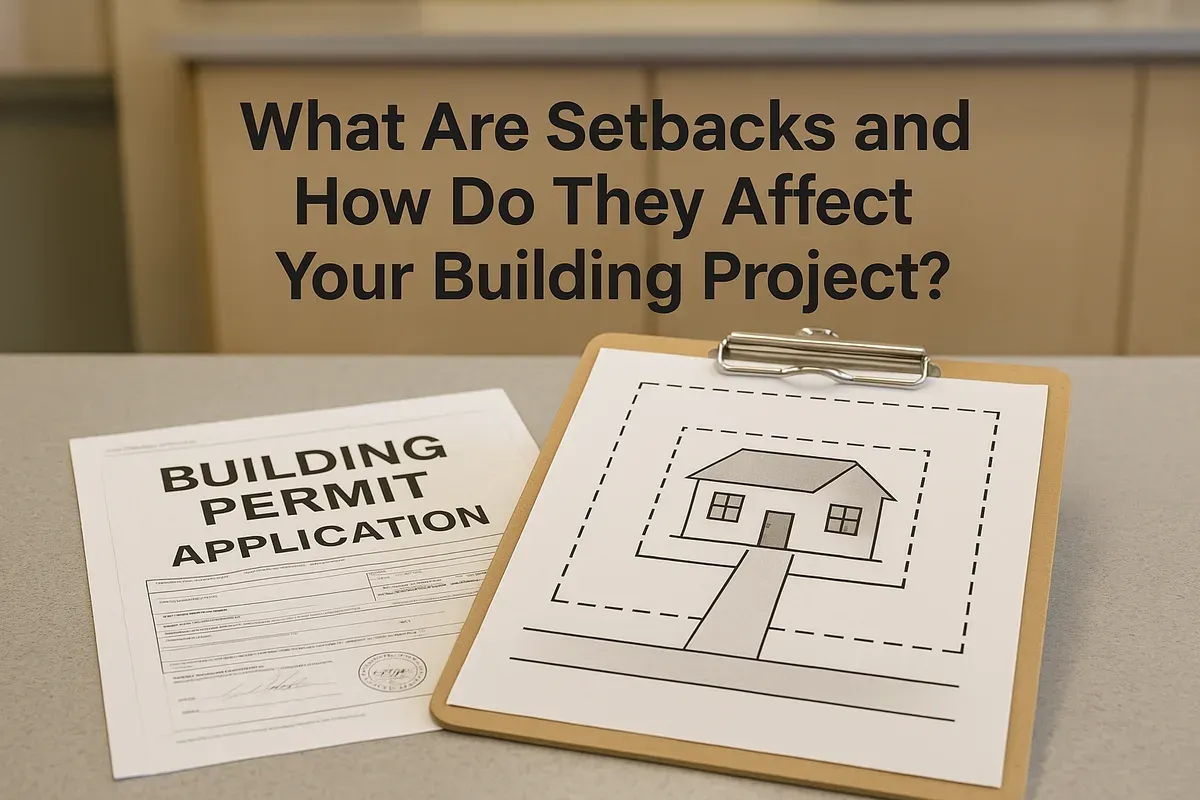
<p>Think of your property as a rectangle. Setbacks essentially shrink that rectangle inward from each side, creating a smaller buildable area in the center. That interior zone is where any new structure must be located. Everything outside of it, the setback zones themselves, must remain free of permanent structures (with a few notable exceptions, which we will cover later).</p>
<h3>Why Do Setbacks Exist?</h3>
<p>Setbacks serve a number of practical and community-oriented purposes:</p>
<ul>
<li><strong>Fire safety:</strong> Keeping structures away from property lines reduces the risk of fire spreading between buildings on adjacent lots.</li>
<li><strong>Light and air access:</strong> Setbacks ensure that neighboring properties receive adequate natural light and ventilation, which is especially important in densely developed areas.</li>
<li><strong>Privacy:</strong> Buffer zones between structures protect the privacy of neighboring residents.</li>
<li><strong>Emergency access:</strong> Fire trucks and emergency personnel need room to maneuver around structures. Setbacks help ensure that access is maintained.</li>
<li><strong>Utility corridors:</strong> Underground and overhead utilities often run along property lines. Setbacks keep structures clear of these corridors.</li>
<li><strong>Aesthetic consistency:</strong> Uniform front setbacks create the visual rhythm of a neighborhood streetscape, ensuring that homes are roughly aligned along the street.</li>
<li><strong>Flood and drainage management:</strong> In flood-prone areas, setbacks from waterways and drainage easements help protect structures and manage stormwater.</li>
</ul>
<p>Understanding the reasoning behind setback rules can help you work within them more creatively, and also helps you make a stronger case if you ever need to apply for a variance.</p>
<hr>
<h2>The Three Main Types of Setbacks</h2>
<p>Most zoning codes define setbacks in terms of three primary boundaries: the front, the rear, and the sides of your lot. Each serves a distinct purpose and typically has its own minimum distance requirement.</p>
<h3>Front Setbacks</h3>
<p>The front setback is measured from the front property line (usually the line closest to the street) to the nearest point of any structure. Front setbacks are often the most visible and the most strictly enforced, because they directly affect the character of the streetscape.</p>
<p>In many residential zones, front setbacks range from 15 to 30 feet, though this varies widely. Some urban infill zones allow much smaller front setbacks of 5 to 10 feet to encourage walkable, street-oriented development. Rural and agricultural zones may require front setbacks of 50 feet or more.</p>
<p>Important nuances to be aware of with front setbacks:</p>
<ul>
<li>The front property line is not always at the edge of the sidewalk or curb. There is often a public right-of-way between the curb and your actual property line, and setbacks are measured from your property line, not from the street itself.</li>
<li>Corner lots have two front setbacks: one for each street frontage. This can significantly reduce the buildable area on a corner lot.</li>
<li>Some jurisdictions use an "average front setback" rule, where your structure must be set back at least as far as the average of the two neighboring homes. This prevents one house from sticking out dramatically in front of its neighbors.</li>
</ul>
<h3>Rear Setbacks</h3>
<p>The rear setback is measured from the rear property line to the nearest point of any structure. Rear setbacks are typically smaller than front setbacks, ranging from 10 to 25 feet in most residential zones, though again, local rules vary.</p>
<p>Rear setbacks are particularly relevant for:</p>
<ul>
<li>Detached garages and carriage houses</li>
<li>Accessory dwelling units (ADUs) or backyard cottages</li>
<li>Pools and spas</li>
<li>Large decks and patios with roofing or pergola structures</li>
<li>Home additions extending toward the back of the lot</li>
</ul>
<p>One common misconception is that the rear property line is always directly behind the house. On irregularly shaped lots, pie-shaped lots, or flag lots, identifying the rear property line can be less straightforward. When in doubt, refer to your property survey or consult your local planning department.</p>
<h3>Side Setbacks</h3>
<p>Side setbacks are measured from each side property line to the nearest point of any structure. They are typically the smallest of the three setback types, often ranging from 3 to 10 feet in residential zones, though some jurisdictions require larger side setbacks for two-story structures.</p>
<p>Side setbacks matter most when you are:</p>
<ul>
<li>Building an addition that extends sideways on the lot</li>
<li>Adding a garage attached to the side of the house</li>
<li>Installing a fence or wall along the property line (rules vary)</li>
<li>Building on a narrow urban lot where every foot counts</li>
</ul>
<p>Some zoning codes specify a combined side setback requirement rather than (or in addition to) individual minimums. For example, the code might require a minimum of 5 feet on each side, with a combined total of at least 15 feet. This means you could not place both side walls at exactly 5 feet; one would need to be at least 10 feet from its property line.</p>
<hr>
<h2>Setbacks for Accessory Structures</h2>
<p>Detached accessory structures, such as sheds, garages, workshops, and pool houses, often have different <a href="/setback-guide">setback requirements</a> than primary structures. In many jurisdictions, smaller accessory structures are allowed to be placed closer to rear and side property lines, sometimes as close as 3 feet or even right at the property line in certain cases.</p>
<p>However, this leniency usually comes with conditions:</p>
<ul>
<li>The structure must be below a certain height (often 12 to 15 feet at the peak)</li>
<li>The structure must be below a certain square footage (often 200 to 400 square feet)</li>
<li>The structure cannot be used as a habitable space</li>
<li>The structure must not block drainage or access easements</li>
</ul>
<p>If your accessory structure exceeds these thresholds, the standard setback rules for primary structures may apply. Always check your local zoning ordinance before assuming that a small shed can be placed anywhere on your lot.</p>
<hr>
<h2>How Setbacks Interact with Other Zoning Rules</h2>
<p>Setbacks do not exist in isolation. They are part of a broader set of zoning regulations that work together to control land use and development density. Understanding how setbacks interact with other rules will help you plan your project more effectively.</p>
<h3>Lot Coverage</h3>
<p>Lot coverage rules limit the total percentage of your lot that can be covered by impervious surfaces or structures. Even if a proposed addition technically respects all setbacks, it might push your total lot coverage over the allowed maximum. Setbacks and lot coverage together define both where you can build and how much you can build.</p>
<h3>Building Height Limits</h3>
<p>Some jurisdictions apply what are called "setback-to-height" ratios, where taller structures must be set back farther from property lines. This is common in urban areas to prevent tall buildings from casting excessive shadows on neighboring properties.</p>
<h3>Easements</h3>
<p>Easements are legal rights granted to utilities, municipalities, or neighboring property owners to use a portion of your land for a specific purpose. Common easements include utility easements along rear and side property lines, drainage easements, and access easements. Structures generally cannot be built within an easement area, even if that area falls outside of the standard setback zone. Easements are shown on your property survey and deed.</p>
<h3>Flood Zones</h3>
<p>If your property is in or near a FEMA-designated flood zone, additional setback requirements may apply from waterways, floodplains, or flood control channels. The <a href="https://msc.fema.gov/portal/home" rel="nofollow noopener" target="_blank">FEMA Flood Map Service Center</a> is a useful resource for checking whether your property falls within a Special Flood Hazard Area.</p>
<h3>HOA Rules</h3>
<p>If your property is governed by a <a href="/homeowners">homeowners</a> association, the HOA may impose setback requirements that are stricter than the local zoning code. Always check your CC&Rs (Covenants, Conditions, and Restrictions) in addition to the municipal zoning ordinance.</p>
<hr>
<h2>How to Find the Setback Rules That Apply to Your Property</h2>
<p>This is where many homeowners and even some <a href="/contractors">contractors</a> get tripped up. Setback rules are hyperlocal, meaning they depend on your specific municipality, your specific zoning district, and sometimes even the specific street you are on. Here is how to find the rules that apply to your project:</p>
<h3>Step 1: Identify Your Zoning District</h3>
<p>Your property is assigned to a zoning district (such as R-1, R-2, C-1, or similar designations) that determines which rules apply. You can usually find your zoning designation by:</p>
<ul>
<li>Searching your address on your city or county's online zoning map</li>
<li>Checking your property tax records</li>
<li>Calling or emailing your local planning department</li>
</ul>
<h3>Step 2: Look Up the Zoning Ordinance</h3>
<p>Once you know your zoning district, look up the applicable zoning ordinance. Most municipalities publish their zoning codes online. Search for your city or county name plus "zoning ordinance" or "municipal code." Look for the section that covers your zoning district and find the dimensional standards table, which will list minimum setbacks, maximum lot coverage, and height limits.</p>
<p>The <a href="https://www.planning.org" rel="nofollow noopener" target="_blank">American Planning Association</a> offers resources that can help you understand how zoning codes are structured if you are new to reading them.</p>
<h3>Step 3: Check for Overlay Districts or Special Conditions</h3>
<p>Some properties fall within overlay districts (such as historic districts, coastal zones, or transit corridors) that impose additional or different setback rules on top of the base zoning. Ask your planning department whether any overlays apply to your property.</p>
<h3>Step 4: Review Your Property Survey</h3>
<p>A current property survey will show your lot dimensions, property lines, existing structures, easements, and sometimes existing setback violations (if any). If you do not have a recent survey, you may need to hire a licensed surveyor before proceeding with your permit application.</p>
<h3>Step 5: Contact Your Local Planning or Building Department</h3>
<p>When in doubt, call or visit your local planning or building department. Staff members can confirm the setback requirements for your specific property and flag any special conditions you might not have found on your own. Many departments now offer pre-application consultations, which can save you significant time and money.</p>
<hr>
<h2>Setback Variances: When the Rules Do Not Work for Your Project</h2>
<p>Sometimes a project that makes complete practical sense simply cannot be built within the standard setbacks. In these cases, you may be able to apply for a <strong>setback variance</strong>, which is a formal request to deviate from the standard zoning requirements.</p>
<p>Variances are not automatically granted. Most jurisdictions require you to demonstrate:</p>
<ol>
<li>That strict application of the setback rule would cause you an unusual hardship specific to your property (not just inconvenience)</li>
<li>That the variance would not negatively impact neighboring properties or the surrounding neighborhood</li>
<li>That the hardship is due to unique characteristics of your property, not circumstances of your own making</li>
</ol>
<p>The variance process typically involves submitting an application, paying a fee, notifying adjacent property owners, and attending a public hearing before a zoning board. The process can take several weeks to several months depending on your jurisdiction.</p>
<p>If you are considering a variance, consult with a land use attorney or a professional permit expediter before investing significant time in the application.</p>
<hr>
<h2>How to Show Setbacks on a Site Plan for Your Building Permit</h2>
<p>This is where everything comes together. When you apply for a building permit, your permit application will almost certainly require a <strong>site plan</strong> that clearly shows your property boundaries, existing structures, proposed structures, and all applicable setbacks.</p>
<p>A properly prepared site plan for setback compliance should include:</p>
<ul>
<li><strong>Property lines</strong> with accurate dimensions for each side of the lot</li>
<li><strong>North arrow</strong> and scale bar</li>
<li><strong>Existing structures</strong> with their dimensions and distances from all property lines</li>
<li><strong>Proposed structures</strong> with their dimensions and distances from all property lines</li>
<li><strong>Setback lines</strong> drawn parallel to each property line at the required minimum distance, clearly labeled (e.g., "20 ft. front setback," "5 ft. side setback")</li>
<li><strong>Easements</strong> shown with their type and width</li>
<li><strong>Driveways, walkways, and other impervious surfaces</strong> if lot coverage calculations are required</li>
<li><strong>Street names</strong> and right-of-way widths</li>
</ul>
<p>The <a href="https://www.iccsafe.org" rel="nofollow noopener" target="_blank">International Code Council (ICC)</a> publishes model building codes that many jurisdictions adopt, and these codes provide guidance on what site plan documentation is typically required for permit applications.</p>
<h3>Common Setback Mistakes on Site Plans</h3>
<p>Avoid these frequent errors that cause permit applications to be rejected:</p>
<ol>
<li><strong>Measuring from the wrong point:</strong> Setbacks are measured from the property line, not from the curb, sidewalk, fence, or neighboring structure.</li>
<li><strong>Forgetting the right-of-way:</strong> If there is a public right-of-way between the street and your property line, the front setback starts at your property line, not at the edge of the right-of-way.</li>
<li><strong>Using approximate dimensions:</strong> Permit reviewers need precise measurements. Use your property survey as the basis for all dimensions.</li>
<li><strong>Omitting easements:</strong> Failing to show easements on your site plan is a common cause of revision requests.</li>
<li><strong>Not labeling setback lines:</strong> Draw the setback lines and label them clearly. Do not make the reviewer calculate whether your structure complies.</li>
<li><strong>Showing only the proposed structure:</strong> You must show all existing structures as well, so the reviewer can verify total lot coverage and confirm that existing structures are not already in violation.</li>
</ol>
<hr>
<h2>Practical Tips for Working Within Setbacks</h2>
<p>Setbacks can feel like constraints, but with thoughtful planning, they can actually help you design a better project. Here are some practical strategies:</p>
<ul>
<li><strong>Start with the buildable envelope:</strong> Before designing anything, map out your buildable area by drawing all setback lines on your site plan. Design within that envelope from the start rather than designing first and hoping it fits.</li>
<li><strong>Consider the footprint vs. height tradeoff:</strong> If setbacks limit your footprint, consider going up rather than out. Adding a second story or a loft can increase your usable space without consuming more of the buildable area.</li>
<li><strong>Use detached accessory structures strategically:</strong> If your primary structure is already close to the setback limits, a detached accessory structure (with its potentially reduced setback requirements) might give you additional space for a garage, studio, or storage.</li>
<li><strong>Check for nonconforming structure rules:</strong> If your property has an existing structure that already encroaches into a setback (a legal nonconformity), there may be rules about whether and how you can expand or alter it. These rules vary by jurisdiction.</li>
<li><strong>Explore ADU opportunities:</strong> Many jurisdictions have relaxed setback rules for accessory dwelling units in recent years as part of housing affordability initiatives. If you are considering an ADU, check whether your municipality has adopted reduced ADU setbacks.</li>
</ul>
<hr>
<h2>Conclusion: Get Your Setbacks Right Before You Build</h2>
<p>Setbacks are not bureaucratic obstacles designed to frustrate property owners. They are thoughtfully designed rules that protect you, your neighbors, and the broader community. Understanding what setbacks are, how front, rear, and side setbacks work, and how to correctly incorporate them into your site plan is one of the most important steps you can take before starting any building project.</p>
<p>Getting setbacks wrong at the design stage is far less costly than discovering a violation after construction has begun. The time you invest in understanding and correctly documenting setback compliance will pay dividends throughout your permit review process.</p>
<p>When you are ready to create a professional, permit-ready site plan that clearly shows your property boundaries, building footprints, and all required setbacks, <strong><a href="/">Site Plan Creator</a></strong> makes the process straightforward. Our browser-based CAD-style tool is built specifically for property owners, contractors, and design professionals who need accurate, reviewer-approved site plans without the complexity of traditional CAD software. Start your site plan today at <a href="https://www.siteplancreator.com">siteplancreator.com</a> and move your project forward with confidence.</p>