Lot Coverage Calculation: How to Show It on a Site Plan
Lot coverage is one of the most scrutinized numbers on any permit application, yet many property owners get it wrong. This guide explains exactly what lot coverage means, how to calculate it correctly, and how to present it on a professional site plan that satisfies your local building department.
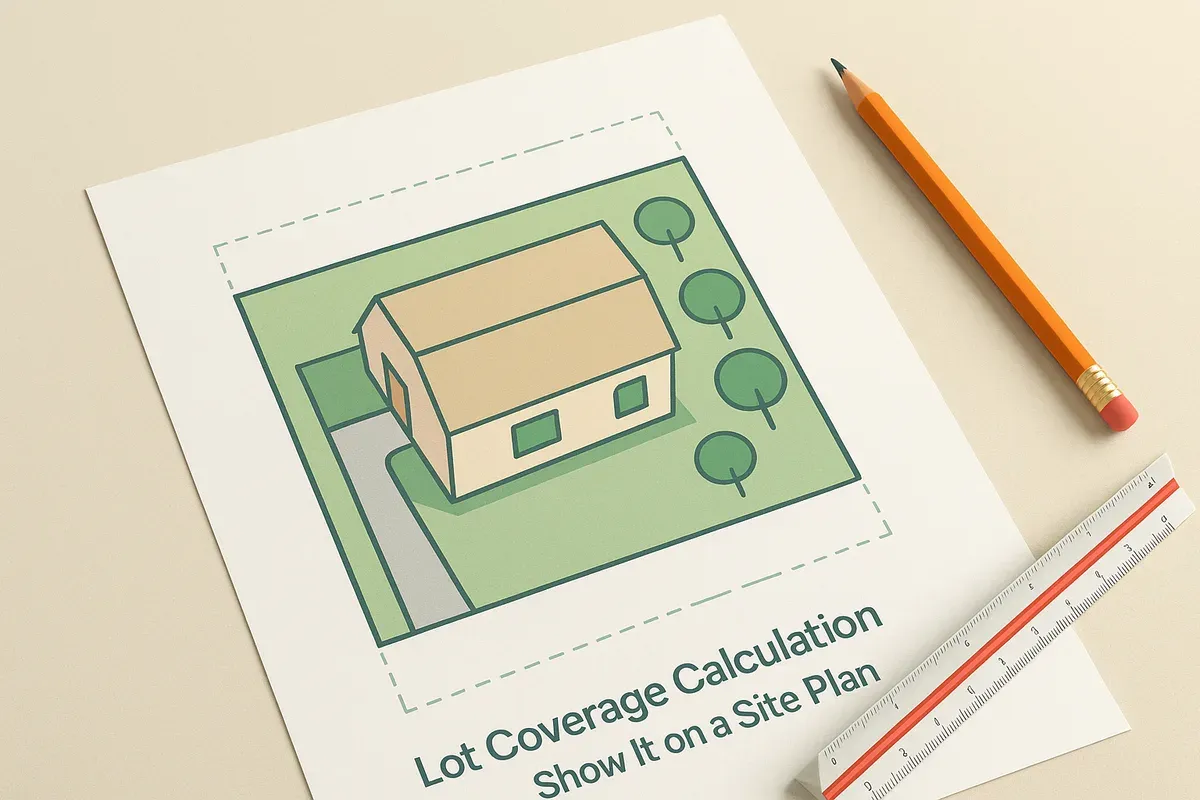
<h2>What Is Lot Coverage and Why Does It Matter for Your Permit?</h2>
<p>If you have ever submitted a permit application and had it kicked back by the building department, there is a good chance lot coverage was part of the problem. It is one of the most commonly misunderstood metrics in residential and commercial property planning, and getting it wrong can delay your project by weeks or even months.</p>
<p>At its core, <strong>lot coverage</strong> is a zoning measurement that expresses the percentage of your total lot area that is covered by structures or impervious surfaces. Local zoning codes use this number to control density, manage stormwater runoff, preserve green space, and maintain neighborhood character. Whether you are building a new home, adding a garage, installing a pool, or expanding a deck, your permit reviewer will check your lot coverage calculation before approving anything.</p>
<p>This article walks you through everything you need to know: what counts toward lot coverage, how to run the numbers, how local codes vary, and how to present your calculation clearly on a permit-ready site plan. By the end, you will have the knowledge to prepare a professional submission that holds up to scrutiny.</p>
<hr>
<h2>Understanding the Basics: What Counts as Lot Coverage?</h2>
<p>This is where most property owners stumble. The definition of lot coverage is not universal. It shifts depending on your municipality, your zoning district, and sometimes even the specific type of project you are pursuing. That said, there are common categories that appear in most zoning ordinances.</p>
<h3>Structures That Almost Always Count</h3>
<ul>
<li>The primary dwelling or building footprint (measured at the foundation, not including overhangs unless specified)</li>
<li>Attached garages</li>
<li>Detached garages and <a href="/adu-feasibility-software">accessory dwelling units</a> (ADUs)</li>
<li>Covered porches and enclosed patios</li>
<li>Permanent sheds over a certain square footage (often 120 sq ft or more)</li>
<li>Commercial outbuildings</li>
</ul>
<h3>Surfaces That Often Count (Impervious Surface Rules)</h3>
<p>Many jurisdictions have moved toward an <strong>impervious surface</strong> model rather than a strict structure-only model. Impervious surfaces are any materials that prevent rainwater from soaking into the ground. These typically include:</p>
<ul>
<li>Concrete driveways and parking pads</li>
<li>Asphalt surfaces</li>
<li>Brick, stone, or paver patios (even if sand-set, in many codes)</li>
<li>Swimming pools (the water surface area)</li>
<li>Concrete or asphalt walkways</li>
</ul>
<p>The EPA's guidance on impervious surfaces and stormwater explains why municipalities care so much about this metric. More impervious surface means more runoff, which stresses storm drains, causes erosion, and degrades local waterways.</p>
<h3>What Usually Does NOT Count</h3>
<ul>
<li>Open wood decks with gaps between boards (in many but not all jurisdictions)</li>
<li>Gravel areas (though some codes count these)</li>
<li>Uncovered, permeable patio systems</li>
<li>Roof overhangs and eaves (unless the code specifies otherwise)</li>
<li>Underground structures like cisterns or basements (the ground above may still count)</li>
</ul>
<p>Always verify with your local zoning office or building department. The <a href="https://www.planning.org/zoningpractice/" rel="nofollow noopener" target="_blank">American Planning Association's zoning practice resources</a> are a helpful reference for understanding how municipalities structure these rules.</p>
<hr>
<h2>How to Calculate Lot Coverage: Step-by-Step</h2>
<p>Once you know what counts in your jurisdiction, the math itself is straightforward. Here is the standard lot coverage calculation formula:</p>
<p><strong>Lot Coverage (%) = (Total Covered Area / Total Lot Area) x 100</strong></p>
<p>Let's walk through a realistic example.</p>
<h3>Step 1: Determine Your Total Lot Area</h3>
<p>Your lot area is the total square footage of your parcel, measured from property line to property line. You can find this on:</p>
<ul>
<li>Your property deed</li>
<li>A recorded plat or survey</li>
<li>Your county assessor's website</li>
<li>A professional survey (most accurate for permit purposes)</li>
</ul>
<p>For our example, let's say your lot is 8,500 square feet.</p>
<h3>Step 2: Identify and Measure Every Covered Surface</h3>
<p>Walk your property and document every structure and surface that your zoning code counts toward lot coverage. Measure the footprint of each one. The footprint is the area it occupies on the ground, not the total floor area of a multi-story building.</p>
<p>Here is a sample inventory:</p>
<table>
<thead>
<tr>
<th>Surface or Structure</th>
<th>Dimensions</th>
<th>Square Footage</th>
</tr>
</thead>
<tbody><tr>
<td>Main house footprint</td>
<td>40 ft x 50 ft</td>
<td>2,000 sq ft</td>
</tr>
<tr>
<td>Attached garage</td>
<td>20 ft x 22 ft</td>
<td>440 sq ft</td>
</tr>
<tr>
<td>Concrete driveway</td>
<td>12 ft x 60 ft</td>
<td>720 sq ft</td>
</tr>
<tr>
<td>Rear patio (concrete)</td>
<td>16 ft x 20 ft</td>
<td>320 sq ft</td>
</tr>
<tr>
<td>Garden shed (over 120 sq ft)</td>
<td>12 ft x 14 ft</td>
<td>168 sq ft</td>
</tr>
<tr>
<td><strong>Total Covered Area</strong></td>
<td></td>
<td><strong>3,648 sq ft</strong></td>
</tr>
</tbody></table>
<h3>Step 3: Run the Calculation</h3>
<p>Using our formula:</p>
<p>3,648 / 8,500 x 100 = <strong>42.9% lot coverage</strong></p>
<p>If your zoning district allows a maximum of 40%, this project has a problem. You would need to reduce one or more covered surfaces before submitting your permit application.</p>
<h3>Step 4: Calculate Your Remaining Allowance</h3>
<p>Permit reviewers also want to see how much coverage you have left, especially if you are proposing a new addition. Calculate your remaining allowance like this:</p>
<p>(Maximum allowed % - Current coverage %) x Lot Area = Remaining square footage</p>
<p>Using the same example, if the maximum were 45%:</p>
<p>(45% - 42.9%) x 8,500 = 178.5 sq ft remaining</p>
<p>That is not much room, and knowing this upfront saves you from designing an addition that cannot be approved.</p>
<hr>
<h2>Common Lot Coverage Limits by Zoning Type</h2>
<p>Zoning codes vary enormously by municipality, but there are general patterns you can use as a starting point. Always verify locally before making any project decisions.</p>
<h3>Residential Zones</h3>
<ul>
<li><strong>Low-density residential (R-1, single-family):</strong> Typically 25% to 40% lot coverage</li>
<li><strong>Medium-density residential (R-2, R-3):</strong> Often 40% to 55%</li>
<li><strong>High-density residential / townhomes:</strong> Can reach 60% to 70%</li>
</ul>
<h3>Commercial and Mixed-Use Zones</h3>
<ul>
<li><strong>Neighborhood commercial:</strong> Often 50% to 70%</li>
<li><strong>Downtown / urban commercial:</strong> Can be 80% to 100% in some cities</li>
<li><strong>Industrial zones:</strong> Varies widely, often 60% to 80%</li>
</ul>
<h3>Overlay Districts and Special Rules</h3>
<p>If your property is in a flood zone, a coastal zone, a watershed protection district, or a historic district, you may face stricter lot coverage limits. <a href="https://msc.fema.gov/portal/home" rel="nofollow noopener" target="_blank">FEMA's Flood Map Service Center</a> is a critical resource for understanding whether your property has special stormwater restrictions tied to flood zone designations.</p>
<p>Some municipalities also have separate impervious surface caps that are stricter than the general lot coverage limit. For example, your zoning might allow 40% lot coverage but cap impervious surfaces at 30% to protect a local watershed.</p>
<hr>
<h2>Why Your Site Plan Is the Most Important Document for Lot Coverage</h2>
<p>A lot coverage calculation is only as credible as the site plan that supports it. When a permit reviewer looks at your application, they are not going to take your word for the numbers. They want to see a drawn-to-scale site plan that visually confirms every measurement you have claimed.</p>
<p>A properly prepared site plan shows:</p>
<ol>
<li>Property boundaries with dimensions and total lot area labeled</li>
<li>All existing structures with accurate footprint dimensions</li>
<li>All proposed new structures or additions with footprint dimensions</li>
<li>Driveways, walkways, patios, and other impervious surfaces with dimensions</li>
<li>Setbacks from property lines, clearly dimensioned</li>
<li>A lot coverage summary table or calculation block</li>
</ol>
<p>That last item is crucial. Many building departments now require a formal <strong>lot coverage calculation table</strong> printed directly on the site plan. This table lists each covered element, its square footage, the total covered area, the total lot area, and the resulting percentage. It eliminates any ambiguity and makes the reviewer's job faster and easier.</p>
<h3>What a Lot Coverage Table Looks Like on a Site Plan</h3>
<p>Here is an example of how you might format a lot coverage summary block on your site plan:</p>
<pre><code>LOT COVERAGE CALCULATION
------------------------
Total Lot Area: 8,500 sq ft
Existing Structures:
House Footprint: 2,000 sq ft
Attached Garage: 440 sq ft
Existing Driveway: 720 sq ft
Existing Patio: 320 sq ft
Garden Shed: 168 sq ft
Subtotal Existing: 3,648 sq ft
Proposed Addition: 400 sq ft
Total Covered Area: 4,048 sq ft
Lot Coverage: 4,048 / 8,500 = 47.6%
Allowed Maximum: 50%
Remaining Allowance: 2.4% (204 sq ft)
</code></pre>
<p>This format is clean, professional, and gives the reviewer everything they need at a glance.</p>
<hr>
<h2>How to Show Lot Coverage on a Site Plan: Best Practices</h2>
<p>Creating a site plan that accurately reflects your lot coverage requires more than just drawing some boxes on a page. Here are the professional practices that make your submission stand out.</p>
<h3>Use a Consistent Scale</h3>
<p>Your site plan must be drawn to a recognized scale, such as 1 inch = 10 feet, 1 inch = 20 feet, or 1 inch = 30 feet depending on your lot size. A plan that is not to scale will be rejected immediately by most building departments. Every dimension on the plan must be consistent with the stated scale.</p>
<h3>Differentiate Existing vs. Proposed Elements</h3>
<p>Use different line weights, hatching patterns, or shading to distinguish between:</p>
<ul>
<li>Existing structures (typically shown with solid lines)</li>
<li>Proposed new construction (often shown with dashed lines or a different hatch)</li>
<li>Impervious surfaces like driveways and patios (often shaded or cross-hatched)</li>
</ul>
<p>This visual distinction helps reviewers quickly understand what is existing and what is being added, which directly affects how they evaluate your coverage numbers.</p>
<h3>Dimension Everything</h3>
<p>Every structure, surface, and setback on your site plan needs a dimension label. Do not make the reviewer calculate dimensions from the scale bar. Label the length and width of every covered surface explicitly. This also protects you: if your dimensions are clearly stated and your math adds up, there is very little room for dispute.</p>
<h3>Label Setbacks from Property Lines</h3>
<p>Setbacks and lot coverage go hand in hand in permit review. Show the distance from every structure to every relevant property line. Most zoning codes have front, rear, and side <a href="/setback-guide">setback requirements</a>, and your site plan needs to demonstrate compliance with all of them alongside your coverage calculation.</p>
<h3>Include a North Arrow and Scale Bar</h3>
<p>These are non-negotiable on a professional site plan. A north arrow orients the reviewer to your property's position, and a scale bar allows them to visually verify dimensions even if the plan is printed at a different size than intended.</p>
<h3>Add a Title Block</h3>
<p>A proper title block includes:</p>
<ul>
<li>Property address</li>
<li>Parcel or assessor's number</li>
<li>Owner name</li>
<li>Preparer name (and license number if applicable)</li>
<li>Date of preparation</li>
<li>Sheet number and revision history</li>
<li>Scale</li>
</ul>
<hr>
<h2>Mistakes That Will Get Your Lot Coverage Calculation Rejected</h2>
<p>After reviewing thousands of permit submissions, certain errors come up again and again. Avoid these common mistakes to keep your project moving forward.</p>
<h3>Forgetting Existing Impervious Surfaces</h3>
<p>One of the most frequent errors is calculating only the new construction and forgetting to include existing driveways, patios, and sheds. Your lot coverage calculation must reflect the total covered area after your project is complete, including everything that already exists.</p>
<h3>Using Gross Floor Area Instead of Footprint</h3>
<p>A two-story house with a 1,500 sq ft footprint has 3,000 sq ft of gross floor area. For lot coverage purposes, you use the footprint (1,500 sq ft), not the total floor area. Using the wrong number will either inflate or deflate your calculation.</p>
<h3>Ignoring Accessory Structures Below the Permit Threshold</h3>
<p>Small sheds under 120 sq ft might not require a permit individually, but they may still count toward your lot coverage total. Check your local code carefully. A cluster of small sheds can add up quickly.</p>
<h3>Not Accounting for Roof Overhangs</h3>
<p>Some jurisdictions measure the footprint from the drip line of the roof rather than the foundation. If your home has a 2-foot overhang on all sides, that could add significant square footage to your coverage calculation. Read your local code definition carefully.</p>
<h3>Using an Outdated Survey</h3>
<p>If your property has had any changes since your last survey, including fences, sheds, driveways, or additions, your old survey may not reflect current conditions. Building departments increasingly require a current survey or at minimum a site plan that matches current aerial imagery.</p>
<hr>
<h2>Lot Coverage and Impervious Surface Permits: What You Need to Know</h2>
<p>In many jurisdictions, exceeding a certain threshold of impervious surface triggers additional permit requirements beyond the standard <a href="/construction-permit-site-plans">building permit</a>. This is especially common in:</p>
<ul>
<li>Coastal communities managing stormwater under state environmental regulations</li>
<li>Properties in designated watershed protection areas</li>
<li>Municipalities that have adopted green infrastructure requirements</li>
<li>Areas with combined sewer systems that are sensitive to runoff volume</li>
</ul>
<p>An <strong>impervious surface permit</strong> or a stormwater management plan may be required if your project pushes total impervious coverage above a threshold, often 15% to 25% of the lot in sensitive areas. These permits may require you to demonstrate that you are managing runoff on-site through features like rain gardens, permeable pavers, bioswales, or detention basins.</p>
<p>If your project is near this threshold, it is worth investing time in understanding your local stormwater requirements before you finalize your design. Retrofitting stormwater management features after the fact is expensive and sometimes impossible without redesigning the project entirely.</p>
<h3>Permeable Paving as a Strategy</h3>
<p>One increasingly popular approach to managing lot coverage is the use of permeable paving systems for driveways, walkways, and patios. Permeable pavers, gravel-filled grid systems, and porous concrete allow water to infiltrate rather than run off. Many jurisdictions allow these surfaces to be excluded from impervious surface calculations or counted at a reduced rate.</p>
<p>If you are close to your lot coverage limit, permeable paving can be a practical way to add usable outdoor surface area without triggering additional permit requirements. Always confirm with your local building or planning department how permeable surfaces are treated under your specific code.</p>
<hr>
<h2>How <a href="/">Site Plan Creator</a> Simplifies Lot Coverage Documentation</h2>
<p>Generating an accurate, permit-ready site plan that includes a proper lot coverage calculation used to require expensive surveying software or a hired CAD professional. Site Plan Creator changes that equation entirely.</p>
<p>As a browser-based CAD-style application, Site Plan Creator lets you:</p>
<ul>
<li>Draw your property boundaries to exact dimensions using real measurements</li>
<li>Place building footprints, driveways, patios, and other structures accurately on the plan</li>
<li>Automatically calculate areas as you draw</li>
<li>Add a formatted lot coverage calculation table directly to your plan</li>
<li>Include all required elements: north arrow, scale bar, title block, setback dimensions, and labels</li>
<li>Export a clean, professional PDF ready for permit submission</li>
</ul>
<p>You do not need to be a CAD expert or hire a draftsperson for most residential permit applications. Site Plan Creator is designed specifically for property owners, <a href="/contractors">contractors</a>, and small design firms who need professional results without professional-level software costs.</p>
<p>The tool is particularly useful for projects where lot coverage is a central concern, such as ADU additions, garage conversions, pool installations, and home additions. Being able to visualize your coverage in real time as you adjust the design means you can optimize your layout before committing to a final plan.</p>
<hr>
<h2>Conclusion: Get Your Lot Coverage Right the First Time</h2>
<p>Lot coverage is not a bureaucratic technicality. It is a fundamental aspect of property planning that affects your permit approval, your project design, and your property's relationship to the broader neighborhood and environment. Getting it right the first time saves you money, time, and frustration.</p>
<p>The formula is simple: total covered area divided by total lot area, multiplied by 100. But the details, knowing what counts, how to measure it, and how to present it on a site plan, require careful attention. A professional, to-scale site plan with a clearly formatted lot coverage calculation table is your best tool for a smooth permit submission.</p>
<p>Ready to create your permit-ready site plan? <a href="https://www.siteplancreator.com">Site Plan Creator</a> gives you everything you need to draw accurate property plans, calculate lot coverage, and generate professional PDF submissions, all from your browser, with no software installation required. Start your plan today and take the guesswork out of your next permit application.</p>