Dallas Shed Permit Requirements: What Homeowners Need to Know in 2026
Building a shed in Dallas comes with specific permit requirements that catch many homeowners off guard. This comprehensive guide breaks down the City of Dallas shed rules, size thresholds, setback requirements, and exactly what documentation you need to get your project approved in 2026.
<h2>Dallas Shed Permit Requirements: What Homeowners Need to Know in 2026</h2>
<p>You have finally decided to build that backyard shed you have been planning for years. Maybe it is extra storage for lawn equipment, a workshop for weekend projects, or a dedicated space for hobbies. Whatever the reason, the moment you start measuring out the footprint in your backyard, one question should come to mind: do I need a permit for this in Dallas?</p>
<p>The answer, like most things in municipal planning, depends on the details. The City of Dallas has specific rules governing accessory structures like sheds, and getting it wrong can mean costly fines, forced removal, or serious complications when you try to sell your home. In 2026, with Dallas continuing to grow and its Development Services Department actively enforcing zoning and building codes, understanding the rules before you build has never been more important.</p>
<p>This guide covers everything Dallas <a href="/homeowners">homeowners</a> need to know: when a permit is required, what the setback rules are, how to prepare your application, and what a proper site plan needs to include to get your project approved the first time.</p>
<hr>
<h2>Does Your Shed Require a Permit in Dallas?</h2>
<p>The most common question homeowners ask is whether a small shed requires a permit at all. In Dallas, the threshold is straightforward but often misunderstood.</p>
<h3>The 200 Square Foot Rule</h3>
<p>Under the City of Dallas building code (which adopts and amends the <a href="https://www.iccsafe.org" rel="nofollow noopener" target="_blank">International Building Code published by the ICC</a>), accessory structures including sheds that are <strong>200 square feet or less</strong> in floor area are generally exempt from a <a href="/construction-permit-site-plans">building permit</a>, provided they meet all of the following conditions:</p>
<ul>
<li>The structure is a single-story detached accessory building</li>
<li>It is not used for habitation (no sleeping, cooking, or plumbing)</li>
<li>It does not contain electrical wiring (if you want electricity, a permit is required regardless of size)</li>
<li>It complies with all applicable zoning <a href="/setback-guide">setback requirements</a></li>
<li>It is not located in a floodplain</li>
</ul>
<p>If your shed exceeds 200 square feet, a building permit is required. Period. And if your shed is under 200 square feet but you want to run electricity to it, you will need at minimum an electrical permit.</p>
<h3>When Zoning Still Applies Even Without a Building Permit</h3>
<p>Here is where many Dallas homeowners get tripped up. Even if your shed is small enough to skip the building permit, zoning regulations still apply. You are still required to meet setback distances from property lines, comply with lot coverage limits, and follow any deed restrictions or HOA rules that govern your property.</p>
<p>Skipping the building permit does not mean skipping the rules. It just means you are self-certifying that your structure meets all applicable standards. If a code enforcement officer investigates and finds your shed is in violation of setbacks or lot coverage, you can still face enforcement action.</p>
<hr>
<h2>Dallas Zoning Rules for Sheds and Accessory Structures</h2>
<p>Dallas zoning is governed by the Dallas Development Code, and it sets specific standards for accessory structures based on your zoning district. Most residential properties in Dallas fall under one of the single-family zoning categories (R-1 through R-10), and the rules below apply broadly to those districts.</p>
<h3>Setback Requirements</h3>
<p>Setbacks define how close your shed can be to your property lines. In Dallas, the standard setback requirements for detached accessory structures in residential zones are:</p>
<ul>
<li><strong>Rear yard:</strong> Accessory structures must be located entirely within the rear yard and maintain a minimum setback of 3 feet from the rear property line</li>
<li><strong>Side yard:</strong> A minimum setback of 3 feet from the side property line is typically required</li>
<li><strong>Front yard:</strong> Sheds are generally not permitted in the front yard in residential districts</li>
<li><strong>From the primary structure:</strong> The shed must maintain a minimum separation distance from the main house, typically 6 feet, to comply with fire separation requirements</li>
</ul>
<p>These are the baseline standards. Some zoning districts or specific lots may have different requirements, so always verify with the <a href="https://dallascityhall.com/departments/sustainabledevelopment/Pages/default.aspx" rel="nofollow noopener" target="_blank">City of Dallas Development Services Department</a> before you finalize your plans.</p>
<h3>Lot Coverage Limits</h3>
<p>Dallas zoning also limits the total percentage of your lot that can be covered by impervious or built surfaces. Your shed's footprint counts toward this total, along with your house, garage, driveway, and any other structures. Exceeding lot coverage limits is a common reason permit applications get rejected, so calculate your existing coverage before you design your shed.</p>
<p>For most single-family residential zones in Dallas, the maximum lot coverage ranges from 40% to 60% depending on the specific district. Check your zoning district's standards in the Dallas Development Code to confirm the applicable limit for your property.</p>
<h3>Height Restrictions</h3>
<p>Accessory structures in Dallas residential zones are typically limited to a maximum height of 14 feet. This is measured from the average grade at the base of the structure to the highest point of the roof. If you are planning a tall barn-style shed with a loft, make sure your design stays within this limit.</p>
<hr>
<h2>When You Definitely Need a Dallas <a href="/shed-site-plans">Shed Permit</a></h2>
<p>To be completely clear about when a permit is required, here is a checklist. You need a building permit in Dallas if your shed:</p>
<ol>
<li>Has a floor area greater than 200 square feet</li>
<li>Will have any electrical wiring or outlets (requires an electrical permit at minimum)</li>
<li>Will have plumbing (requires a plumbing permit)</li>
<li>Is located in a FEMA-designated Special Flood Hazard Area (check your property on <a href="https://msc.fema.gov/portal/home" rel="nofollow noopener" target="_blank">FEMA's Flood Map Service Center</a>)</li>
<li>Is attached to your primary residence or garage</li>
<li>Will be used for any habitable purpose</li>
<li>Has a concrete foundation beyond a simple slab (some foundation types trigger permit requirements)</li>
</ol>
<p>If any of these apply to your project, plan on pulling a permit. The process is not as painful as most people fear, especially when you have the right documentation ready.</p>
<hr>
<h2>What You Need to Submit for a Dallas Shed Permit</h2>
<p>If your shed requires a building permit, you will need to submit a permit application to the City of Dallas Development Services Department. Here is what that application typically requires:</p>
<h3>1. Completed Permit Application Form</h3>
<p>The application captures basic project information: property address, owner contact information, contractor information (if you are hiring out the work), and a description of the proposed work.</p>
<h3>2. A Site Plan</h3>
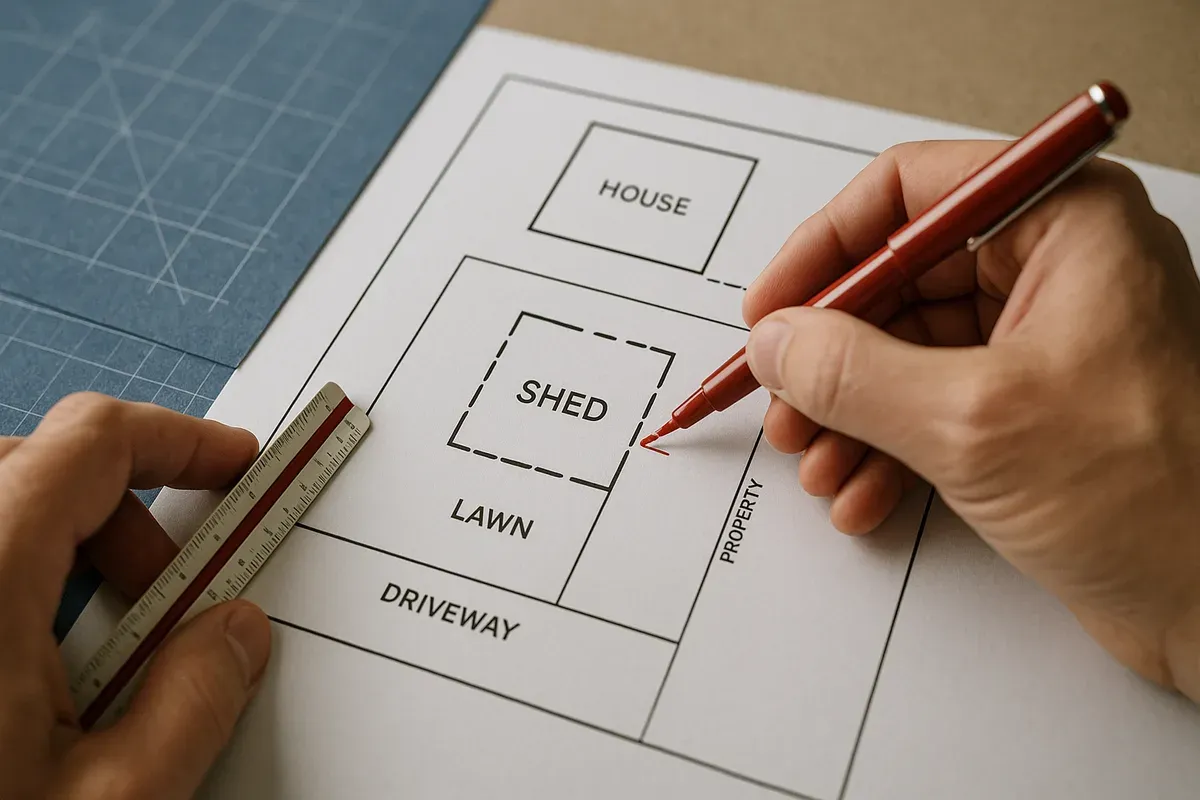
<p>This is often the document that homeowners underestimate. A site plan is a scaled, bird's-eye view drawing of your property that shows:</p>
<ul>
<li>The property boundaries with accurate dimensions</li>
<li>The footprint and location of all existing structures (house, garage, fences, etc.)</li>
<li>The proposed shed footprint with exact dimensions</li>
<li>Measured setback distances from the shed to all property lines</li>
<li>Measured distance from the shed to the primary residence</li>
<li>North arrow and scale indicator</li>
<li>Any easements, rights-of-way, or other encumbrances on the property</li>
<li>Driveway and access points</li>
</ul>
<p>The site plan does not need to be drawn by a licensed architect for a simple accessory structure, but it does need to be accurate, legible, and drawn to scale. Freehand sketches on notebook paper are routinely rejected. This is exactly where a tool like <a href="/">Site Plan Creator</a> becomes invaluable: you can produce a professional, permit-ready site plan in your browser without hiring a drafter or learning complex CAD software.</p>
<h3>3. Construction Documents</h3>
<p>For sheds over 200 square feet, you will typically need to provide:</p>
<ul>
<li>Floor plan showing interior layout and dimensions</li>
<li>Elevation drawings showing all four sides of the structure</li>
<li>Foundation plan and details</li>
<li>Framing plan or structural details (especially for larger sheds)</li>
</ul>
<p>For prefabricated or kit sheds, the manufacturer's installation drawings and specifications are often accepted in lieu of custom construction drawings.</p>
<h3>4. Proof of Property Ownership</h3>
<p>A copy of your deed or recent property tax statement is typically required to confirm you are the property owner.</p>
<hr>
<h2>The Permit Application Process in Dallas</h2>
<p>Once you have your documents together, here is how the permit process typically flows for a residential shed in Dallas:</p>
<h3>Step 1: Verify Your Zoning</h3>
<p>Before anything else, look up your property's zoning district using the City of Dallas GIS mapping tools. This tells you exactly which setbacks, height limits, and lot coverage rules apply to your property.</p>
<h3>Step 2: Prepare Your Site Plan and Construction Documents</h3>
<p>This is where you invest time upfront to save time later. A complete, accurate submittal dramatically reduces the chance of a rejection or a request for additional information (RFI), which can add weeks to your timeline.</p>
<h3>Step 3: Submit Your Application</h3>
<p>Dallas accepts permit applications through its online permitting portal for many project types. Residential accessory structure permits can often be submitted digitally, which speeds up the review process considerably compared to in-person submissions.</p>
<h3>Step 4: Plan Review</h3>
<p>City plan reviewers will check your submittal for compliance with the building code, zoning regulations, and any applicable Dallas amendments. For simple shed permits, review times in 2026 are typically running 5 to 15 business days, though complex projects or incomplete submittals can extend this significantly.</p>
<h3>Step 5: Permit Issuance and Inspections</h3>
<p>Once approved, your permit is issued and you can begin construction. Depending on the scope of work, you may need one or more inspections:</p>
<ul>
<li><strong>Foundation inspection:</strong> Before pouring concrete</li>
<li><strong>Framing inspection:</strong> After framing is complete but before sheathing or siding</li>
<li><strong>Final inspection:</strong> When the project is complete</li>
</ul>
<p>Always schedule inspections before covering any work that needs to be inspected. Skipping inspections is one of the most common mistakes that leads to problems during home sales.</p>
<hr>
<h2>Common Reasons Dallas Shed Permits Get Rejected</h2>
<p>Understanding why applications get rejected helps you avoid the same mistakes. The most frequent reasons for rejection or requests for revision include:</p>
<ol>
<li><strong>Incomplete or inaccurate site plans.</strong> The site plan is missing dimensions, does not show all existing structures, or the setbacks are not labeled.</li>
<li><strong>Setback violations.</strong> The proposed shed location does not meet the minimum setback distances from property lines or the primary residence.</li>
<li><strong>Lot coverage exceedance.</strong> The shed pushes total lot coverage over the allowed maximum.</li>
<li><strong>Wrong zoning district rules applied.</strong> The applicant used standard setbacks but the property has different requirements due to its specific zoning district or overlay.</li>
<li><strong>Missing construction details.</strong> For larger sheds, the structural drawings are insufficient to demonstrate code compliance.</li>
<li><strong>Floodplain issues.</strong> The property is in a flood zone and additional documentation or elevation certificates are required.</li>
</ol>
<p>The good news is that most of these issues are preventable with thorough preparation. Getting your site plan right the first time is the single most impactful thing you can do to keep your project on schedule.</p>
<hr>
<h2>Shed Rules in Dallas vs. Surrounding Cities</h2>
<p>If your property is in a city that is technically within the Dallas-Fort Worth metro but not within Dallas city limits, the rules may be different. Cities like Plano, Garland, Mesquite, Irving, and Grand Prairie each have their own building departments and development codes. Do not assume Dallas rules apply to your property just because you have a Dallas mailing address.</p>
<p>Always confirm which jurisdiction has authority over your property. Your county appraisal district records or your city's official website can help you confirm this. If you are in an unincorporated area of Dallas County, county rules (which are generally less restrictive) may apply instead.</p>
<hr>
<h2>Special Situations: HOAs, Historic Districts, and Flood Zones</h2>
<h3>HOA Rules</h3>
<p>If your property is in a neighborhood governed by a homeowners association, the HOA's deed restrictions and architectural guidelines may impose requirements that are stricter than the city's rules. Common HOA restrictions include:</p>
<ul>
<li>Limits on shed size that are smaller than the city's 200 square foot threshold</li>
<li>Requirements that the shed match the primary residence in color and material</li>
<li>Prohibitions on certain shed styles (metal sheds are banned in many HOA communities)</li>
<li>Approval requirements before construction begins</li>
</ul>
<p>HOA approval and city permits are separate processes. Getting a city permit does not override HOA restrictions, and vice versa.</p>
<h3>Historic Districts</h3>
<p>Dallas has several historic overlay districts where additional design review is required before permits are issued. If your property is in a historic district, your shed design may need to be reviewed by the Landmark Commission or a similar body before a building permit can be issued. Check with the Dallas Office of Historic Preservation if you think this might apply to your property.</p>
<h3>Flood Zones</h3>
<p>Properties in FEMA-designated Special Flood Hazard Areas (SFHAs) face additional requirements. Even small accessory structures may require elevation certificates and compliance with Dallas's floodplain management ordinance. Building in a floodplain without proper permits and documentation can jeopardize your flood insurance and create serious liability issues. Always check your flood zone status before starting any construction.</p>
<hr>
<h2>How to Create a Permit-Ready Site Plan for Your Dallas Shed</h2>
<p>A professional site plan is the cornerstone of a successful permit application. Here is what separates a permit-ready site plan from a sketch that gets rejected:</p>
<h3>Accuracy Over Aesthetics</h3>
<p>Permit reviewers are not looking for beautiful drawings. They are looking for accurate, dimensioned plans that demonstrate your project meets all applicable requirements. Every measurement needs to be correct. If your setback dimensions do not match what is shown on the drawing, reviewers will flag it.</p>
<h3>Draw to Scale</h3>
<p>Your site plan must be drawn to a consistent, noted scale. Common scales for residential site plans include 1 inch = 10 feet or 1 inch = 20 feet. The scale must be indicated on the drawing, either as a written scale or a graphic scale bar.</p>
<h3>Show Everything on the Property</h3>
<p>Do not just draw the shed. Show the entire property: the house, garage, fences, pools, decks, driveways, easements, and any other structures. Reviewers need the full picture to assess lot coverage and verify setbacks.</p>
<h3>Label All Dimensions and Setbacks</h3>
<p>Every structure on the plan should have its dimensions labeled. Every setback distance from a structure to a property line should be explicitly labeled. Do not make the reviewer calculate or estimate anything.</p>
<h3>Use Site Plan Creator for Professional Results</h3>
<p>Site Plan Creator is designed specifically for this kind of work. The browser-based platform lets you input your property dimensions, place structures accurately to scale, and generate a clean, professional site plan that meets permit submission standards. You do not need CAD experience or expensive software. Within an hour, most homeowners can produce a site plan that is ready to submit with their Dallas permit application.</p>
<p>The tool is particularly useful for Dallas shed permits because it handles the exact details that reviewers check: scaled drawings, labeled setbacks, property boundary dimensions, and a clean layout that communicates your project clearly.</p>
<hr>
<h2>Consequences of Building Without a Permit in Dallas</h2>
<p>Some homeowners are tempted to skip the permit process, especially for smaller sheds. This is a risk that rarely pays off. Here is what can happen if you build without a required permit in Dallas:</p>
<ul>
<li><strong>Stop-work orders:</strong> If a code enforcement officer or inspector notices unpermitted construction, they can issue a stop-work order that halts your project immediately.</li>
<li><strong>Fines and penalties:</strong> The City of Dallas can assess fines for unpermitted construction. In some cases, the permit fee itself doubles or triples when applied retroactively.</li>
<li><strong>Forced removal:</strong> In serious cases, the city can require you to remove an unpermitted structure entirely, at your own expense.</li>
<li><strong>Complications at home sale:</strong> <a href="/real-estate">Real estate</a> transactions often involve title searches and disclosure requirements. An unpermitted structure can complicate or kill a sale, or require you to retroactively permit and potentially modify the structure before closing.</li>
<li><strong>Insurance issues:</strong> Your homeowner's insurance may not cover damage to or caused by an unpermitted structure.</li>
</ul>
<p>The permit process exists to protect you as much as it protects the public. A properly permitted and inspected shed is a legal, insured, and marketable asset on your property.</p>
<hr>
<h2>Conclusion</h2>
<p>Building a shed in Dallas in 2026 is entirely manageable when you understand the rules going in. The key takeaways are simple: sheds over 200 square feet require a building permit, all sheds must meet setback and zoning requirements regardless of size, and electricity in any shed triggers a permit requirement. Prepare a complete, accurate application with a professional site plan, and you will move through the Dallas permitting process far more smoothly than homeowners who try to wing it.</p>
<p>The biggest single factor in a smooth permit approval is the quality of your site plan. A clear, accurate, scaled site plan that shows your property boundaries, existing structures, proposed shed location, and all setback distances gives plan reviewers everything they need to approve your project quickly.</p>
<p>That is exactly what Site Plan Creator is built to deliver. Whether you are a first-time permit applicant or a seasoned homeowner who has been through the process before, Site Plan Creator helps you produce permit-ready property site plans in your browser, without expensive software or professional drafting fees. Start your site plan today at siteplancreator.com and move your Dallas shed project from idea to approved permit with confidence.</p>