ADU Site Plan DIY vs Pro: When to Draw It Yourself
Drawing your own ADU site plan can save thousands of dollars, but it's not always the right move. This guide breaks down exactly when DIY works, when to call a professional, and how to make sure your permit application succeeds either way.
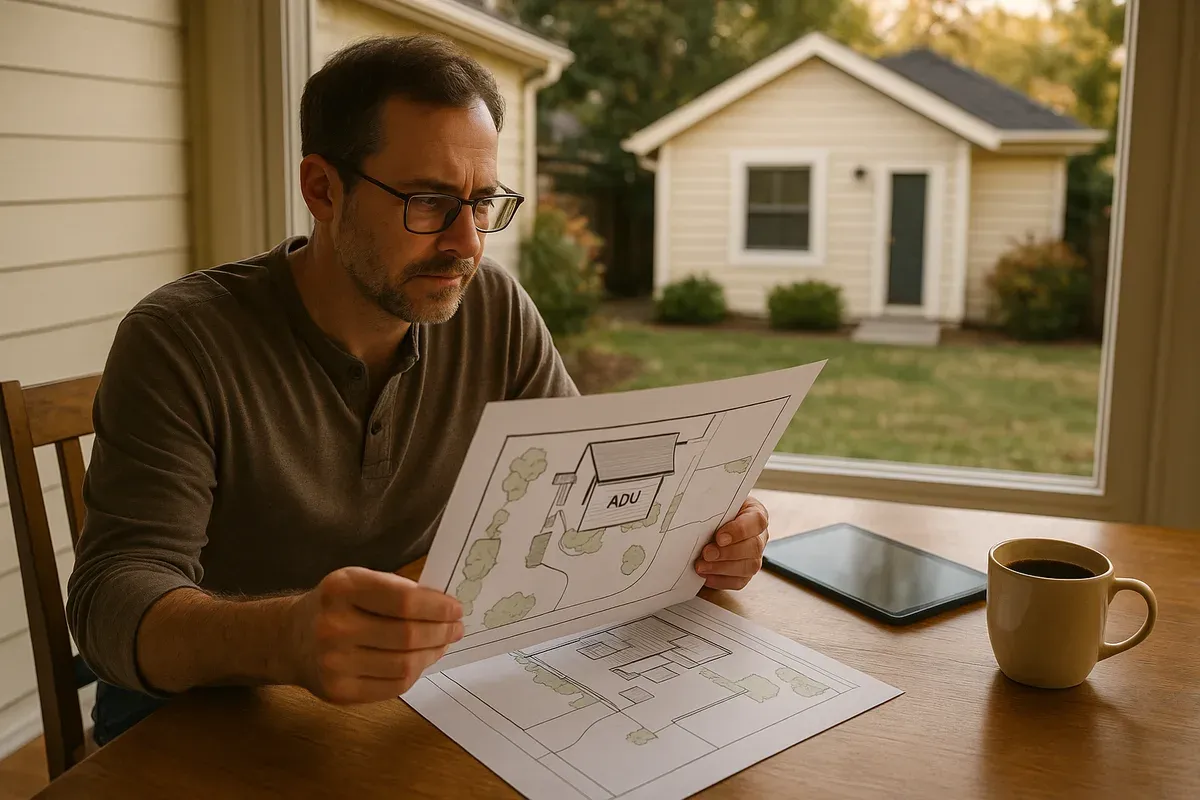
<h2>Drawing Your Own ADU Site Plan: When DIY Works and When to Call a Pro</h2>
<p>You've decided to build an <a href="/adu-feasibility-software">accessory dwelling unit</a>. Maybe it's a backyard cottage for a family member, a garage conversion for rental income, or a detached studio to add value to your property. Whatever the motivation, you've hit the same wall that nearly every ADU owner hits early in the process: the permit office wants a site plan, and you have no idea where to start.</p>
<p>The good news is that drawing your own ADU site plan is genuinely achievable for many <a href="/homeowners">homeowners</a> in 2026. The not-so-good news is that "many" doesn't mean "all," and misjudging your situation can cost you weeks of delays, rejected applications, and frustrating back-and-forth with your local planning department. This article walks you through the real factors that determine whether a DIY approach will serve you well or whether hiring a professional is the smarter investment.</p>
<hr>
<h2>What Is an ADU Site Plan and Why Does It Matter?</h2>
<p>A site plan is a scaled, bird's-eye drawing of your property that shows how structures, features, and spaces relate to each other and to your property boundaries. For an ADU permit application, your site plan typically needs to show:</p>
<ul>
<li>Property lines and lot dimensions</li>
<li>The footprint of your existing primary dwelling</li>
<li>The proposed ADU footprint and location</li>
<li>Required setbacks from all property lines</li>
<li>Driveways, walkways, and parking areas</li>
<li>Utility connections (water, sewer, electrical)</li>
<li>Easements and rights-of-way</li>
<li>Any other structures on the lot (sheds, pools, detached garages)</li>
<li>North arrow and scale indicator</li>
</ul>
<p>This document is not decorative. It is a legal instrument that your planning department, building department, and sometimes your HOA will use to verify that your proposed ADU complies with local zoning codes, state building codes, and applicable regulations. Errors or omissions can result in permit denial, required revisions, or in worst-case scenarios, stop-work orders after construction has already begun.</p>
<p>The <a href="https://www.iccsafe.org" rel="nofollow noopener" target="_blank">International Code Council</a> publishes the model building codes that most jurisdictions adopt and adapt, and understanding how your local code interprets these standards is foundational to any permit drawing you create.</p>
<hr>
<h2>The Case for DIY: When Drawing Your Own ADU Site Plan Makes Sense</h2>
<p>Let's start with the optimistic scenario, because for a meaningful percentage of homeowners, DIY is genuinely the right call.</p>
<h3>Your Lot Is Straightforward</h3>
<p>Simple, rectangular lots in standard residential subdivisions are the sweet spot for DIY site plans. If your property has:</p>
<ul>
<li>Clear, recorded lot dimensions available from your county assessor</li>
<li>No irregular angles or curved boundaries</li>
<li>No overlapping easements or complex right-of-way issues</li>
<li>A single existing structure (your home)</li>
<li>No flood zone complications</li>
</ul>
<p>...then the geometric and regulatory complexity is manageable for a careful, detail-oriented homeowner.</p>
<h3>Your ADU Project Is Relatively Simple</h3>
<p>Not all ADU projects are created equal. A detached backyard studio on a flat lot with a standard setback situation is very different from a hillside attached ADU with a shared wall, complex grading, and a tight lot. DIY tends to work well when:</p>
<ul>
<li>You're building a new detached ADU in an open backyard</li>
<li>You're converting an existing garage with no structural changes to the primary dwelling</li>
<li>The proposed ADU location is comfortably within all <a href="/setback-guide">setback requirements</a> with room to spare</li>
<li>Your local jurisdiction has published clear, specific ADU guidelines</li>
</ul>
<h3>Your Jurisdiction Has Streamlined ADU Permitting</h3>
<p>Since California's landmark ADU legislation took effect and other states followed, many jurisdictions have created simplified ADU permit pathways. Some cities now offer pre-approved ADU plans, online permit portals, and published checklists that make DIY site plan creation much more accessible. Check whether your city or county has an ADU-specific permit guide before assuming the process is complicated.</p>
<p>The <a href="https://www.planning.org" rel="nofollow noopener" target="_blank">American Planning Association</a> tracks ADU policy developments nationally and can point you toward resources for your region.</p>
<h3>You're Comfortable with Measurements and Basic Drawing Tools</h3>
<p>You don't need to be an architect to draw a usable site plan. You do need to be comfortable with:</p>
<ul>
<li>Taking accurate measurements with a tape measure or laser distance tool</li>
<li>Working with scale (converting real-world feet into proportional drawing dimensions)</li>
<li>Using a browser-based tool like <a href="/">Site Plan Creator</a> to produce a clean, dimensioned drawing</li>
<li>Reading your property survey or plat map</li>
</ul>
<p>If you can read a tape measure, understand what "1 inch equals 20 feet" means on a drawing, and follow detailed instructions carefully, the technical barrier is lower than most people assume.</p>
<h3>Your Budget Is Tight</h3>
<p>Professional site plan preparation from a licensed surveyor, architect, or draftsperson typically costs between $500 and $3,000 or more depending on complexity and location. For homeowners working with a tight ADU budget, saving that money matters. If your situation is straightforward and you're willing to invest a few hours learning the process, DIY can be a legitimate cost-saving strategy.</p>
<hr>
<h2>What a Good DIY ADU Site Plan Needs to Include</h2>
<p>If you're going the DIY route, don't cut corners on the fundamentals. Here's what permit reviewers consistently look for:</p>
<h3>Accurate Property Boundary Information</h3>
<p>Start with your recorded plat or survey. Your county assessor's website often provides this digitally. Do not estimate or eyeball property lines. Even a few feet of error can mean your proposed ADU is shown in the wrong setback zone, which will trigger a revision request or denial.</p>
<h3>Correct Scale and North Arrow</h3>
<p>Your drawing must be to scale, and the scale must be labeled (for example, 1" = 20'). A north arrow is required on virtually every permit site plan. These aren't bureaucratic formalities; they allow reviewers to quickly orient themselves and verify dimensions.</p>
<h3>All Existing Structures Accurately Placed</h3>
<p>Measure the distance from your primary home to each property line, and show those measurements on your drawing. Include any other existing structures: sheds, detached garages, pools, pergolas. Some jurisdictions count all impervious surfaces toward lot coverage maximums, so leaving things out can create problems later.</p>
<h3>Proposed ADU Footprint with Dimensions</h3>
<p>Show the proposed ADU as a clearly labeled rectangle (or appropriate shape) with all exterior dimensions noted. Include the distance from the ADU to each property line, confirming setback compliance.</p>
<h3>Setback Annotations</h3>
<p>Label your setbacks explicitly. Don't make the reviewer measure them. Write "10' rear setback" or "5' side setback" directly on the drawing with a dimension line. This makes the reviewer's job easier and signals that you understand the requirements.</p>
<h3>Utility Connections</h3>
<p>Many jurisdictions require you to show where the ADU will connect to existing water and sewer lines. Even a schematic indication (a dashed line from the ADU to the main service connection) is usually sufficient at the site plan level.</p>
<h3>Parking (If Required)</h3>
<p>Depending on your jurisdiction and the ADU's proximity to transit, you may need to show that adequate parking exists on the property. Note that many states now prohibit local governments from requiring additional parking for ADUs near transit stops, but confirm your local rules.</p>
<hr>
<h2>Common DIY Mistakes That Lead to Permit Rejection</h2>
<p>Knowing what goes wrong is just as important as knowing what to do right. These are the most frequent issues that cause DIY ADU site plans to be rejected:</p>
<ol>
<li><strong>Using Google Maps or aerial imagery as your base drawing.</strong> These images are not survey-accurate and are not acceptable as the basis for permit drawings.</li>
<li>Failing to show all existing structures on the lot.</li>
<li>Omitting required setback dimensions or mislabeling them.</li>
<li>Drawing the plan without a consistent, labeled scale.</li>
<li>Not including a north arrow.</li>
<li>Using incorrect or outdated property boundary information.</li>
<li>Forgetting to show easements that appear on the recorded plat.</li>
<li>Submitting a drawing that doesn't match the written project description in the permit application.</li>
<li>Ignoring lot coverage calculations when the jurisdiction has a maximum.</li>
<li>Failing to show the relationship between the ADU and the primary dwelling clearly.</li>
</ol>
<p>Each of these mistakes is fixable, but each one costs you time. In busy permit offices, a rejected application may go back to the end of a queue that takes weeks to clear.</p>
<hr>
<h2>When to Call a Professional: Situations Where DIY Is Risky</h2>
<p>Honesty matters here. There are real scenarios where attempting a DIY ADU site plan is likely to cost you more time and money than it saves. Recognize these situations before you start.</p>
<h3>Irregular or Complex Lot Shapes</h3>
<p>Flag lots, pie-shaped lots, lots with curved frontages, or properties with multiple non-parallel boundaries require accurate angular measurements and sometimes trigonometric calculations to draw correctly. If your lot isn't a simple rectangle, the margin for error in a DIY drawing increases significantly.</p>
<h3>Flood Zone Properties</h3>
<p>If your property is in a FEMA-designated flood zone, your ADU permit process involves an additional layer of complexity. Flood zone determinations, base flood elevation requirements, and floodplain management regulations intersect with your site plan in ways that require professional knowledge. Check your flood zone status at the <a href="https://msc.fema.gov" rel="nofollow noopener" target="_blank">FEMA Flood Map Service Center</a> before deciding on your approach.</p>
<h3>Hillside or Sloped Properties</h3>
<p>Grading, drainage, and slope stability are engineering concerns that go beyond a standard site plan. If your lot has meaningful topographic variation, a professional can incorporate grading plans and drainage solutions that a DIY drawing typically won't address adequately.</p>
<h3>Properties with Easements, Encroachments, or Title Issues</h3>
<p>If your property has utility easements, access easements, or any recorded encroachments, these must be accurately reflected on your site plan. Misrepresenting or omitting easement areas can create legal liability beyond just a permit rejection.</p>
<h3>Attached ADUs or ADUs Requiring Structural Changes</h3>
<p>If your ADU shares a wall with the primary dwelling or requires structural modifications (removing load-bearing walls, adding a foundation, altering the roofline), your permit package will likely require architectural and structural drawings in addition to the site plan. At that point, a licensed architect or designer is typically involved anyway, and having them produce the site plan as part of the package makes sense.</p>
<h3>Jurisdictions with Complex or Ambiguous Requirements</h3>
<p>Some planning departments have nuanced, difficult-to-interpret zoning codes. If you've read your local ADU ordinance three times and still can't determine your setback requirements or whether your proposed ADU triggers design review, a professional who regularly works in that jurisdiction is worth the investment. They know the reviewers, understand the unwritten preferences, and can navigate ambiguity that would stall a DIY applicant.</p>
<h3>When Time Is a Critical Factor</h3>
<p>Permit timelines matter. If you're working against a contractor's schedule, a tenant's move-in date, or a financing deadline, the risk of a DIY rejection and resubmission cycle may outweigh the cost savings of doing it yourself. A professional who produces an approvable drawing the first time can actually save you money when time has real value.</p>
<hr>
<h2>The Middle Path: DIY with Professional Review</h2>
<p>One option that many homeowners overlook is a hybrid approach. You draw the site plan yourself using a tool like Site Plan Creator, and then pay a local architect, draftsperson, or permit expediter to review it before submission. This typically costs far less than having a professional create the drawing from scratch, while still giving you an expert set of eyes on your work.</p>
<p>This approach works particularly well when:</p>
<ul>
<li>Your situation is mostly straightforward but you have one or two uncertain elements</li>
<li>You want confidence before submitting without paying for full professional services</li>
<li>Your jurisdiction is moderately complex but not unusually so</li>
</ul>
<p>When pursuing this path, be specific about what you're asking the reviewer to check. Give them your local zoning code section numbers, your proposed setbacks, and any specific requirements you're uncertain about. A focused review is more efficient and less expensive than an open-ended consultation.</p>
<hr>
<h2>How Site Plan Creator Supports DIY ADU Applicants</h2>
<p>Site Plan Creator is designed specifically for property owners, <a href="/contractors">contractors</a>, and small design firms who need professional-quality site plan drawings without the overhead of traditional CAD software. For ADU permit applications, the platform offers several advantages:</p>
<ul>
<li>A browser-based interface that requires no software installation or CAD training</li>
<li>Accurate scaling tools that let you work in real-world dimensions</li>
<li>Pre-built symbols for structures, driveways, utilities, trees, and other common site elements</li>
<li>Clean, dimensioned output that meets the visual standards permit offices expect</li>
<li>The ability to annotate setbacks, label structures, and add north arrows and scale bars</li>
</ul>
<p>Homeowners who use Site Plan Creator consistently report that the learning curve is short and that the resulting drawings look professional enough to pass permit review in jurisdictions across the country. The tool bridges the gap between a hand-sketched drawing (which most permit offices won't accept) and a full professional CAD drawing (which costs significantly more).</p>
<hr>
<h2>A Practical Decision Framework</h2>
<p>Use this checklist to make your DIY vs. professional decision:</p>
<p><strong>Lean toward DIY if:</strong></p>
<ul>
<li>Your lot is rectangular and clearly surveyed</li>
<li>Your ADU is a simple detached structure</li>
<li>Your jurisdiction has clear, published ADU guidelines</li>
<li>You're comfortable with measurements and basic drawing tools</li>
<li>Budget is a primary constraint</li>
<li>You have time to learn the process and handle a potential revision</li>
</ul>
<p><strong>Lean toward professional help if:</strong></p>
<ul>
<li>Your lot is irregular, sloped, or in a flood zone</li>
<li>Your ADU involves structural changes to the primary dwelling</li>
<li>Easements or encroachments complicate your property</li>
<li>Your jurisdiction has complex or ambiguous requirements</li>
<li>Time is critical and you can't afford a rejection cycle</li>
<li>You're also hiring an architect for the building plans (bundle the site plan into their scope)</li>
</ul>
<p><strong>Consider the hybrid approach if:</strong></p>
<ul>
<li>Your situation is mostly straightforward with a few uncertain elements</li>
<li>You want professional validation without full professional cost</li>
<li>You're confident in your drawing but want a second opinion before submitting</li>
</ul>
<hr>
<h2>Tips for a Successful DIY ADU Site Plan Submission</h2>
<p>If you've decided to go the DIY route, these practical tips will improve your odds of first-time approval:</p>
<ol>
<li><p><strong>Call your planning department before you start drawing.</strong> Ask specifically what they require on an ADU site plan. Many offices have a checklist they'll email you. This one call can save hours of guesswork.</p>
</li>
<li><p><strong>Get your recorded plat or survey first.</strong> Don't start measuring until you have the legal boundary document in hand. Your county assessor or recorder's office is the place to start.</p>
</li>
<li><p><strong>Measure twice, draw once.</strong> Take field measurements of all existing structures and verify them against your plat. Discrepancies happen, and you need to understand them before you draw.</p>
</li>
<li><p><strong>Check your setbacks from the actual code, not from memory or neighbor advice.</strong> Look up your specific zoning district's setback requirements in the municipal code. ADU setbacks are often different from primary structure setbacks.</p>
</li>
<li><p><strong>Label everything explicitly.</strong> Don't make reviewers figure out what a shape represents. Label every structure, dimension every distance, and annotate every setback.</p>
</li>
<li><p><strong>Submit a clean, readable drawing.</strong> A cluttered, hard-to-read site plan creates doubt even when the content is correct. Use a tool that produces clean output.</p>
</li>
<li><p><strong>Keep a copy of everything you submit.</strong> If revisions are requested, you need to know exactly what you submitted so you can make targeted changes.</p>
</li>
</ol>
<hr>
<h2>Conclusion: Make the Right Call for Your Situation</h2>
<p>Drawing your own ADU site plan is not a universal solution, but it's also not the impossible task many homeowners assume it to be. The key is honest self-assessment: evaluate your lot, your project complexity, your jurisdiction's requirements, and your own comfort with technical drawing before committing to either path.</p>
<p>For straightforward projects on simple lots in jurisdictions with clear guidelines, a well-executed DIY ADU site plan using the right tools can save you real money and move your project forward efficiently. For complex situations, investing in professional help upfront is almost always cheaper than dealing with the consequences of a flawed submission.</p>
<p>Site Plan Creator was built to make the DIY path accessible to homeowners who have the right situation for it. With accurate scaling, professional-quality output, and an interface designed for non-CAD users, it's the tool that makes permit-ready ADU site plan drawings achievable without a design degree. If you're ready to see whether your project is a good candidate for DIY, start a free plan on Site Plan Creator today and find out how straightforward the process can be.</p>